Bitcoin Adjusted On-Chain Velocity Relative to Realized Cap
Definition
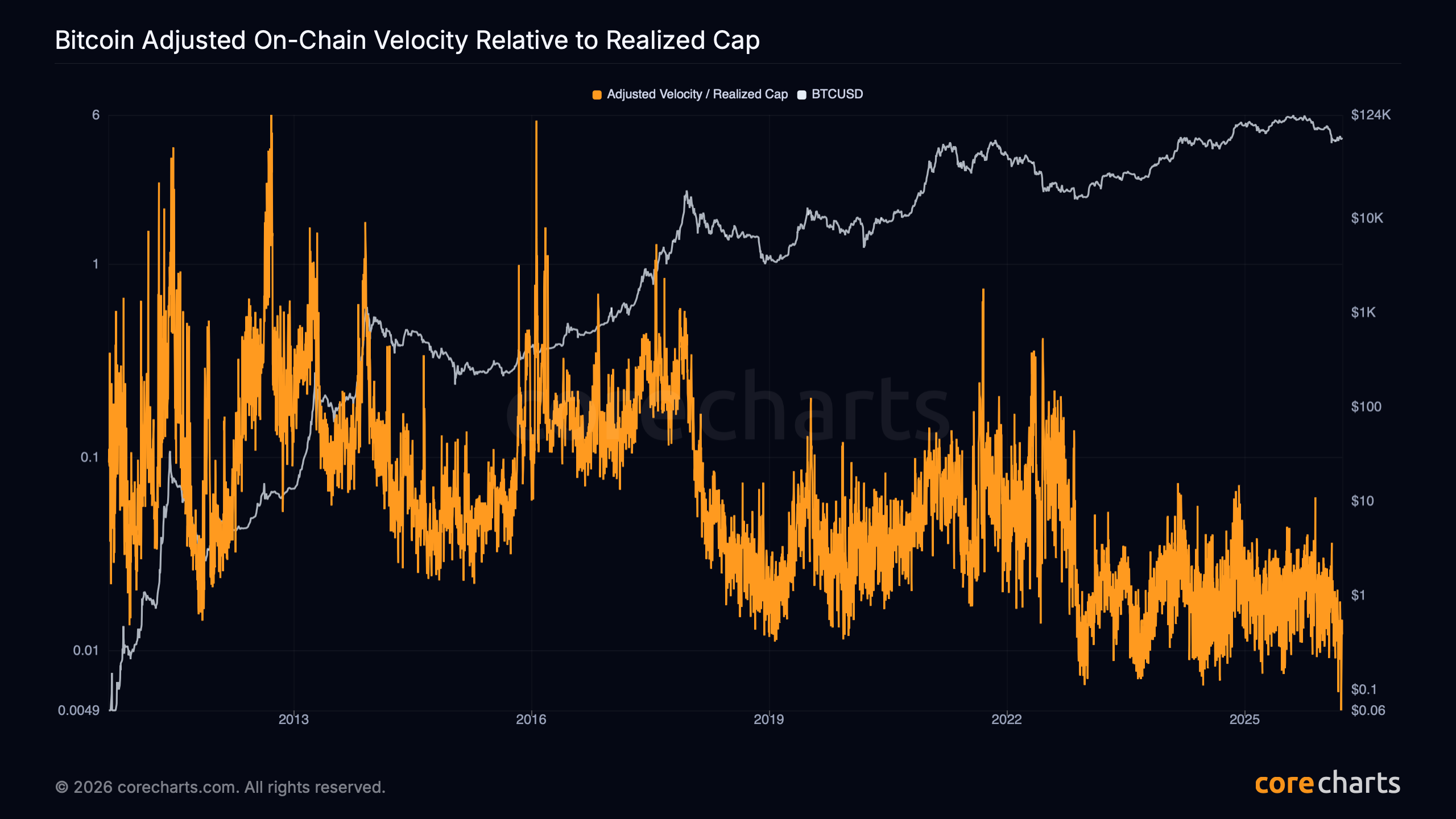
Bitcoin Adjusted On-Chain Velocity Relative to Realized Cap compares adjusted transfer volume with Realized Cap rather than Market Cap.
That difference changes the question materially. The metric no longer asks how much filtered transfer flow exists relative to current market valuation. It asks how large that flow is relative to the network’s aggregate cost basis.
Adjusted transfer volume remains the numerator. Realized Cap becomes the valuation anchor.
Interpretation
Realized Cap tracks the value of supply at the price when coins last moved on-chain. Because of that, this series links current transfer activity to embedded cost basis rather than speculative repricing.
A high reading means adjusted on-chain flow is large compared with the network’s stored realized value. A low reading means transfer activity is muted relative to the capital base recorded in the UTXO set.
This can make the series more stable than market-cap-based velocity during sharp repricing. Market Cap can expand or collapse quickly. Realized Cap usually moves more slowly. That gives this ratio a different texture. The focus shifts away from speculative heat and toward how actively the capitalized supply is being used.
Market use
This metric is strongest when the analyst wants to compare present transfer demand with the network’s cost-basis structure. Rising readings can mark periods when economically filtered activity is increasing against a slower-moving realized valuation base. Falling readings may suggest that settlement demand is weakening even if market value remains elevated.
The metric is most useful during transitions between accumulation and expansion. If price remains subdued while adjusted flow rises relative to Realized Cap, network usage is strengthening on a slow-moving cost-basis denominator, which can precede the speculative repricing visible in MVRV or NVT. In overheated phases, the opposite can appear: price runs ahead of cost basis while adjusted flow stays muted, leaving this series flat even as Market Cap-based ratios stretch.
That makes it a good cross-check against both velocity-adjusted and the MVRV family.
Relationship to other metrics
Velocity Adjusted uses the same numerator but divides by Market Cap. The contrast between the two tells you whether transfer activity is weak relative to speculative valuation, weak relative to cost basis, or both.
NVT-style metrics invert the same logic and express valuation relative to transfer flow. MVRV Ratio and Realized Price belong on the same map because they also use Realized Cap as the anchor, though for valuation rather than throughput.
Historical note
This variant is a CoreCharts extension. It combines the adjusted transfer concept from modern on-chain volume analysis with the Realized Cap anchor introduced by Coin Metrics. The result is a throughput measure tied to cost basis rather than market price.