Bitcoin Market Capitalization in US Dollars
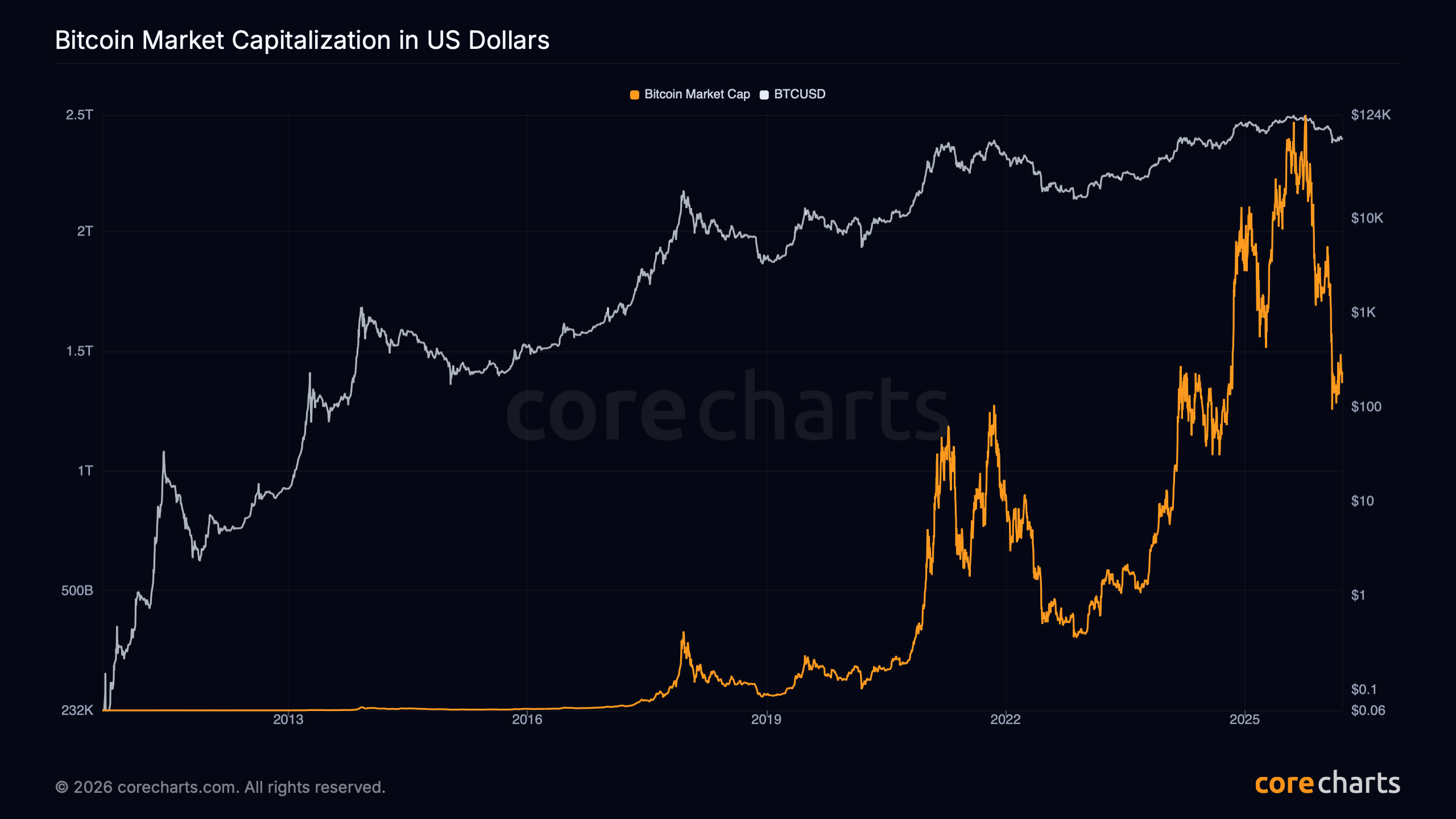
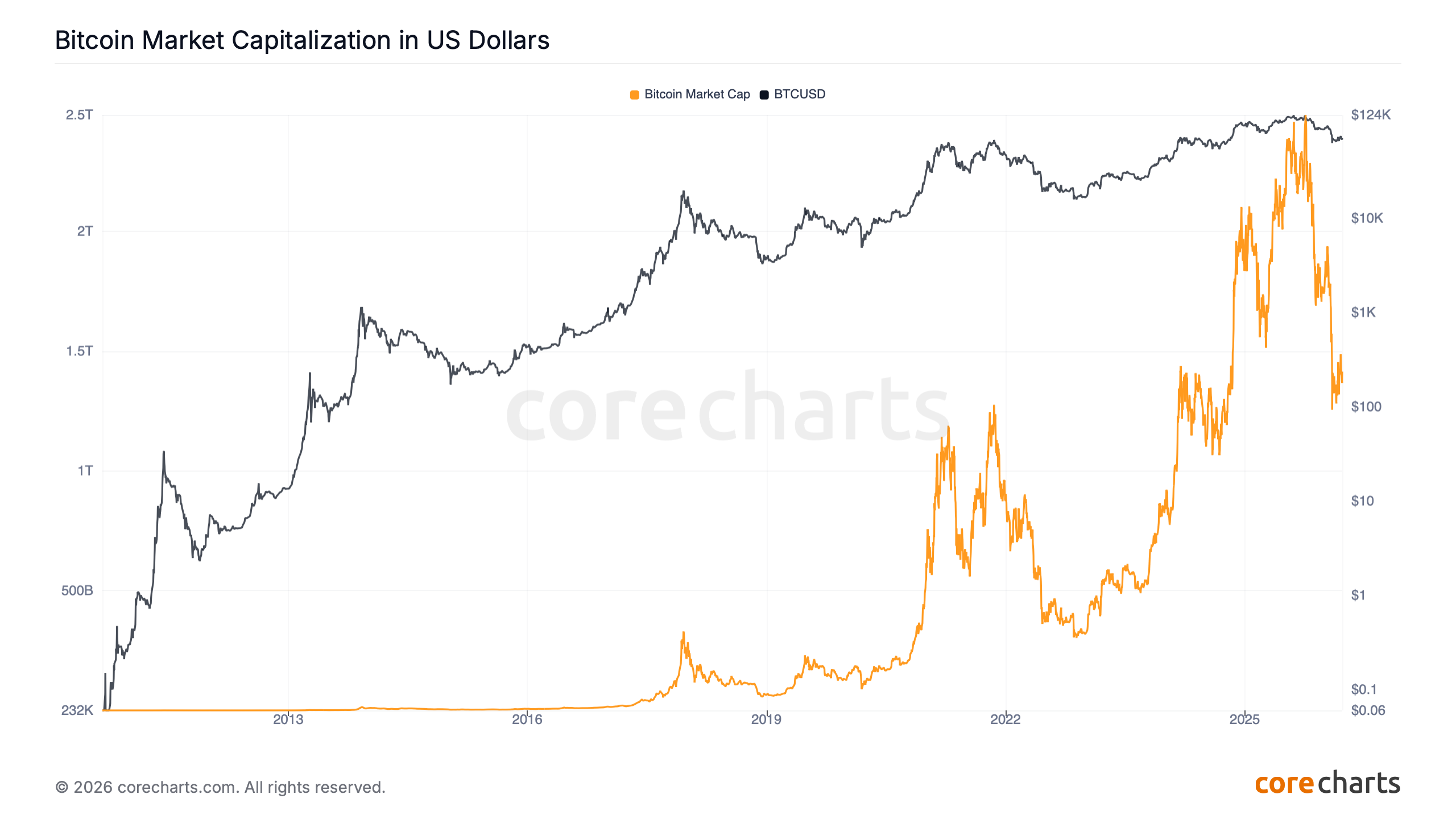
Bitcoin Market Capitalization in US Dollars is the dollar value of circulating BTC at the current market price.
This is the market’s spot valuation of Bitcoin’s issued supply. It moves with price and, more slowly, with supply growth. In practice, price dominates the series.
Interpretation
Market Cap answers a simple question: how large is Bitcoin in current market-value terms?
It is the base series behind many valuation metrics. When price rises, Market Cap rises immediately. New issuance also adds to it, but the daily contribution from issuance is small relative to price moves once Bitcoin reaches mature market size.
The metric is most useful for scale and comparison. It frames Bitcoin’s size relative to prior cycles, other assets, and other on-chain valuation measures. It is not a cost basis and not a measure of capital actually stored on-chain at acquisition prices.
For market structure, the level matters less than the relationship to other series. A high Market Cap with a much slower-moving Realized Cap often implies a large unrealized profit base. A falling Market Cap that approaches Realized Cap usually reflects compression in aggregate profitability and weaker market conditions.
Relationship to Realized Metrics
Market Cap and Realized Cap are often read together.
Market Cap marks every circulating coin at the latest spot price. Realized Cap marks supply at the price when coins last moved on-chain. The distance between the two is central to MVRV-style analysis.
Realized Price is derived from Realized Cap, not from Market Cap. That makes Market Cap the fast series in the trio: it reacts instantly to market repricing, while the realized side moves only when supply changes hands on-chain.
Limits
Market Cap assumes the full circulating supply is valued at the marginal market price. That is standard in market analysis, but it does not mean the full supply could actually clear at that price.
Lost coins remain part of circulating supply in conventional Market Cap. The metric also says nothing about holder cost basis, conviction, or spent-side behavior. For those questions, Realized Cap and Realized Price are the better reference points.