Bitcoin Miner Hash Price
What It Measures
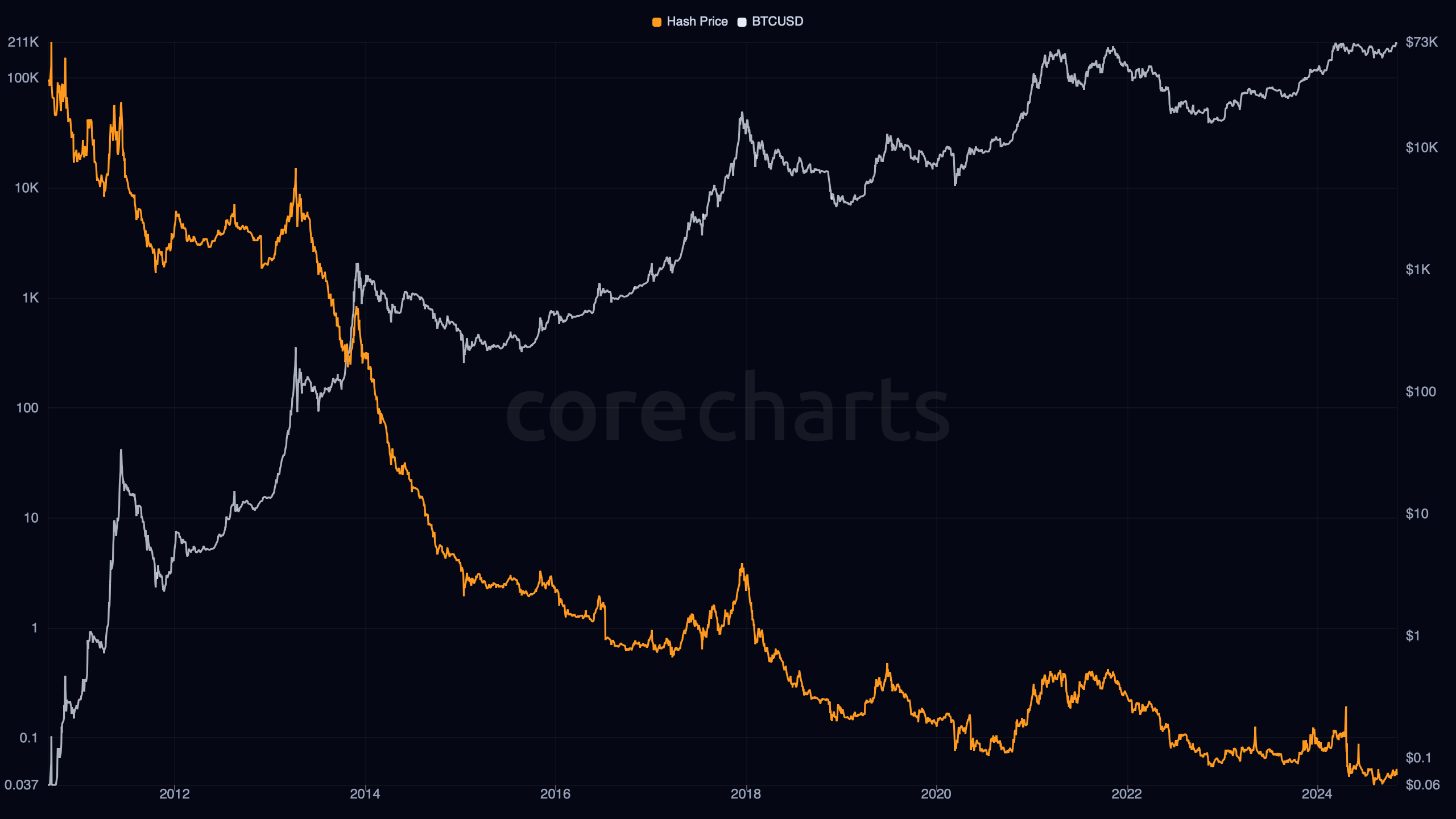
Bitcoin Miner Hash Price shows how much daily revenue a miner earns per unit of deployed hash power.
It answers a direct economic question:
How much USD revenue does one terahash per second generate per day under current network conditions?
In CoreCharts, the metric is expressed in:
USD per TH/s per day
In simplified form:
This is a miner-economics metric. It compresses the current revenue environment into one number by combining:
- block subsidy,
- fee revenue,
- BTC price,
- and total network hash rate.
A higher reading means each unit of mining power is earning more revenue per day. A lower reading means mining power is earning less.
How To Use It
Hash Price is useful when the goal is to understand miner profitability pressure at the unit-economics level.
It helps answer questions such as:
- Is mining becoming more attractive or less attractive?
- Are miners earning enough revenue per unit of hash power to support expansion?
- Is the sector under margin pressure even if BTC price is rising?
This metric is especially useful next to:
- Hash Rate
- Difficulty
- Miner Revenue
- Fee Share of Revenue
Hash Rate tells you how much competition exists. Hash Price tells you how rewarding that competition currently is.
What It Can Say About Price And Market Regime
Hash Price is one of the clearest ways to read miner conditions in real economic terms.
Rising hash price
When Hash Price rises, miners are earning more per unit of deployed computation. That usually happens when BTC price rises, fee income expands, or both. It can also improve if hash rate falls faster than revenue.
This tends to support stronger miner balance sheets and can encourage additional participation.
Falling hash price
When Hash Price falls, miners are earning less revenue for each unit of hash power. That often happens when price weakens, fees remain subdued, or network competition rises faster than revenue.
This can lead to margin compression, weaker operators shutting down, or slower expansion in mining capacity.
Why this metric matters
Two mining environments can show the same hash rate but very different economics. Hash Price captures that difference directly. It is one of the most practical miner-side indicators for judging whether the network is in a generous revenue regime or a compressed one.
Historical Background
Hash Price emerged as Bitcoin mining matured into a capital-intensive industry. Once miners began thinking in terms of fleet efficiency, hosting costs, and per-unit economics, revenue per unit of hash power became a more useful lens than headline block rewards alone.