Bitcoin Puell Multiple, 365-Day
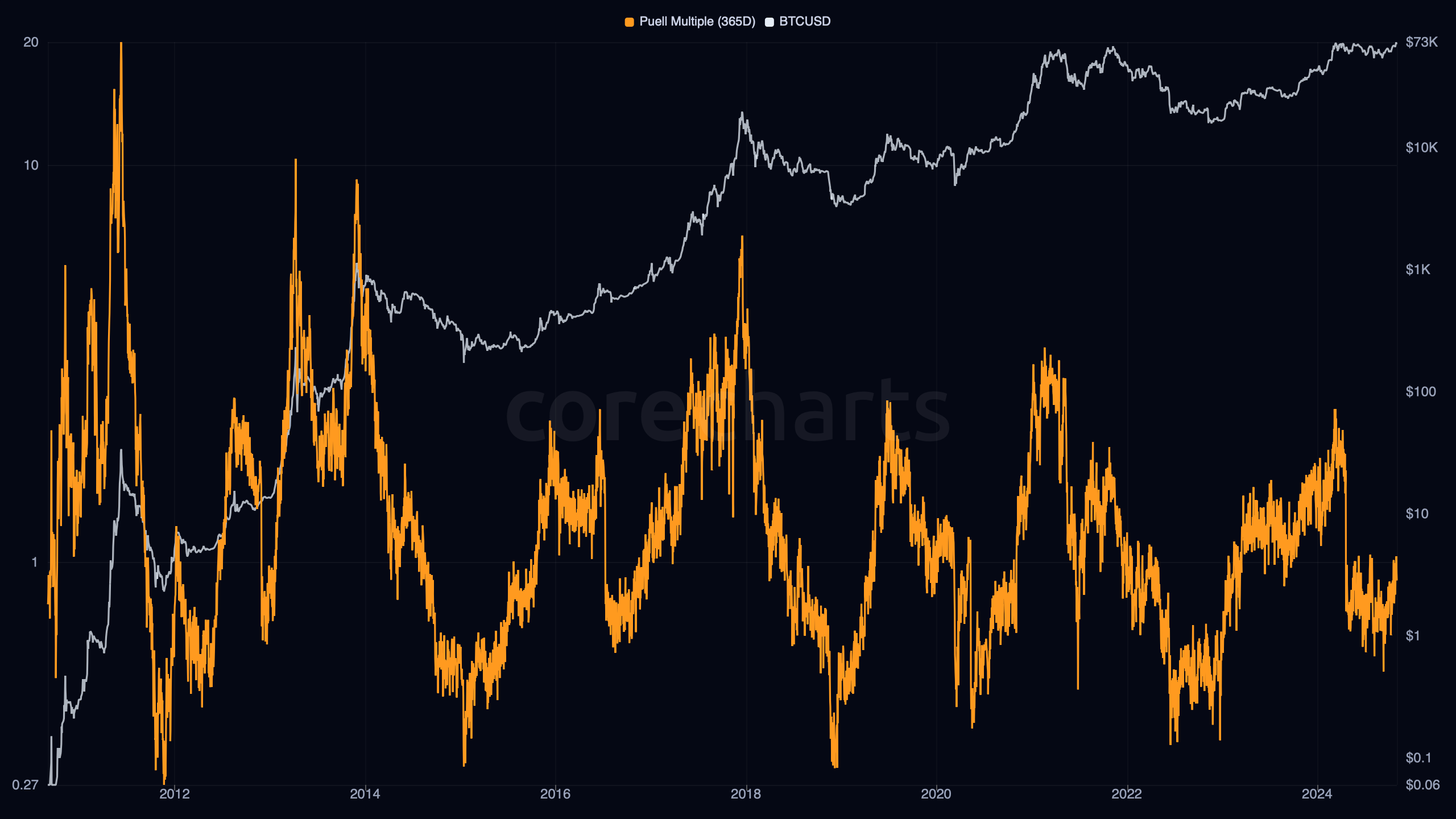
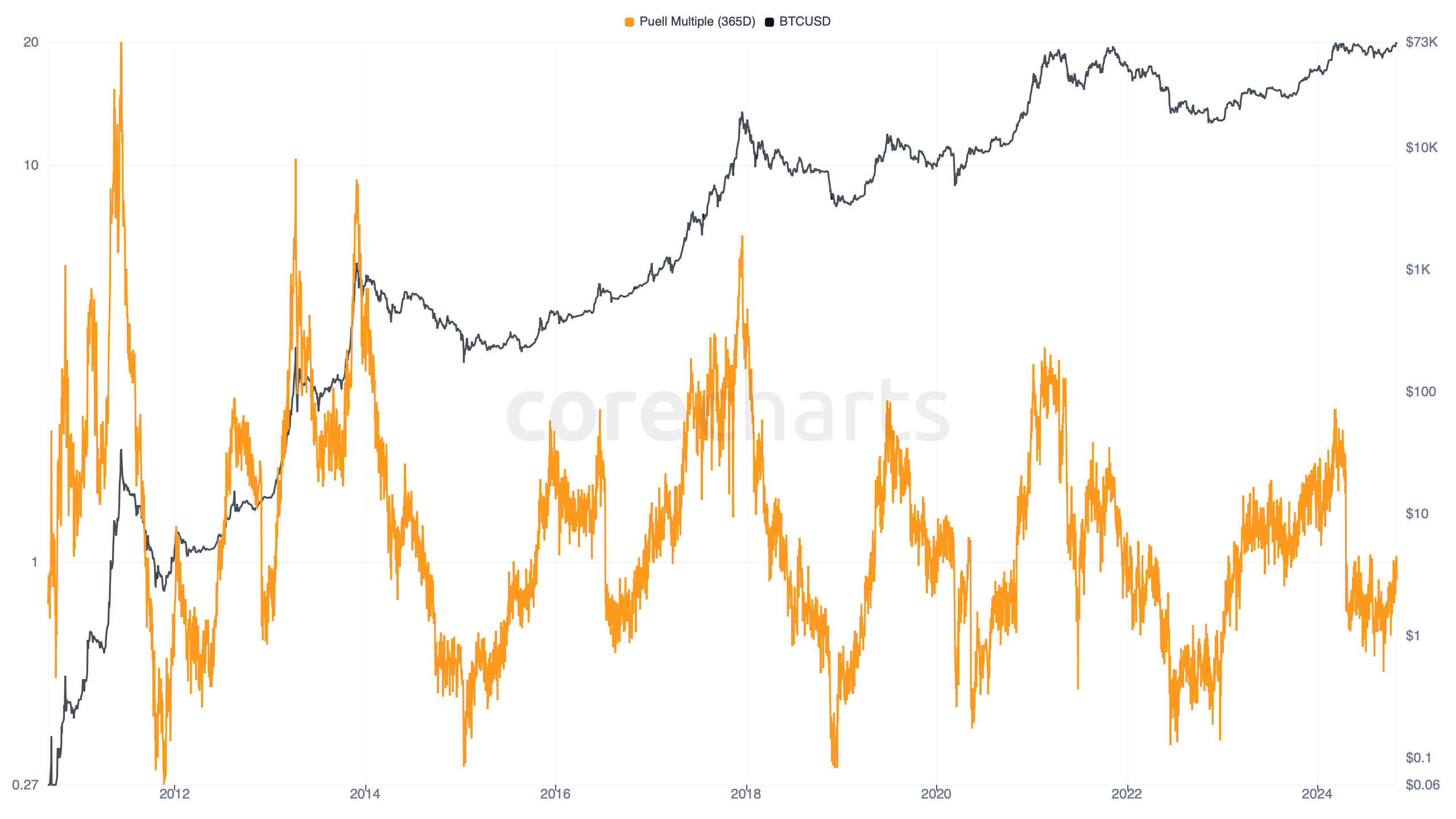
What It Measures
Bitcoin Puell Multiple, 365-Day compares today’s daily issuance value in USD with the average daily issuance value over the last 365 days.
It answers a specific question:
How rich or poor is the current miner issuance environment relative to the last full year?
In CoreCharts, the metric is built from daily subsidy issuance translated into USD. The logic is:
This is the canonical version of Puell Multiple. When analysts refer to Puell Multiple without a suffix, they usually mean the long-window version built against a one-year average.
The reason is simple. Miner issuance has strong structural shifts around price cycles and halvings. A full-year baseline smooths out short bursts of volatility and gives a cleaner macro read on whether current miner revenue from newly issued coins is unusually strong or unusually weak.
A high reading means today’s issuance value is well above its one-year norm. A low reading means it is well below that norm.
How To Use It
The 365-day version is the best choice when the goal is to read macro miner conditions rather than short-term noise.
It helps answer questions such as:
- Is miner issuance value running unusually hot relative to the last year?
- Has miner revenue from new supply become historically stretched?
- Is the market moving into a miner-stress zone or a miner-expansion zone?
This version is most useful next to:
- BTC Price
- Miner Revenue
- Hash Price
- Hash Rate
- Difficulty
Puell Multiple is not a full miner-profitability metric. It isolates the subsidy-driven part of miner economics and asks how unusual today’s issuance value is against its own recent baseline.
What It Can Say About Price And Market Regime
The canonical Puell Multiple is primarily a cycle-context metric.
High readings
When the 365-day Puell Multiple rises sharply, the USD value of newly issued BTC has moved far above its annual norm. That usually happens in strong bull-market phases, when high prices lift the value of daily issuance.
Historically, very elevated readings have often appeared in overheated parts of major cycles, when miner issuance value becomes unusually rich relative to its longer-run baseline.
Low readings
When the metric falls deeply, the USD value of daily issuance has compressed far below its annual norm. That often happens in bear markets or post-cycle resets, when miners are receiving much less market-value compensation for newly issued supply.
Those low readings are usually associated with miner stress rather than with strong speculative expansion.
Why this version is the canonical one
The one-year window is slow enough to absorb temporary fee bursts, short-lived price swings, and local volatility. That makes it the best version for long-cycle interpretation.
If the analytical question is, where are miners relative to the broad cycle?, the 365-day version is the default choice.
Historical Background
Puell Multiple is associated with David Puell and became widely used in Bitcoin cycle analysis as a way to compare current miner issuance value with its historical norm. The original idea was not to measure all miner economics, but to measure whether the value of newly issued supply had become unusually high or unusually low relative to a long baseline.
That long-baseline version became the standard reference, which is why the 365-day series remains the canonical form of the indicator.