Bitcoin Average Spent Output Lifespan (ASOL)
What It Measures
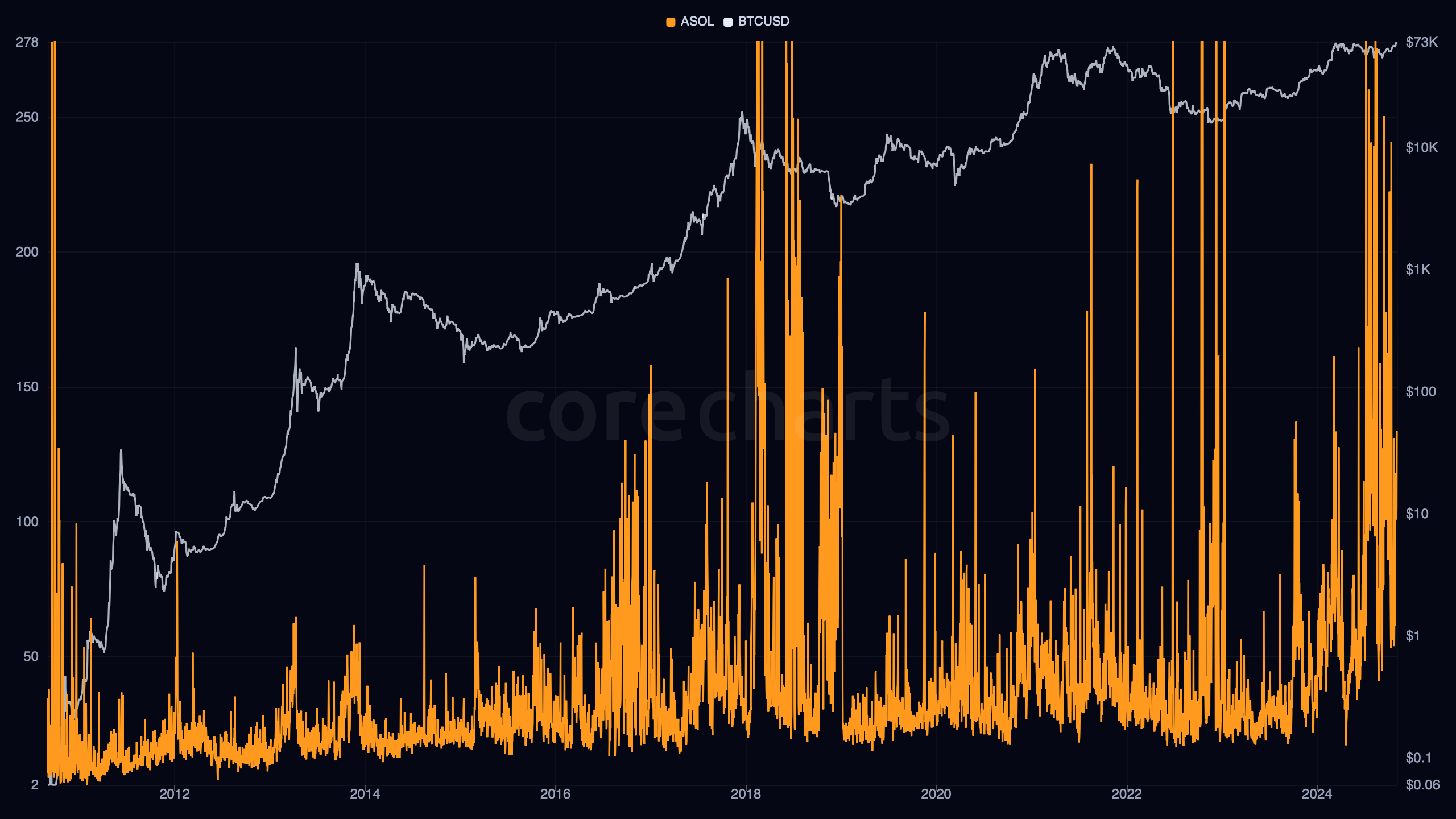
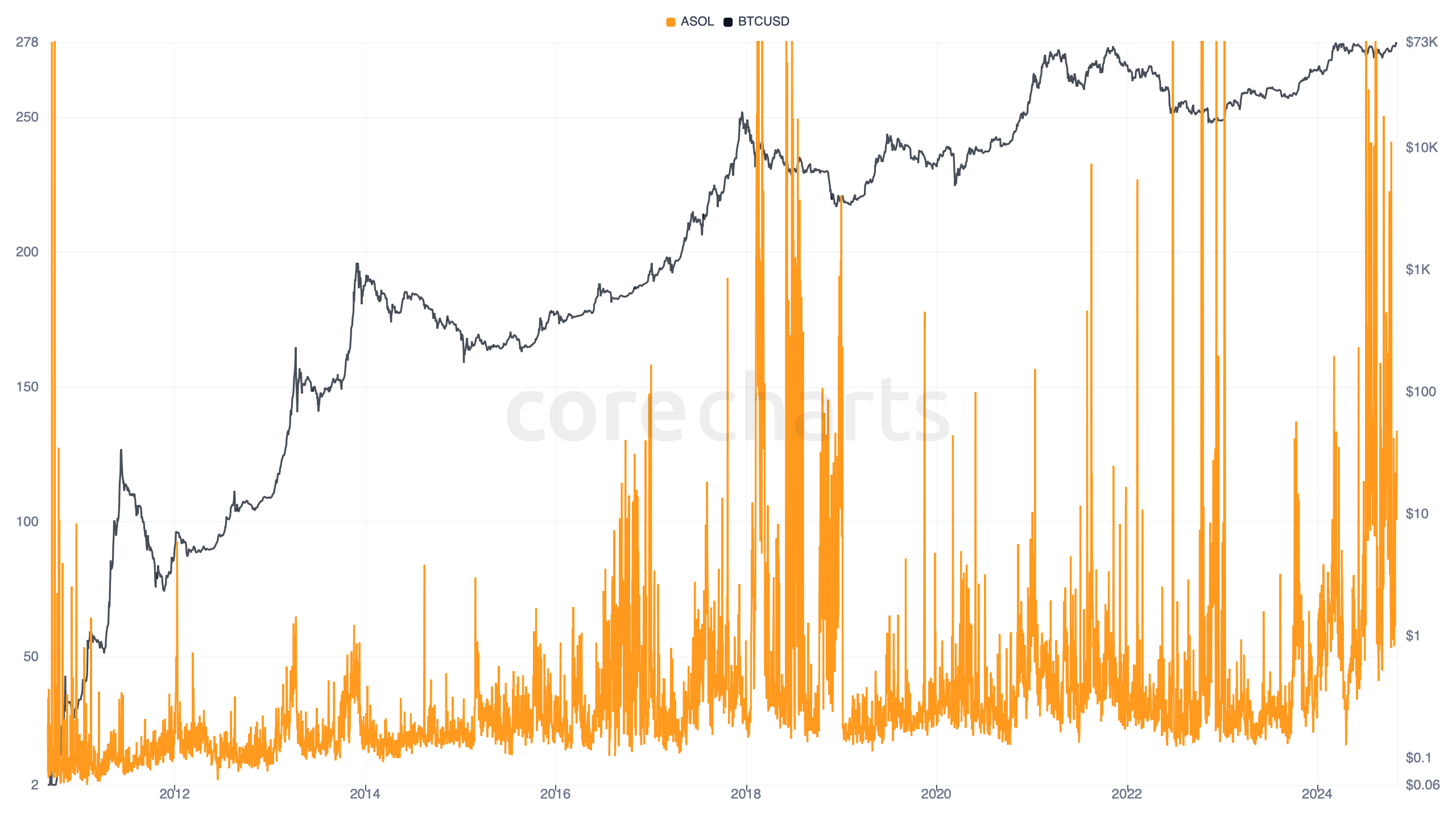
Bitcoin Average Spent Output Lifespan shows the average age of outputs spent on a given day.
It answers a specific question:
How old, on average, were the coins that were actually spent today?
The metric is calculated from spent outputs rather than from held supply. For each spent output, the age is measured as the time between its creation and the moment it was spent. CoreCharts then takes the arithmetic mean of those spent-output ages for the day.
In simplified form:
The result is shown in days.
This is a spent-side metric. It does not describe how old the held supply is. It describes the age profile of coins that left dormancy and moved on that day.
A higher reading means older coins were spent on average. A lower reading means the day’s spending was dominated by recently created outputs.
How To Use It
ASOL is useful when the goal is to understand which part of the age spectrum supplied coins to the market today.
If ASOL rises sharply, the market is spending older outputs than usual. That often points to participation from holders with deeper dormancy and older cost bases.
If ASOL stays low, the day’s flow is being driven mostly by young coins. That usually means recent buyers, short-term holders, or ordinary transactional churn dominate the spending profile.
In practice, ASOL helps answer questions like:
- Was today’s selling or transfer activity driven by old coins or recent coins?
- Is long-dormant supply starting to move?
- Is the market seeing routine turnover, or a broader release of older inventory?
ASOL is especially useful next to:
- MSOL
- Spent Volume Age Bands
- CDD
- Revived Supply
- SOPR
Each of those metrics looks at spent dormancy from a different angle. ASOL is the simplest average view.
What It Can Say About Market Regime
ASOL can be informative around major turning points because old-coin spending tends to matter more than routine short-term turnover.
Quiet spending profile
When ASOL stays low, the market is mostly moving younger outputs. That often happens during ordinary trading flow, reactive positioning, or day-to-day transaction activity.
In those conditions, there is little evidence that deeply dormant supply is participating in size.
Old-coin activation
When ASOL rises, older outputs are entering the spent set. That often happens during stronger distribution phases, profit-taking by long-term holders, or moments when previously inactive supply starts re-entering circulation.
The metric does not tell you whether those coins were sold, consolidated, or moved internally. It does tell you that their dormancy ended.
Bull-market context
In stronger market phases, a rising ASOL can signal that long-held coins are finally being spent into strength. That does not identify an exact top, but it often marks a market that is no longer being supplied only by recent holders.
Why ASOL should not be read alone
ASOL is an average. A few very old outputs can lift the reading sharply even if most spent outputs were young. That is why ASOL works best when paired with MSOL and spent-age band metrics. Together they show whether the move came from broad old-coin participation or from a thinner tail of very old outputs.
Historical Background
The broader idea of spent output lifespan comes out of Bitcoin’s coin-age framework. Once analysts began tracking how long coins remained dormant before moving, it became natural to summarize that spent-age distribution with simple statistics such as average and median lifespan.
ASOL became widely used because it gives a fast read on whether a day’s spending profile came from recent turnover or from older supply.