Bitcoin Liveliness
What It Measures
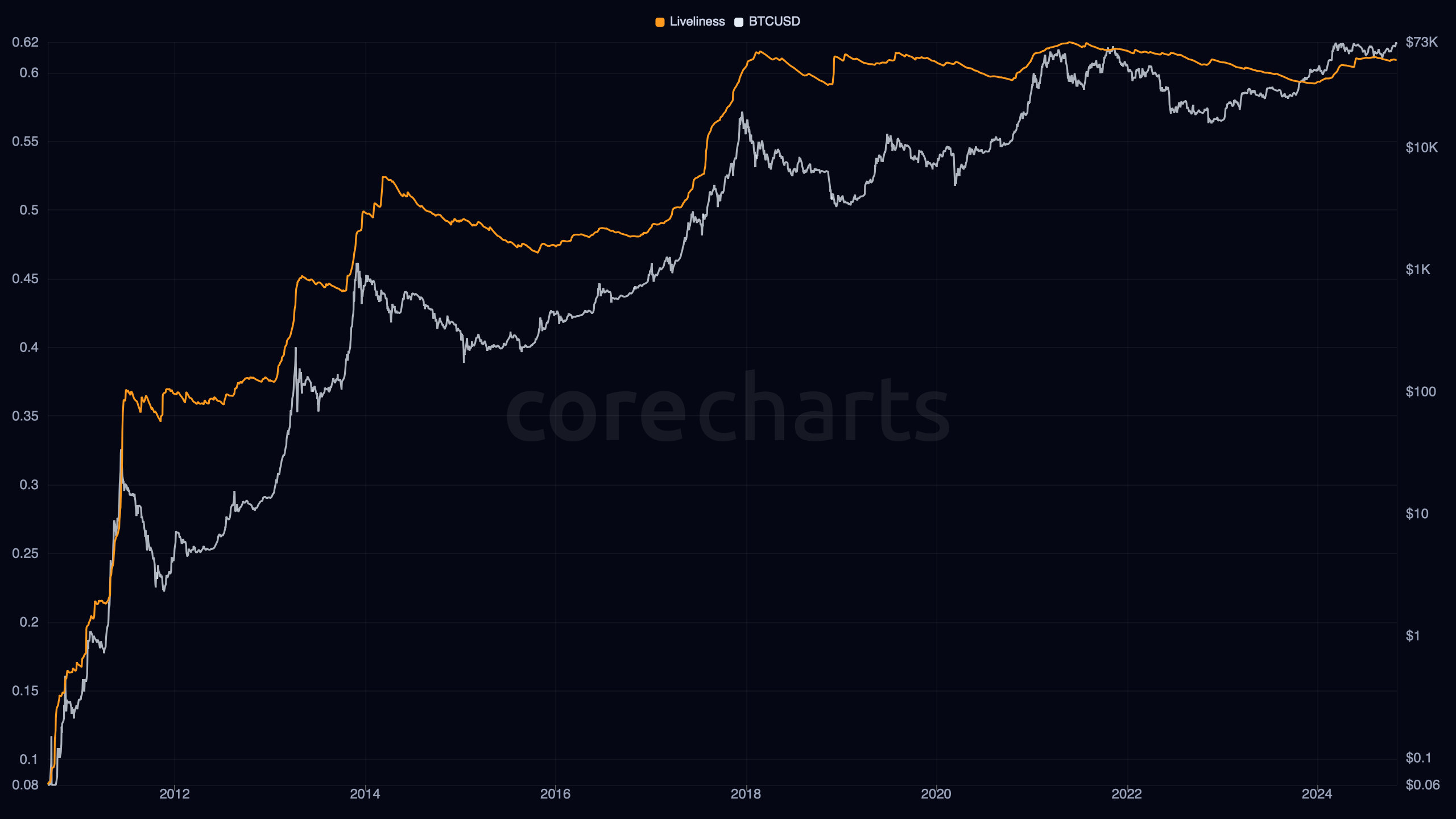
Bitcoin Liveliness measures how much of Bitcoin’s accumulated coin-age has been destroyed by spending, relative to how much coin-age the network could have accumulated in total.
It answers a precise question:
Is long-held supply being spent faster, or is dormant supply continuing to build?
The basic logic is:
The numerator captures the history of coin-age destroyed when old coins move. The denominator captures the total stock of supply-days the network could have accumulated through time.
Because of that structure, Liveliness is not a daily activity oscillator. It is a long-range behavioral ratio.
A rising Liveliness means more stored age is being destroyed relative to the network’s total age base. A falling Liveliness means more age is being preserved in dormant supply than released through spending.
How To Use It
Liveliness is most useful when the analytical goal is to judge whether long-term holders are distributing or holding back supply.
The metric is especially strong in three situations.
Persistent distribution
When Liveliness rises over a meaningful period, older supply is being spent often enough to outweigh the dormant-age build-up happening elsewhere in the network. That usually points to a market where long-term holders are distributing, realizing gains, or otherwise releasing aged coins back into circulation.
Persistent accumulation
When Liveliness flattens or declines, dormant supply is building faster than historic age is being destroyed. That usually points to stronger holding behavior and reduced release of old supply.
Comparing cycles
Because the metric is cumulative and ratio-based, it is more useful for comparing broad market phases than for reading short bursts of activity. It helps answer whether a cycle is characterized more by coin-age destruction or by coin-age preservation.
What It Can Say About Market Regime
Liveliness is one of the clearest holder-behavior regime metrics in Bitcoin.
Bull-market distribution
During strong bull-market phases, older holders often begin spending into strength. If that distribution is broad and sustained, Liveliness tends to rise. That does not happen because price is high by itself. It happens because aged supply is actually moving.
A rising Liveliness in a mature bull market often means long-term holders are becoming more active on the sell side.
Bear-market dormancy
In colder markets, especially after major distribution phases, old supply often stops moving and begins aging again. In those periods, Liveliness tends to flatten or drift lower.
That usually reflects a market where the release of dormant supply has slowed and a larger share of coins is returning to inactivity.
Why the metric matters
Many on-chain metrics show activity. Liveliness is narrower and more useful in one specific way: it isolates the balance between stored dormancy and spent dormancy.
That makes it a useful regime filter when price and activity metrics alone do not tell you whether old supply is actually participating.
Historical Background
Liveliness is associated with David Puell and Murad Mahmudov, who introduced it as a way to compare destroyed coin-age with the supply-age the network had available to build.
The metric became important because it added behavioral context that price and raw transaction activity could not provide. It does not focus on how much BTC moved in nominal terms. It focuses on whether the market is spending away long-held age or allowing that age to continue accumulating.