Bitcoin HODL Waves
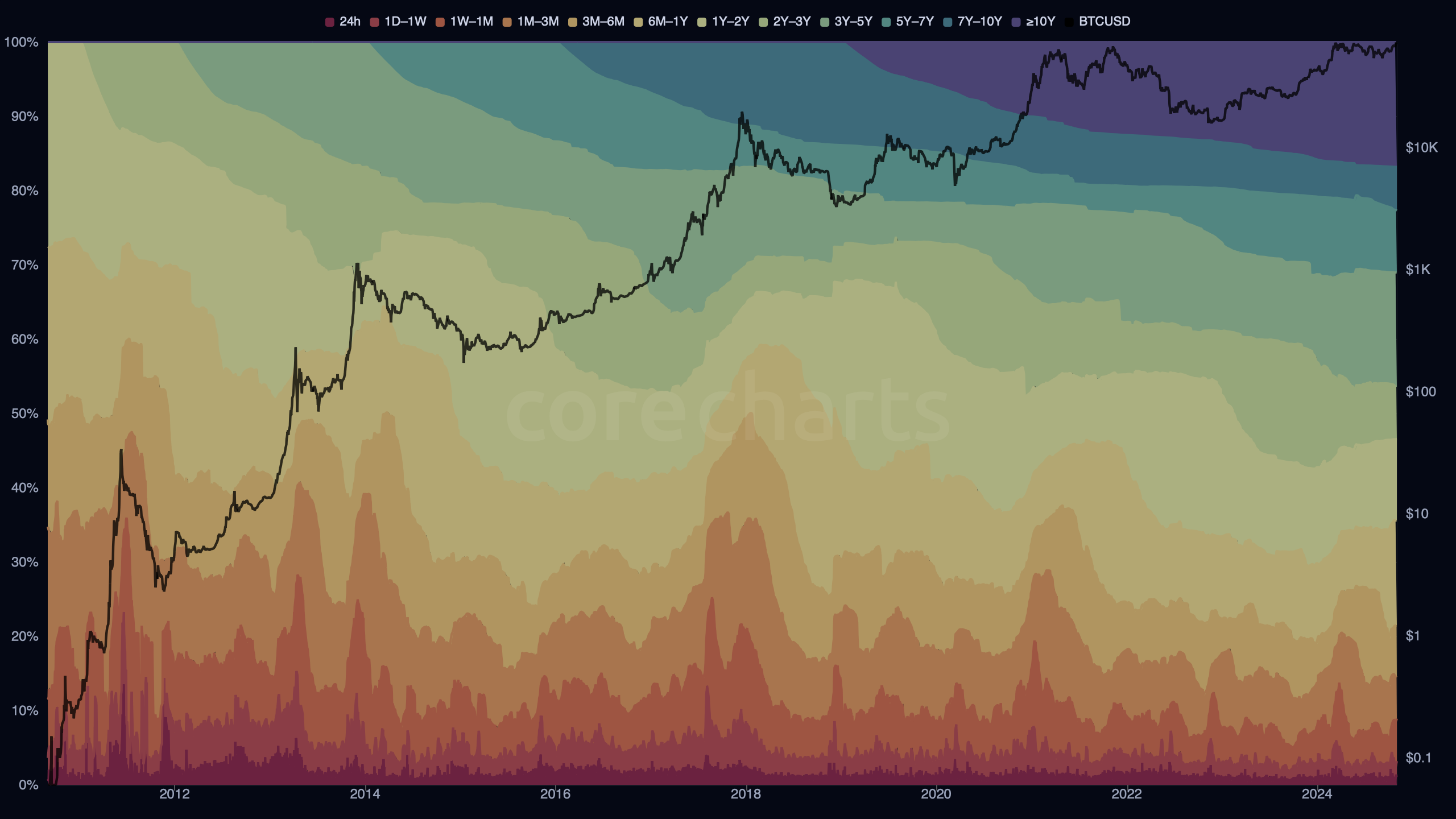
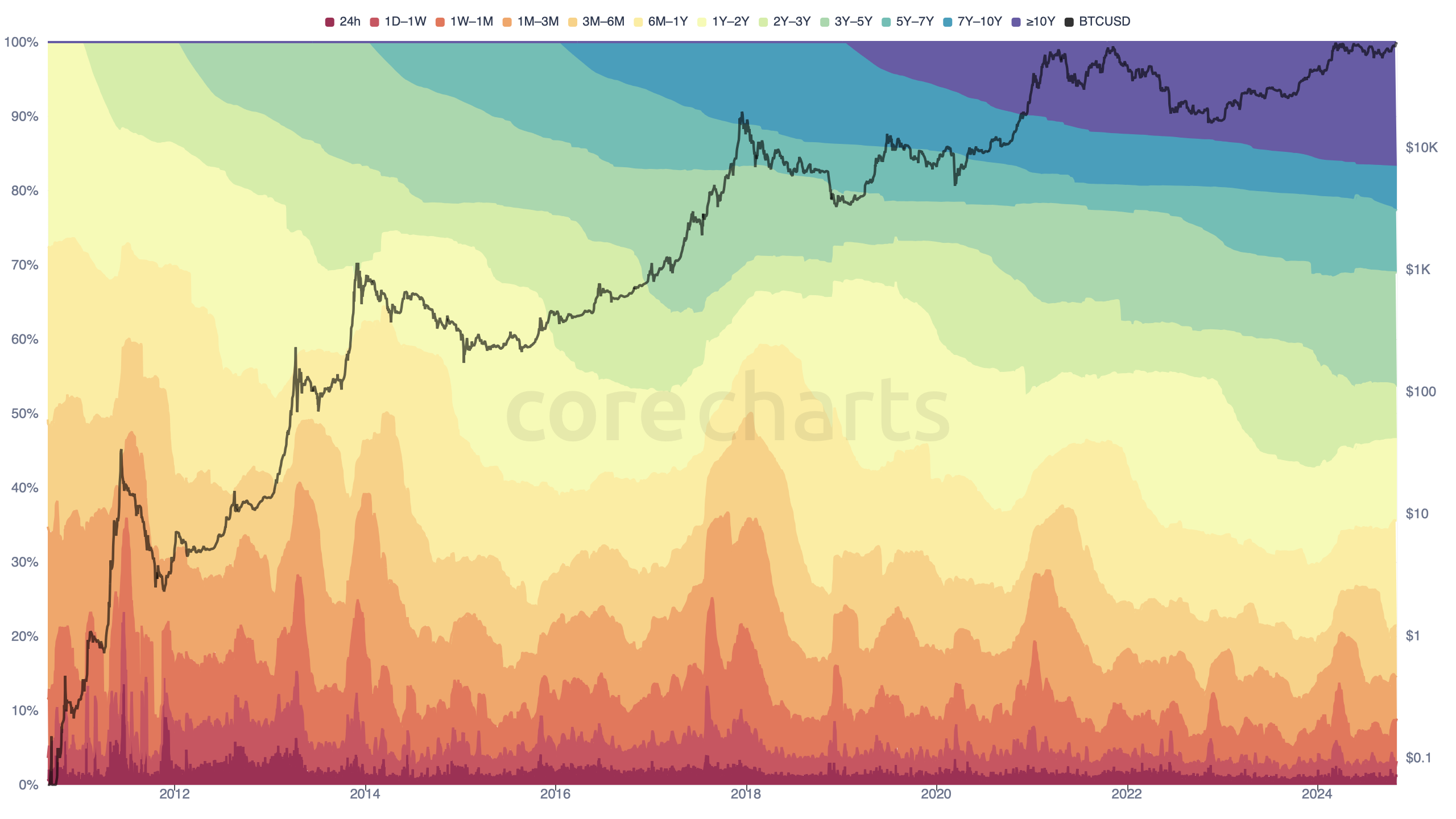
What It Shows
Bitcoin HODL Waves split the current Bitcoin supply into age bands based on how long coins have remained unspent. Each band answers a specific question: what share of supply has not moved for this length of time.
The chart is built from the UTXO set. Every unspent output is assigned to an age bucket according to the time since it was created, and each bucket is then expressed as a share of total supply tracked by the metric.
The standard bands are:
- Less than 1 day
- 1 day to 1 week
- 1 week to 1 month
- 1 month to 3 months
- 3 months to 6 months
- 6 months to 1 year
- 1 year to 2 years
- 2 years to 3 years
- 3 years to 5 years
- 5 years to 7 years
- 7 years to 10 years
- 10 years and older
For any band, the basic idea is:
This is a held-supply view. It shows where coins are sitting now. It does not show which coins were spent today. That is the key difference from spent-age metrics.
How To Use It
HODL Waves are useful when the question is about supply structure rather than daily transaction flow.
A rise in the youngest bands means a larger part of supply has moved recently. That usually reflects one of two things:
- older coins were spent and reset into young age bands;
- recently acquired coins are turning over quickly.
A rise in older bands means coins are remaining unspent for longer. That indicates coins are aging in place.
In practice, the chart helps answer questions like:
- Is supply becoming more dormant?
- Is older supply being reactivated?
- Is turnover concentrated in recent coins, or are long-held coins starting to move?
It is a direct way to separate aging supply from reactivated supply.
Reading Market Regimes
HODL Waves are especially useful for identifying broad market structure.
Accumulation and post-cycle rebuilding
When younger bands shrink and older bands expand, coins are aging without being spent. That usually appears during long consolidation phases, deep bear-market recovery, or extended accumulation.
More supply is moving out of short-term circulation and into long-term dormancy.
Bull-market distribution
When young bands begin expanding while older bands stop growing or start contracting, older supply is being spent and reset into newer cohorts. That usually happens when demand is strong enough to draw previously dormant coins back into circulation.
The chart does not call a precise top, but it often shows when a market stops being driven only by fresh demand and starts pulling in deeper-held supply.
Supply tightness
When a large share of supply sits in older bands and stays there, the actively rotating part of the market becomes smaller. That does not guarantee price appreciation, but it does change the supply backdrop. HODL Waves show that tightening directly.
Historical Background
The HODL Waves concept is widely associated with Dhruv Bansal, who introduced the visualization to show how Bitcoin supply shifts across age cohorts over time.
The underlying idea comes directly from Bitcoin’s UTXO model. Because every coin has a creation point and an unspent status, supply can be grouped by dormancy age without relying on off-chain labels or behavioral guesswork.
Over time, HODL Waves became one of the standard long-horizon tools in Bitcoin on-chain analysis because they show something price cannot show on its own: whether supply is aging, churning, or returning to market.