Bitcoin Coin Days Destroyed in Sat-Seconds
What It Measures
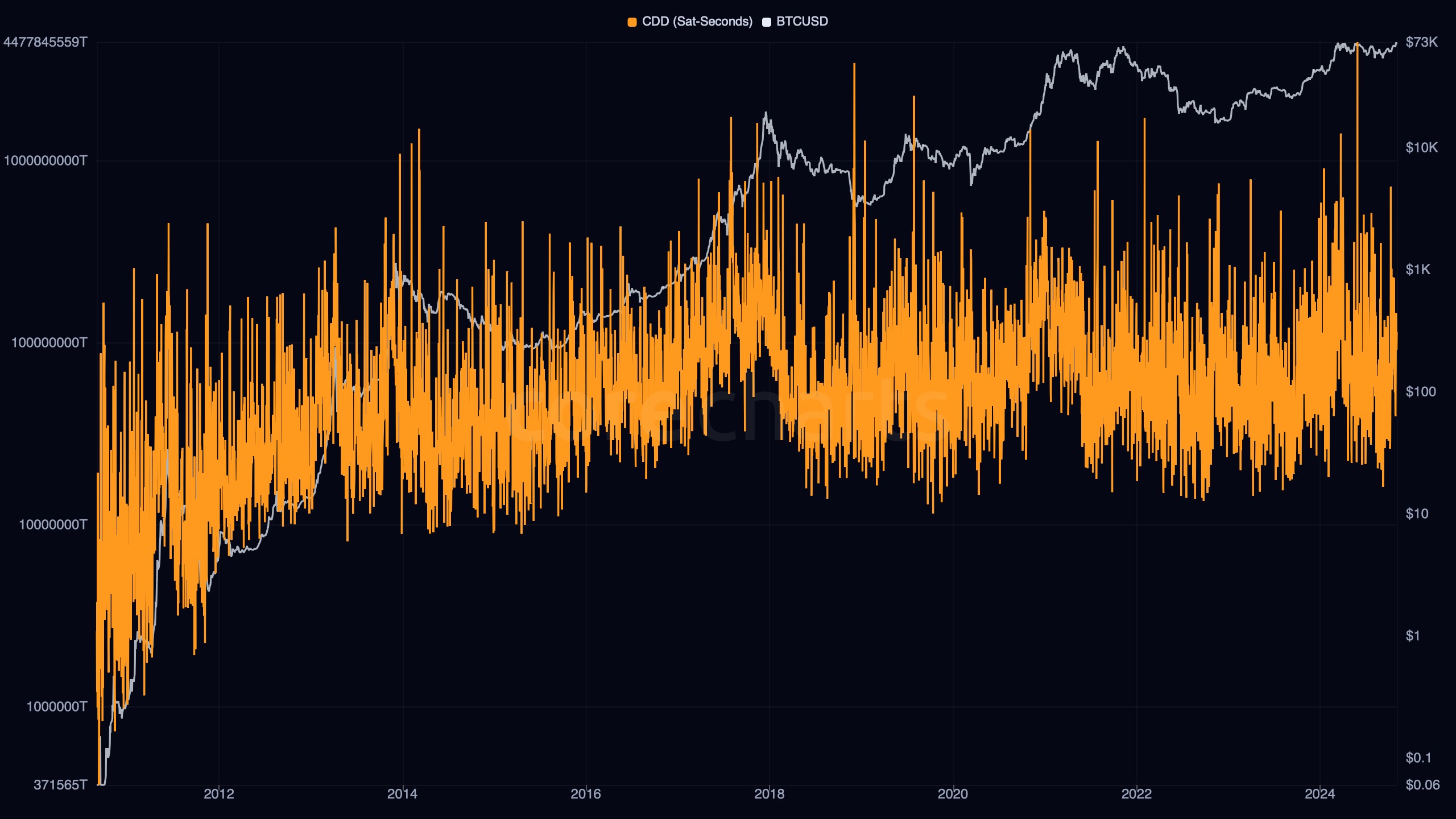
Bitcoin Coin Days Destroyed in Sat-Seconds measures the total dormant satoshi-time destroyed by spending on a given day.
It answers a precise question:
How much stored satoshi-time was brought back into motion today?
For each spent input, the metric multiplies:
- the input value in satoshis,
- by the time it remained unspent, in seconds.
In simplified form:
The result is expressed in sat-seconds.
This makes the metric highly sensitive to two things at once:
- how much BTC was spent;
- how long those coins had remained dormant.
A small amount of very old supply can produce a meaningful reading. A large amount of recently moved supply can also produce a meaningful reading, but through scale rather than long dormancy.
How To Use It
This series is useful when the goal is to observe dormant-age destruction in its most granular time-value form.
A higher reading means more dormant satoshi-time was destroyed that day. That can happen because:
- more BTC moved,
- older BTC moved,
- or both happened at the same time.
This metric is especially useful when compared with:
- Bitcoin Transfer Volume
- Coin Days Destroyed
- Average Dormancy
- Revived Supply
Transfer Volume shows how much BTC moved.
CDD sat-seconds shows how much dormant time-value was destroyed by that movement.
That distinction matters because not all transfer activity carries the same informational weight. Spending recent coins is different from spending coins that sat untouched for years.
What It Can Say About Market Regime
CDD sat-seconds is most informative when older supply begins participating more actively.
Low readings
When the metric stays low, the market is not destroying much dormant satoshi-time. That usually means one of two things:
- spent volume is modest;
- or the spent coins are relatively young.
In either case, older dormant supply is not playing a large role in the day’s activity.
High readings
When the metric rises sharply, dormant time-value is being released in larger size. That often reflects:
- old-coin activation,
- long-term holder distribution,
- or unusually large spending from aged supply.
This can become especially relevant in strong bull phases, late-cycle distribution, or major market resets where dormant supply re-enters circulation.
Why the sat-second view can still matter
The sat-second unit keeps the original time-value product intact. That makes it a useful companion to normalized dormancy metrics, especially when the goal is to examine the full scale of dormant-age destruction without collapsing it immediately into a more familiar presentation format.
Historical Background
The underlying idea comes from the broader Bitcoin coin-age framework. Once analysts began treating spent value and dormancy as a combined signal, the natural quantity was the product of coin value and holding time. That is what this metric captures directly at the satoshi-second level.
The better-known Coin Days Destroyed series expresses the same underlying logic in a more familiar unit. The sat-second version preserves the raw time-value magnitude of that process.