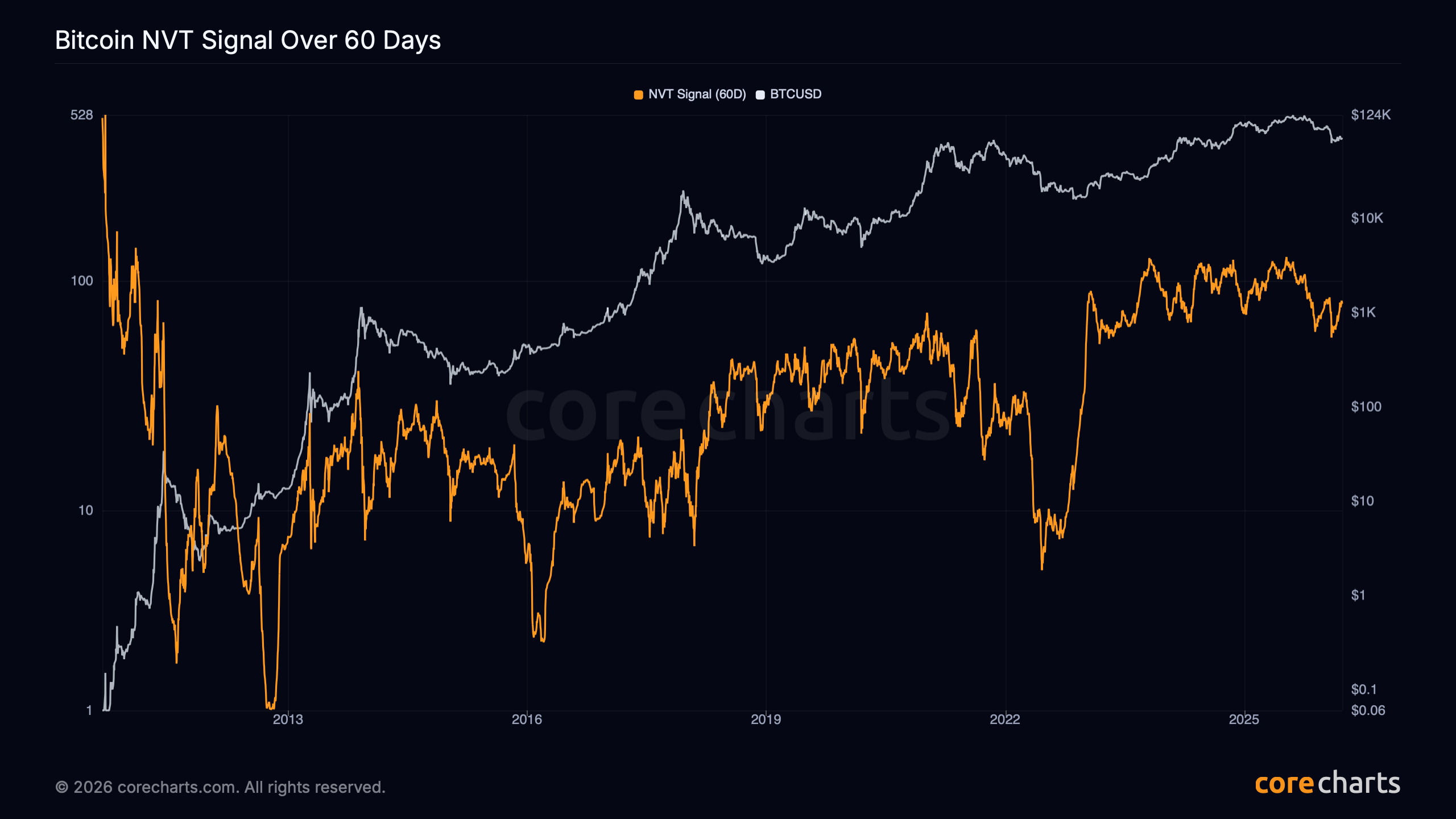
Bitcoin NVT Signal Over 60 Days
Definition
Bitcoin NVT Signal 60 compares Market Cap with the 60-day average of adjusted transfer volume.
This sits between the shorter 30-day signal and the slower 90-day version. The denominator smooths adjusted transfer activity over roughly two months, which reduces short bursts and temporary distortions without becoming too inert.
The analytical question stays the same: how expensive the network is relative to recent adjusted value transfer.
Interpretation
A high NVT Signal 60 means market value is elevated compared with the recent two-month transfer base. A lower reading means adjusted activity is stronger relative to valuation.
The 60-day window offers a balanced read. It ignores more short-term churn than the 30-day signal, yet it still reacts earlier than the 90-day version when market structure begins to shift.
That makes it a strong middle-range series for cycle work. Valuation stretch often comes through clearly here without the extra instability of the shorter window.
Market use
NVT Signal 60 is well suited to swing and medium-term macro analysis. During advancing markets, it can show when price appreciation is no longer matched by a durable rise in adjusted throughput. During bear phases, it helps track whether activity is recovering in a way that supports repricing.
Signals arrive later than in the 30-day version, but they are usually cleaner. They also appear earlier than in the 90-day window, where the smoothing is heavier.
For many analysts this is the compromise setting inside the NVT Signal family. It picks up changing conditions without reacting to every burst in recent flow.
Relationship to other metrics
NVT Signal 30 is the fast version. NVT Signal 90 is the slow, macro-heavy version. All three share the same adjusted transfer denominator family and differ only in the length of the moving average.
NVT Ratio Adjusted is the unsmoothed reference point. Velocity Adjusted moves in the opposite direction because it divides adjusted transfer flow by Market Cap rather than the reverse.
Historical note
Smoothed NVT variants became common once analysts moved away from reading raw transaction ratios alone. The 60-day window sits between short-horizon responsiveness and slower macro filtering, which is why it is often chosen as the default middle setting.