Short-Term Holder Market Value to Realized Value Ratio
Definition
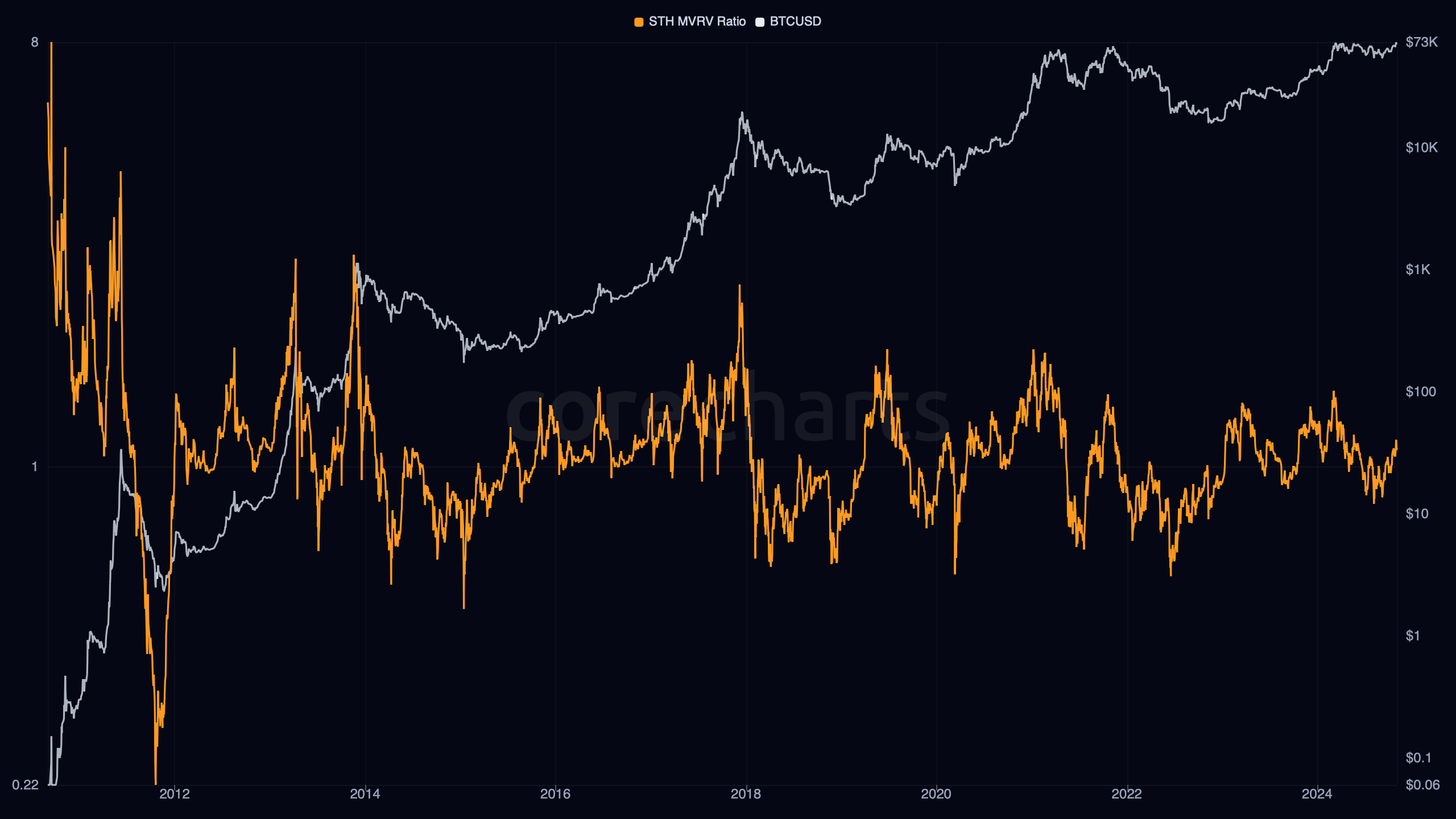
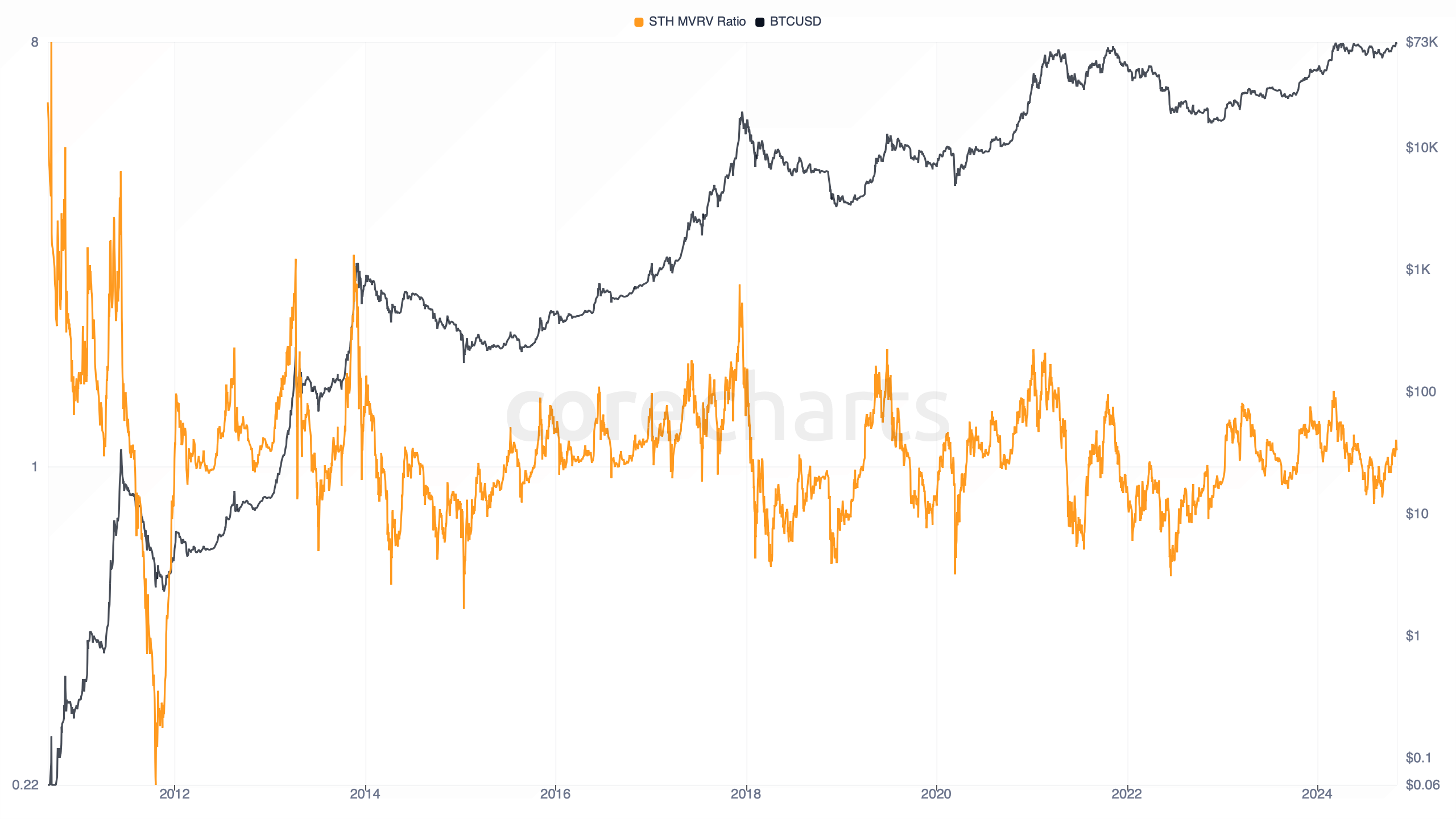
STH MVRV Soft Ratio compares the market value of younger supply with the realized value of that same supply.
The short-term holder segment is not split with a hard binary cutoff. Supply is weighted smoothly around the 155-day region, so coins near the boundary contribute gradually rather than switching cohorts in one step.
This ratio estimates whether newer holders, as a group, are sitting on large unrealized profit or loss.
Why the short-term cohort matters
Younger supply is more reactive. It is usually more price-sensitive, more likely to be repriced after sharp moves, and more likely to participate in distribution during fast advances or panic during drawdowns.
That gives STH MVRV a different role from aggregate MVRV. It is less about the valuation of the whole network and more about the financial condition of the marginal holder base.
When STH MVRV rises well above 1.0, newer buyers are carrying visible unrealized gains. That tends to increase the probability of profit-taking. When it falls below 1.0, recent buyers are under water. That often coincides with stress, forced exits, or local exhaustion in downtrends.
Market behavior
STH MVRV often reacts faster than aggregate MVRV because recent supply reprices quickly. During sharp rallies it tends to expand early. During corrections it can compress hard even while older cohorts remain comfortably profitable.
That makes it useful for reading shorter-cycle market pressure. A reset in STH MVRV toward 1.0 during an ongoing bull market often marks a washout in overheated positioning. If it stays deeply elevated without a reset, the market may be vulnerable to distribution. If it remains depressed while price struggles to recover, recent demand is still trapped at higher cost basis.
The signal is strongest around local and intermediate turning zones, not secular valuation extremes.
Relationship to other metrics
LTH MVRV Soft Ratio is the natural counterpart. The gap between the two shows how profit or stress is distributed between newer and older supply. Aggregate MVRV blends both cohorts together.
STH Realized Price is closely related. When spot trades near the realized price of younger supply, STH MVRV approaches 1.0. SOPR variants for short-term holders often move alongside this ratio during stress and recovery phases.
Historical note
The broader STH/LTH framework is widely used in Bitcoin on-chain analysis and is commonly associated with a 155-day holder boundary. The soft version adapts that idea by using a gradual age weighting around the same region instead of a hard split.