Bitcoin Supply Last Active ≥ N Years
What This Metric Family Shows
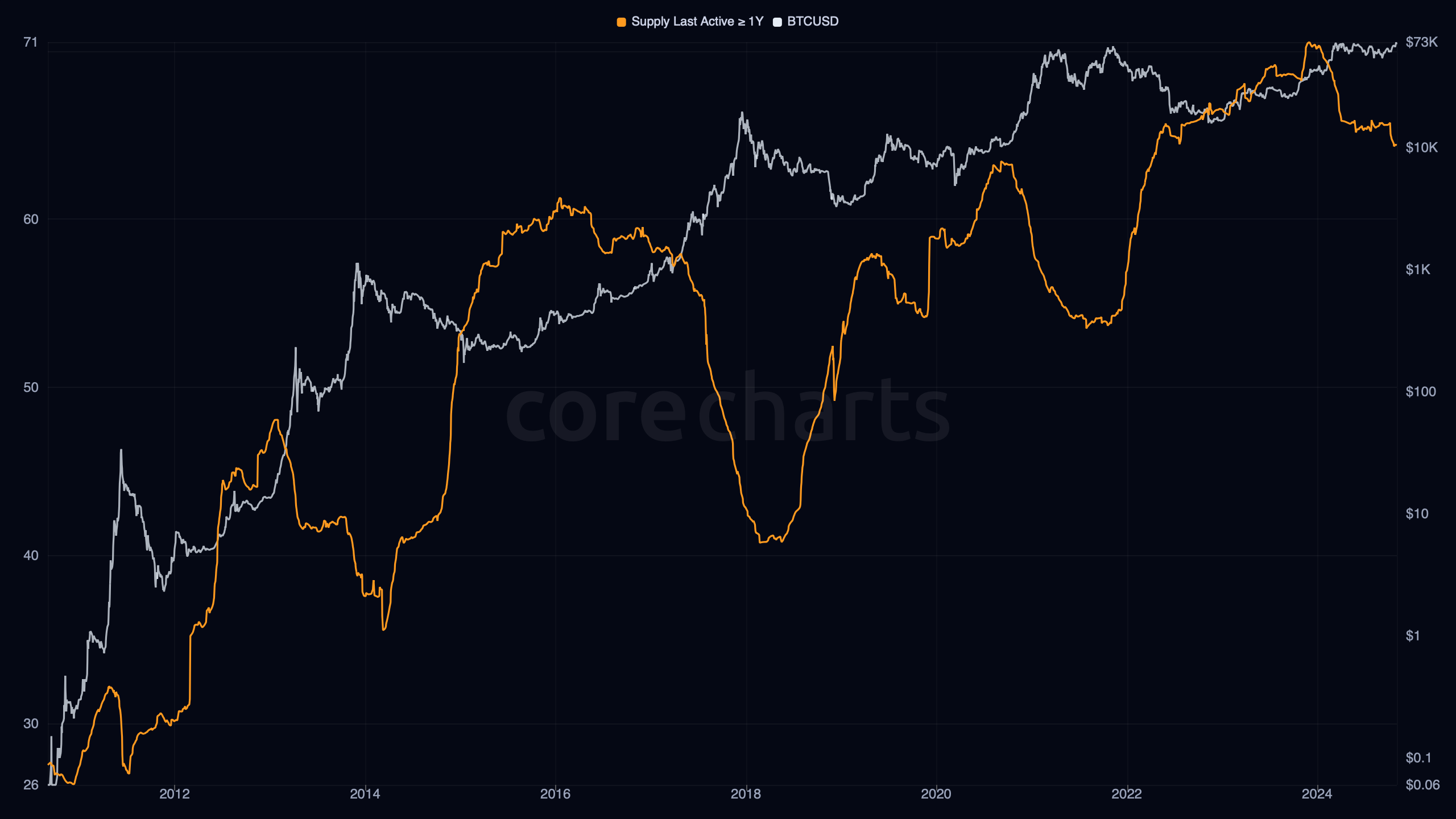
Bitcoin Supply Last Active ≥ N Years shows how much of the current Bitcoin supply has not moved for at least a chosen threshold.
The family includes five variants:
- Supply Last Active ≥ 1 Year
- Supply Last Active ≥ 2 Years
- Supply Last Active ≥ 3 Years
- Supply Last Active ≥ 5 Years
- Supply Last Active ≥ 10 Years
Each version answers the same basic question at a different depth of dormancy:
What percentage of Bitcoin supply has remained inactive for at least this long?
In CoreCharts, these series are derived from the held-age distribution. For each threshold, all older age bands are added together and expressed as a percentage of the supply covered by the metric.
The logic is:
So the thresholds work as cumulative layers, not as isolated buckets.
That means:
- ≥ 1Y includes all supply aged 1 year and older;
- ≥ 2Y includes only supply aged 2 years and older;
- ≥ 3Y includes only supply aged 3 years and older;
- ≥ 5Y includes only supply aged 5 years and older;
- ≥ 10Y includes only supply aged 10 years and older.
This is a held-supply metric. It does not describe spending today. It shows how much supply has stayed unspent beyond a chosen time threshold.
How To Use It
This metric family is useful when the analytical question is about dormant supply concentration.
A rising reading means a larger share of supply has remained untouched for at least that long. A falling reading means some of that dormant supply has been spent and reset into younger age cohorts.
The practical use depends on the threshold.
Supply Last Active ≥ 1 Year
This is the broadest long-term dormancy threshold in the family. It is useful for asking:
How much supply has already moved beyond short-cycle behavior and stayed inactive for a full year or more?
This version responds earlier than the others. It is useful for tracking whether supply is generally maturing into long-term holding.
Supply Last Active ≥ 2 Years
This threshold is narrower and more selective. It answers:
How much supply has stayed inactive across a longer market cycle window?
It filters out part of the 1-year cohort and focuses more on supply that has remained dormant through a more extended period.
Supply Last Active ≥ 3 Years
This version begins to isolate deeper dormancy. It is useful when the goal is to track supply that has remained untouched well beyond ordinary market participation windows.
It is often more informative in cycle analysis than the 1-year threshold because it is less affected by recent holding behavior.
Supply Last Active ≥ 5 Years
This is a much stricter threshold. It focuses on supply that has remained inactive through multiple market phases.
It is useful for judging how much of Bitcoin supply has moved into a very low-turnover state.
Supply Last Active ≥ 10 Years
This is the deepest dormancy threshold in the family. It isolates the oldest surviving supply still sitting unspent.
It is best used as a structural measure of ultra-old supply rather than as a fast-moving market indicator.
What The Thresholds Say About Market Structure
These metrics become more informative when read as a ladder rather than as isolated lines.
Broad dormancy versus deep dormancy
- ≥ 1Y tells you whether dormant supply is building in broad terms.
- ≥ 2Y and ≥ 3Y tell you whether that dormancy is persisting through longer cycle windows.
- ≥ 5Y and ≥ 10Y show whether very old supply is continuing to stay locked in place.
This distinction matters because a market can show rising 1-year dormancy without meaningfully increasing the 5-year or 10-year share. That would suggest maturing supply, but not necessarily very deep supply lock-up.
Reactivation of old supply
When one of these lines declines, dormant supply above that threshold has been spent.
A drop in ≥ 1Y is common enough around stronger turnover phases.
A drop in ≥ 5Y or ≥ 10Y is more meaningful, because it implies that very old supply has started moving.
Reading the market by threshold
Each threshold helps answer a slightly different market question:
- ≥ 1Y — Is long-term holding expanding in broad terms?
- ≥ 2Y — Is that held supply surviving through a longer cycle window?
- ≥ 3Y — Is deeper dormancy still building?
- ≥ 5Y — How large is the stock of very inactive supply?
- ≥ 10Y — Is ultra-old supply remaining untouched?
What It Can Say About Price And Regime
These metrics are not short-term timing tools. Their value is in regime context.
Accumulation and post-distribution phases
When the thresholds rise together, especially the lower and middle ones, more supply is remaining inactive through time. That usually points to a market where coins are aging rather than being recycled quickly.
Distribution and supply release
When the lower thresholds flatten or fall, previously dormant supply is returning to circulation. If higher thresholds also begin to fall, the distribution is reaching deeper into older supply.
That is often more important than raw transaction activity, because it tells you that the source of supply is no longer only recent holders.
Why the higher thresholds matter
The longer the threshold, the more selective the supply base becomes.
A change in ≥ 1Y is meaningful.
A change in ≥ 5Y or ≥ 10Y is rarer and usually says more about deep structural supply behavior.
Historical Background
Threshold-based dormant-supply metrics are a natural extension of Bitcoin’s age-distribution framework. Once the held supply is grouped by age, it becomes straightforward to ask how much of supply has survived beyond specific holding periods.
These thresholds became widely used because they translate a complex age distribution into simpler structural questions. Instead of reading every age band at once, the analyst can focus on a chosen dormancy depth: one year, two years, five years, or longer.
They are best understood as summary views built on top of the broader HODL Waves framework.