Bitcoin Halving Epoch
What It Measures
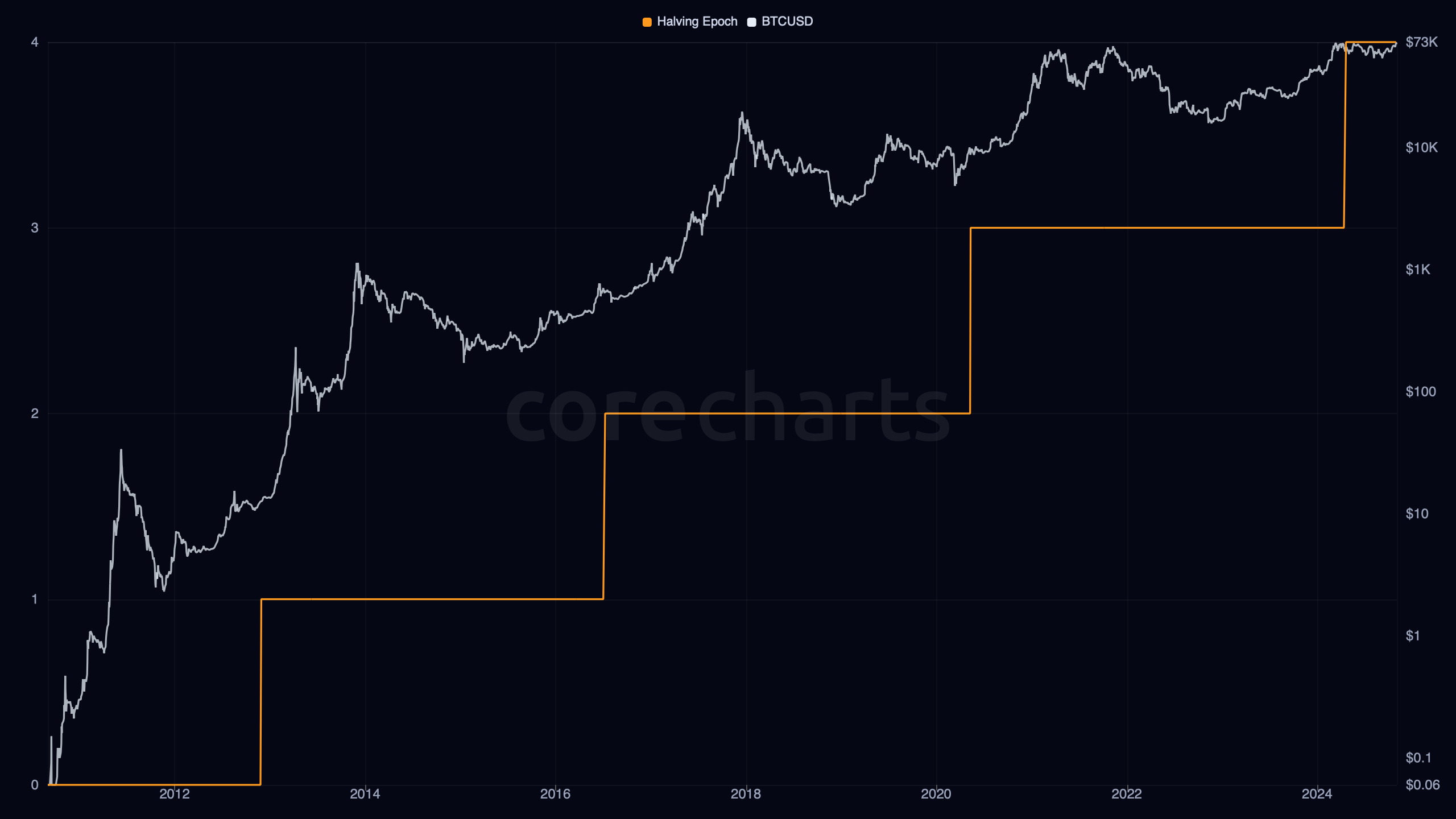
Bitcoin Halving Epoch identifies which subsidy era Bitcoin is currently in.
It answers a simple schedule question:
Which halving cycle is the network operating in right now?
Each epoch begins immediately after a halving and ends at the next one. A new epoch means a new subsidy regime, with block issuance reduced relative to the previous era.
This metric is not a ratio and not a valuation indicator. It is a categorical schedule marker.
Within this group, Halving Epoch is the clearest structural label for the current issuance regime.
How To Use It
Halving Epoch is useful when the goal is to anchor analysis inside Bitcoin’s monetary schedule.
It helps answer questions such as:
- Which issuance era does the current market belong to?
- Are we still in the same subsidy regime as before, or already in a post-halving phase?
- Which set of supply conditions should other issuance metrics be interpreted against?
This metric is especially useful next to:
- Stock-to-Flow
- Annualized Inflation Rate
- Blocks to Next Halving
- Estimated Days to Next Halving
If Stock-to-Flow is the analytical scarcity ratio, Halving Epoch is the clean schedule label that tells you which subsidy regime that ratio belongs to.
What It Can Say About Price And Market Regime
Halving Epoch does not forecast price by itself. Its value is contextual.
Regime framing
A change in epoch means Bitcoin has entered a new monetary regime. Issuance drops, inflation falls, and the background conditions for scarcity metrics change at once.
Historical comparison
Epoch labels are useful because many long-cycle discussions in Bitcoin are organized around halving eras rather than around calendar years. This metric gives that structure explicitly.
Why it matters
Bitcoin’s issuance schedule changes discontinuously, not smoothly. Halving Epoch is the simplest way to mark those discontinuities.
Historical Background
The halving schedule is part of Bitcoin’s original protocol design. Because block subsidy is cut in discrete steps, Bitcoin naturally divides into distinct issuance epochs. Analysts, miners, and market participants have used halving eras as reference periods for years because they provide the cleanest framework for comparing different monetary phases of Bitcoin’s history.