Bitcoin Transaction Fees in US Dollars, 30-Day Average
What It Measures
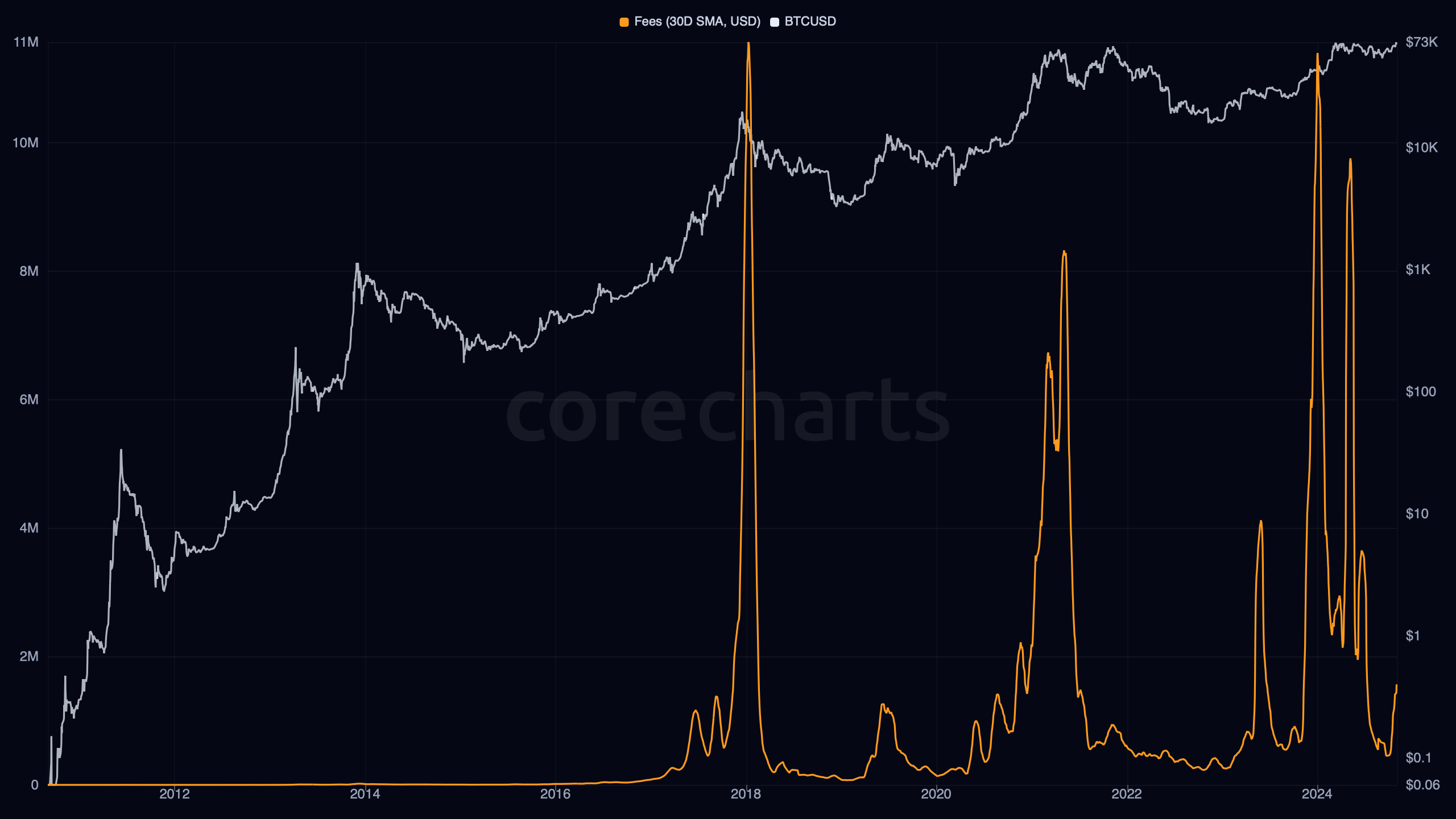
Bitcoin Transaction Fees in US Dollars, 30-Day Average smooths the daily USD fee total over the last thirty days.
It answers a broader question than the 7-day version:
What has the medium-term fee-income environment looked like over the past month?
In simplified form:
This metric is the slower, more stable companion to the 7-day fee average.
It is designed to show the underlying fee trend over a monthly horizon rather than week-to-week fluctuations.
How To Use It
This metric is useful when the analytical goal is to judge whether the fee market is strengthening or weakening on a more durable basis.
It helps answer questions such as:
- Is fee income structurally improving, or only spiking intermittently?
- Has the mining sector entered a stronger or weaker fee-support regime over the last month?
- Are recent fee bursts large enough to change the medium-term trend?
The 30-day average is less reactive than the 7-day average. That is exactly why it is useful. It filters out short-lived bursts and shows whether fee income has actually been persistently strong.
This metric is especially useful next to:
- Daily Transaction Fees in USD
- 7-Day Fee Revenue Average
- Miner Revenue in USD
- Security Budget in USD
What It Can Say About Price And Market Regime
Sustained fee support
When the 30-day average rises, fee revenue has been improving for long enough to affect the medium-term revenue backdrop for miners. That is more important structurally than a brief fee spike.
Weak fee market over time
When the 30-day average trends lower, recent fee activity has not been strong enough to support a durable revenue improvement. That often signals a softer fee environment even if occasional daily spikes still appear.
Why this window matters
The 30-day version is better than the 7-day average for judging whether the fee market has genuinely shifted regime. It is the more useful line when the question is not “what happened this week?” but “has fee support really changed over the last month?”
Historical Background
Longer moving averages of fee revenue became standard once analysts began treating the fee market as a structural component of miner economics rather than as a series of isolated spikes. A 30-day window is especially useful because it captures the monthly fee backdrop without overreacting to temporary bursts of demand.