Bitcoin Network Value to Transactions Ratio Using Adjusted Transfer Volume
Definition
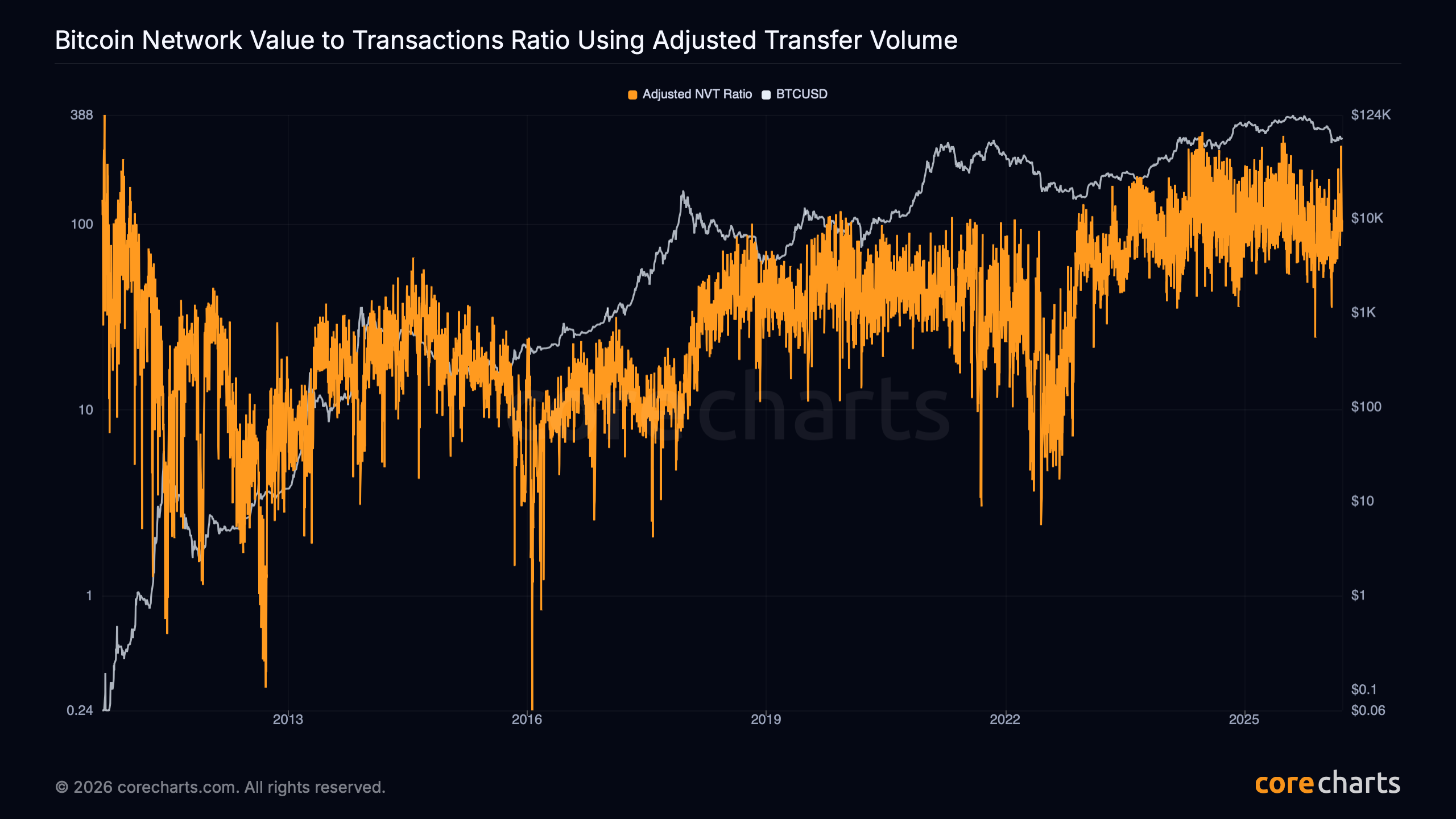
Bitcoin NVT Ratio Adjusted compares Market Cap with adjusted on-chain transfer volume rather than raw transfer volume.
The numerator is unchanged. The difference sits in the denominator. CoreCharts uses an adjusted transfer series intended to remove part of the noise that comes from self-churn, change-like flows, and transaction patterns that inflate apparent economic throughput.
This variant asks a narrower question than raw NVT: how expensive Bitcoin looks relative to a cleaner estimate of on-chain value transfer.
Interpretation
Raw transaction flow can overstate real economic settlement. That is why NVT Ratio Adjusted often reads differently from the unadjusted version at local extremes. When noisy transfer activity drops out, valuation stretch can appear more clearly.
A high reading suggests market value is rich relative to adjusted settlement activity. Lower readings point to stronger economically meaningful transfer flow for the market cap in place.
This version is usually cleaner during periods when exchange behavior, wallet management, or internal shuffling distort the raw denominator. It tends to be the better choice when the goal is valuation work rather than pure activity tracking.
Market use
This series is often more stable than raw NVT for cycle work. It can highlight overvaluation when price expands but adjusted flow does not follow. After major drawdowns, compression often shows up more clearly when transfer activity remains resilient.
Like the raw ratio, it is a regime measure. It should not be treated as a reversal trigger. Long bull phases can keep the ratio elevated. Bear market lows may form before the series reaches its absolute trough.
The gap between raw and adjusted NVT can be informative on its own. If raw flow looks healthy while adjusted flow stays weak, much of the apparent activity may come from internal or low-quality throughput rather than broad economic demand.
Relationship to other metrics
NVT Ratio is the nearest comparison. Both use Market Cap in the numerator. The difference is the transfer base. Raw NVT uses spent input volume. Adjusted NVT uses a filtered transfer estimate.
NVT Signal 30, 60, and 90 build on the adjusted series, but they smooth adjusted transfer volume before taking the ratio. Velocity Adjusted is the inverse logic expressed as throughput relative to valuation rather than valuation relative to throughput.
Historical note
Adjusted transfer approaches emerged as on-chain analysts tried to separate economic activity from mechanical flow. CoreCharts carries that distinction into the NVT family so the adjusted ratio can sit alongside the raw version instead of replacing it.