Bitcoin Block Subsidy
What It Measures
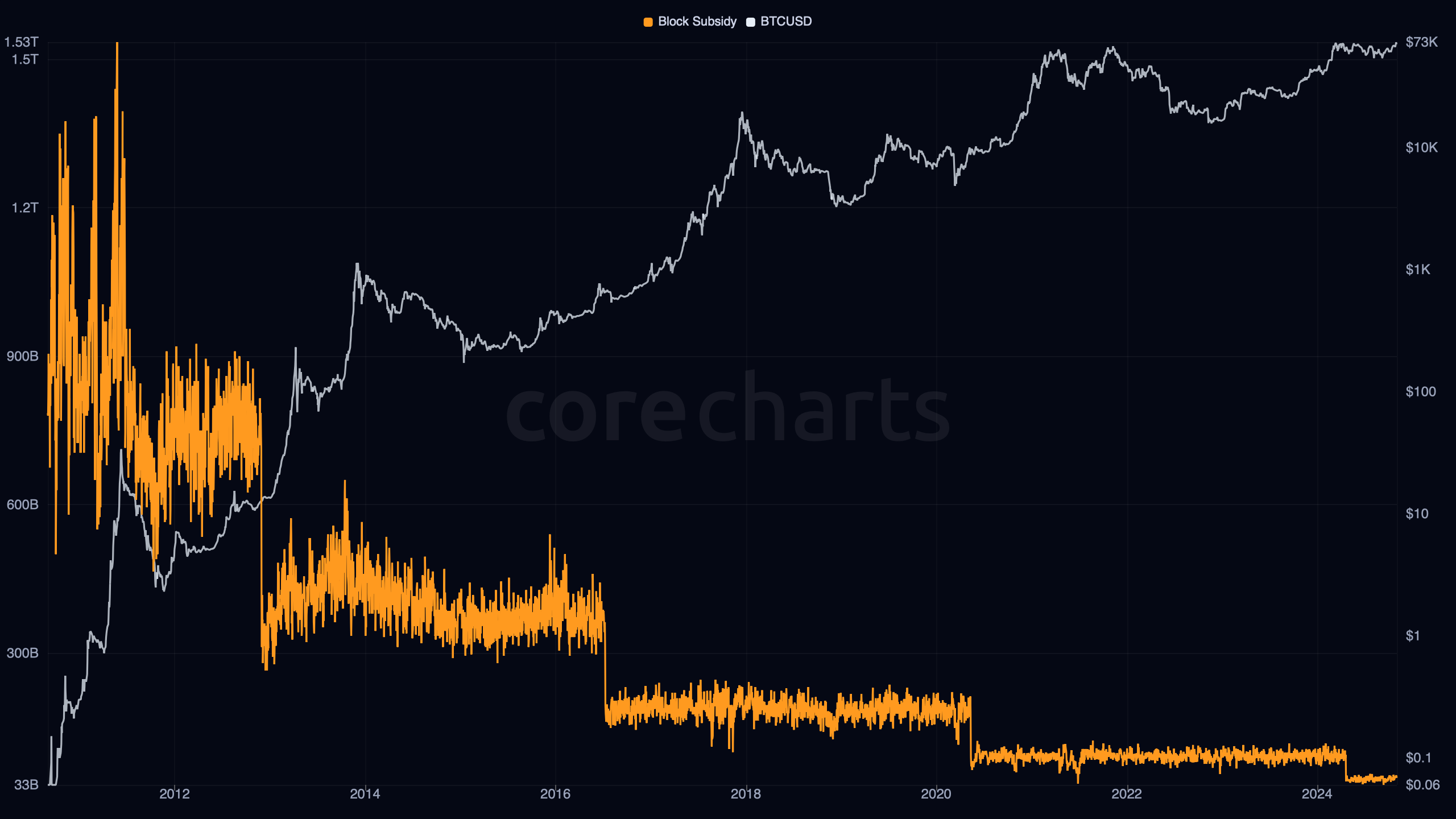
Bitcoin Block Subsidy shows how many satoshis the Bitcoin protocol issued to miners through newly created coins over the observed day.
It answers a protocol-level question:
How much new BTC did the network create as mining subsidy today?
This metric excludes transaction fees. It reflects only the issuance side of miner compensation.
In simplified form:
The result is shown in satoshis per day.
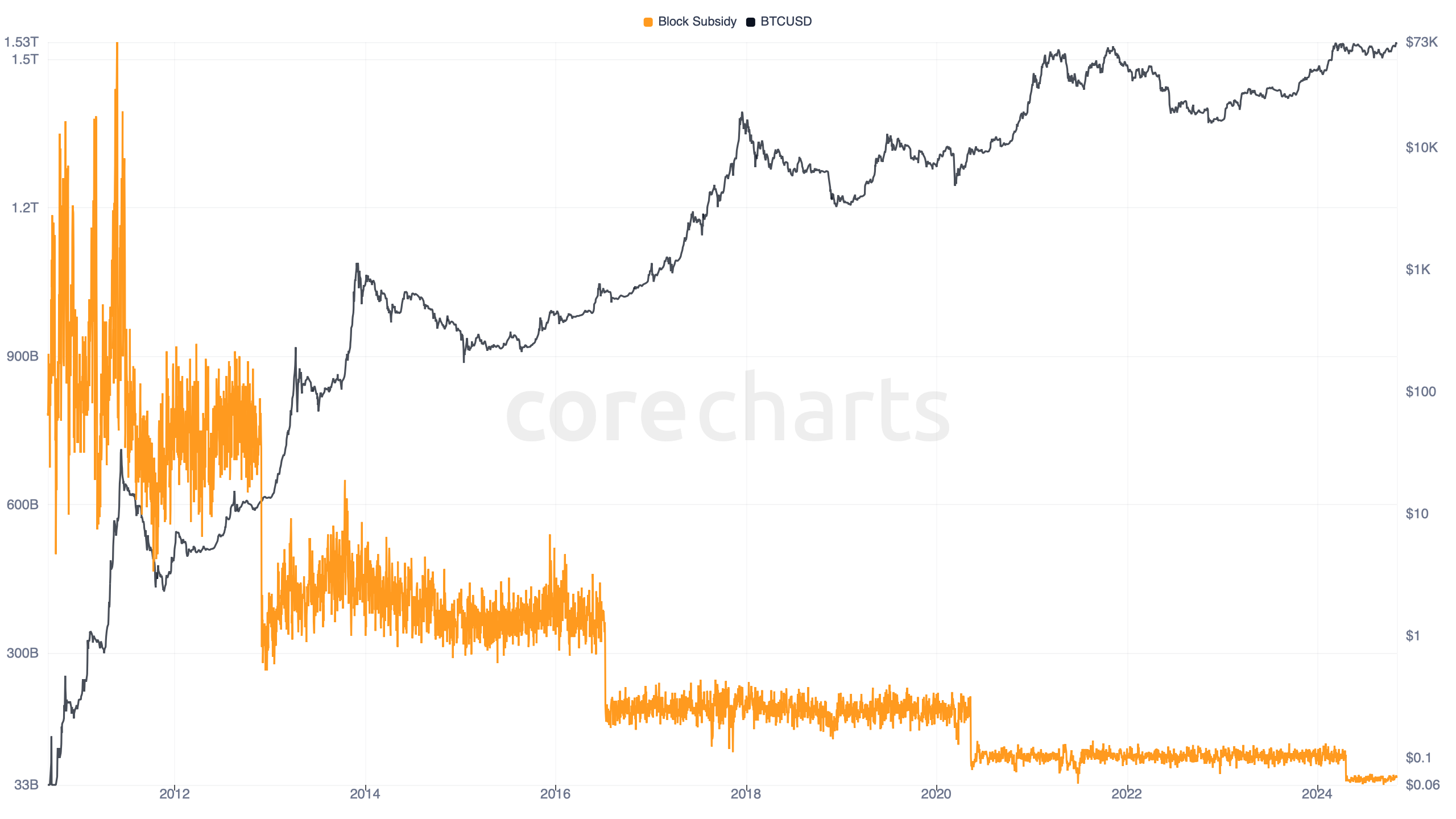
Because the subsidy follows Bitcoin’s issuance schedule, the long-term path of this metric is mostly predetermined. It declines in stepwise reductions at each halving. Between halvings, it remains structurally stable apart from small differences driven by the exact number of blocks found during the day. The current subsidy is 3.125 BTC per block, following the April 2024 halving.
How To Use It
Block Subsidy is useful when the question is about Bitcoin’s fixed issuance schedule rather than market-driven miner income.
It helps answer questions such as:
- How much new BTC is being introduced into circulation right now?
- How large is the subsidy component of miner revenue?
- How does the current issuance regime compare with past halving eras?
This metric is especially useful next to:
- Miner Revenue
- Transaction Fees per Block
- Security Budget
- Inflation
The subsidy tells you what the protocol guarantees miners before fees are added on top.
What It Can Say About Price And Market Regime
By itself, Block Subsidy is not a market timing indicator. Its main value is structural.
Halving transitions
The clearest use of this metric is across halving boundaries. Each halving cuts the subsidy per block by half, which immediately reduces the protocol-driven part of miner compensation.
That changes miner economics, supply issuance, and the balance between subsidy and fees.
Issuance pressure
The subsidy is also the cleanest direct measure of Bitcoin’s current issuance flow in native terms. If the goal is to think about new supply entering the market, this is the foundational metric.
Why it matters even though it is scheduled
The fact that the series is rule-based does not make it unimportant. Quite the opposite. Because it is fixed in advance, it anchors the monetary side of Bitcoin’s security model and the long-run decline in new issuance.
Historical Background
The block subsidy is part of Bitcoin’s original monetary design and was specified by Satoshi Nakamoto. It is the mechanism through which new coins enter circulation, and it follows the well-known halving schedule that steadily reduces issuance over time.
This schedule is central to Bitcoin’s scarcity model and to the long-run transition from subsidy-funded security toward a greater reliance on fees.