Bitcoin Mining Difficulty
What It Measures
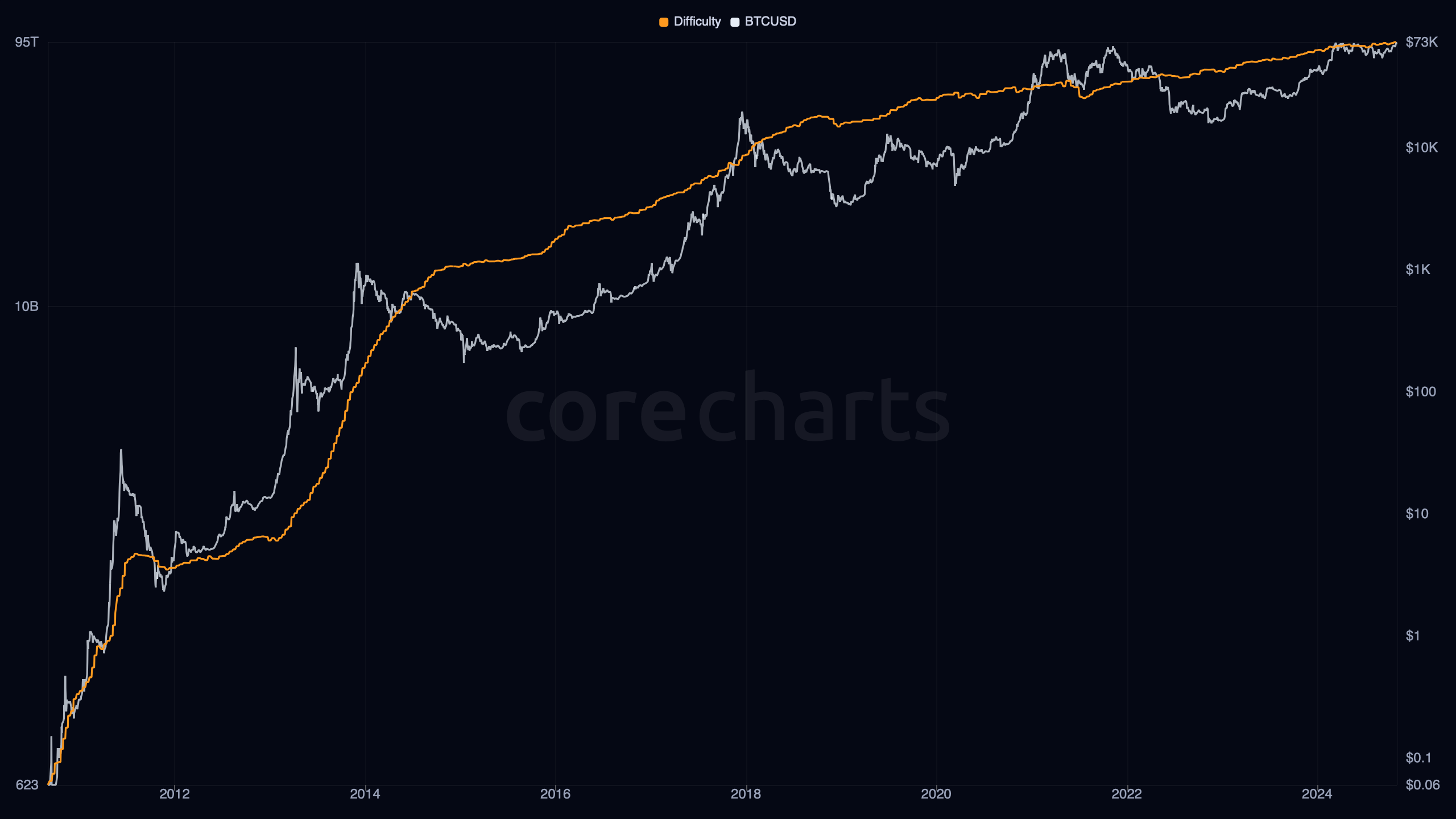
Bitcoin Mining Difficulty shows the current difficulty level miners must overcome to find valid Bitcoin blocks.
It answers a simple protocol-level question:
How hard is it, under the current target, to mine a valid block?
Difficulty is Bitcoin’s built-in adjustment mechanism. It recalculates every 2016 blocks, roughly every two weeks, so that block production stays close to the protocol’s intended 10-minute interval even as total hash power rises or falls.
A higher difficulty means miners must perform more work on average to find a valid block. A lower difficulty means the required work has been reduced.
This metric is shown as the latest difficulty level in force for the observed period.
How To Use It
Difficulty is useful when the analytical focus is on protocol adjustment rather than raw miner output.
It helps answer questions such as:
- Has the network recently adjusted upward or downward?
- Is the protocol responding to growing or shrinking mining participation?
- Are miners operating in an environment of tightening or easing competition?
Difficulty is especially useful next to:
- Hash Rate
- Hash Price
- Miner Revenue
- Security Budget
Hash Rate reflects estimated current participation. Difficulty reflects the protocol’s response to that participation.
What It Can Say About Price And Market Regime
Difficulty is not a fast market-timing indicator, but it is important for understanding miner conditions.
Rising difficulty
When difficulty rises, the network has adjusted to stronger mining participation. That usually means miners have been deploying enough hash power to push block production above the target pace before the adjustment.
This increases competitive pressure inside the mining sector. If miner revenue does not rise alongside it, margins tighten.
Falling difficulty
When difficulty falls, the network is adjusting to weaker mining participation. That usually follows a period where block production slowed because enough hash power left the network or became unavailable.
This can ease pressure on remaining miners by lowering the amount of work required per block.
Why difficulty matters separately from hash rate
Hash rate can move quickly. Difficulty moves only at adjustment points. That makes it the protocol’s slower, official reset mechanism rather than a live estimate of participation.
For miner economics, that distinction matters. A miner may face worsening conditions if difficulty remains high even while price or revenue falls.
Historical Background
Mining difficulty is a core part of Bitcoin’s original design. It was introduced by Satoshi Nakamoto as the mechanism that allows the network to maintain a roughly stable block interval despite changes in total mining power.
It remains one of the defining features of Bitcoin’s proof-of-work system.