Bitcoin Market Value to Realized Value Ratio
Definition
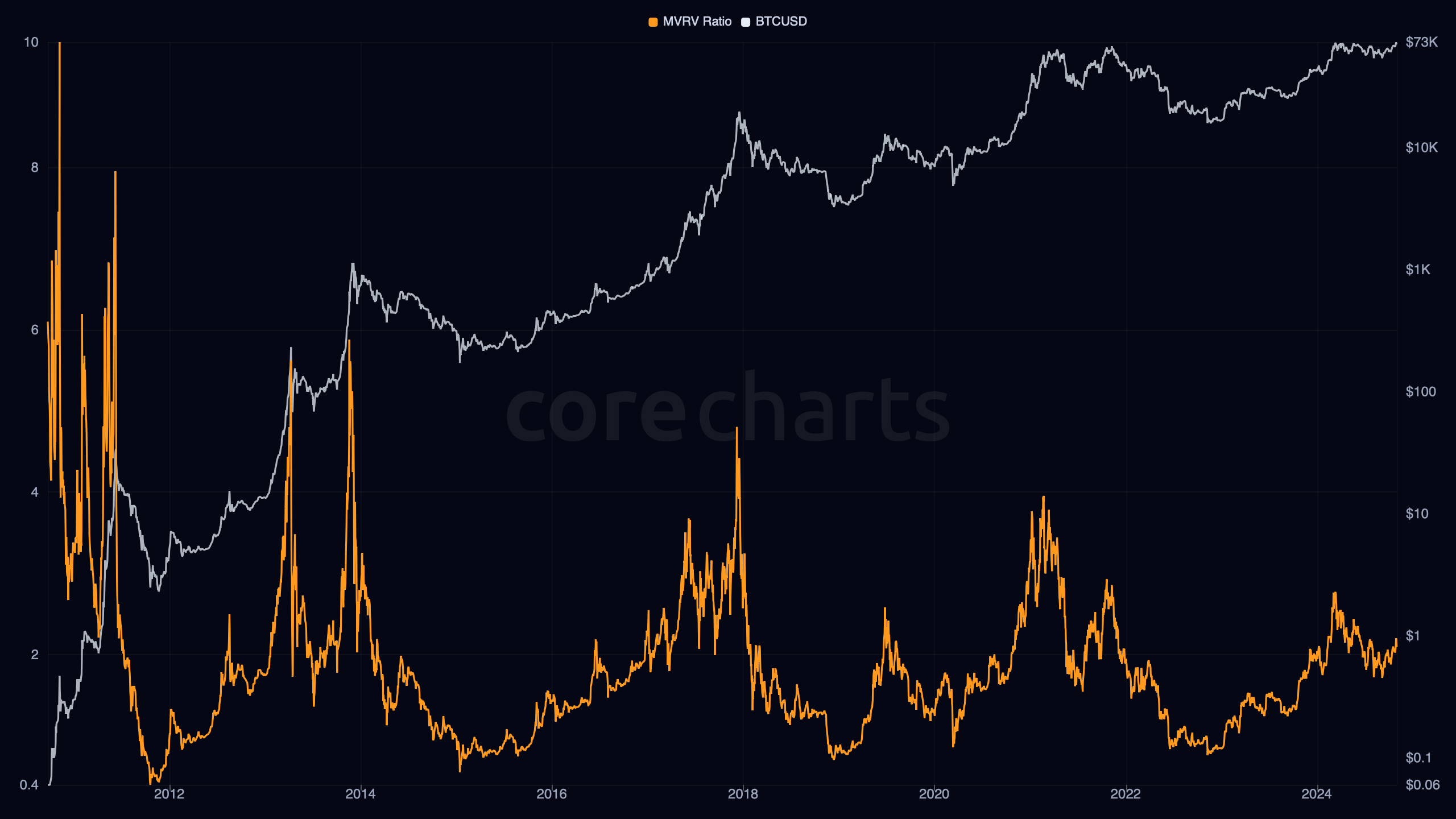
MVRV Ratio compares Bitcoin’s market value with its realized value.
Market Cap values the full circulating supply at the current market price. Realized Cap values each coin at the price when it last moved on-chain. The ratio therefore asks a direct question: how far has the market value of the network moved above or below the aggregate cost basis embedded in the UTXO set.
A reading above 1.0 means the network is, in aggregate, in unrealized profit. A reading below 1.0 means aggregate unrealized loss.
Reading the series
MVRV Ratio is a valuation spread, not a momentum oscillator. It is most informative when the market moves far enough away from the network’s realized cost basis to signal stress or euphoria.
High readings usually appear in late bull phases, when spot price has advanced much faster than realized value. Low readings tend to cluster around deep drawdowns, forced selling, and long accumulation periods. The middle range is less dramatic. It often marks transitions, consolidation, or the early stages of a new trend.
The ratio also helps separate price appreciation driven by durable repricing from price moves that are running well ahead of on-chain cost basis. When MVRV rises because Realized Cap is also climbing, the move is structurally healthier than a pure price spike with little change in realized value.
Market regimes and price behavior
MVRV Ratio does not forecast price in a mechanical sense, but it is useful for judging where price sits relative to the network’s embedded acquisition history.
Extended readings well above the long-term center usually coincide with overheated conditions. They do not mark exact tops, though they often show that upside is becoming more fragile. Readings near or below 1.0 have historically aligned with undervaluation zones, where downside tends to compress and long-horizon buyers re-enter.
A rising ratio during a broader uptrend usually confirms expanding unrealized profit. If price keeps rising while MVRV fails to extend, the market may be advancing on weaker internal support.
Relationship to other metrics
MVRV Ratio sits at the center of the broader MVRV family.
MVRV Z-Score expresses the same market-versus-realized gap in standardized form. MVRV Delta converts the relationship into an absolute dollar spread rather than a ratio. The STH and LTH MVRV variants split the same logic by holding age, which helps identify whether excess profit is concentrated in newer or older supply.
Realized Price is the closest companion series. When spot trades near Realized Price, MVRV approaches 1.0. NUPL uses the same Market Cap and Realized Cap pair, but expresses the gap as a share of Market Cap rather than a multiple.
Historical note
MVRV was introduced by Murad Mahmudov and David Puell in 2018 as a way to compare Bitcoin’s market valuation with the realized value of the coin supply. Since then it has become one of the standard valuation tools in on-chain research.