Bitcoin HODL Waves, BTC
What This Version Adds
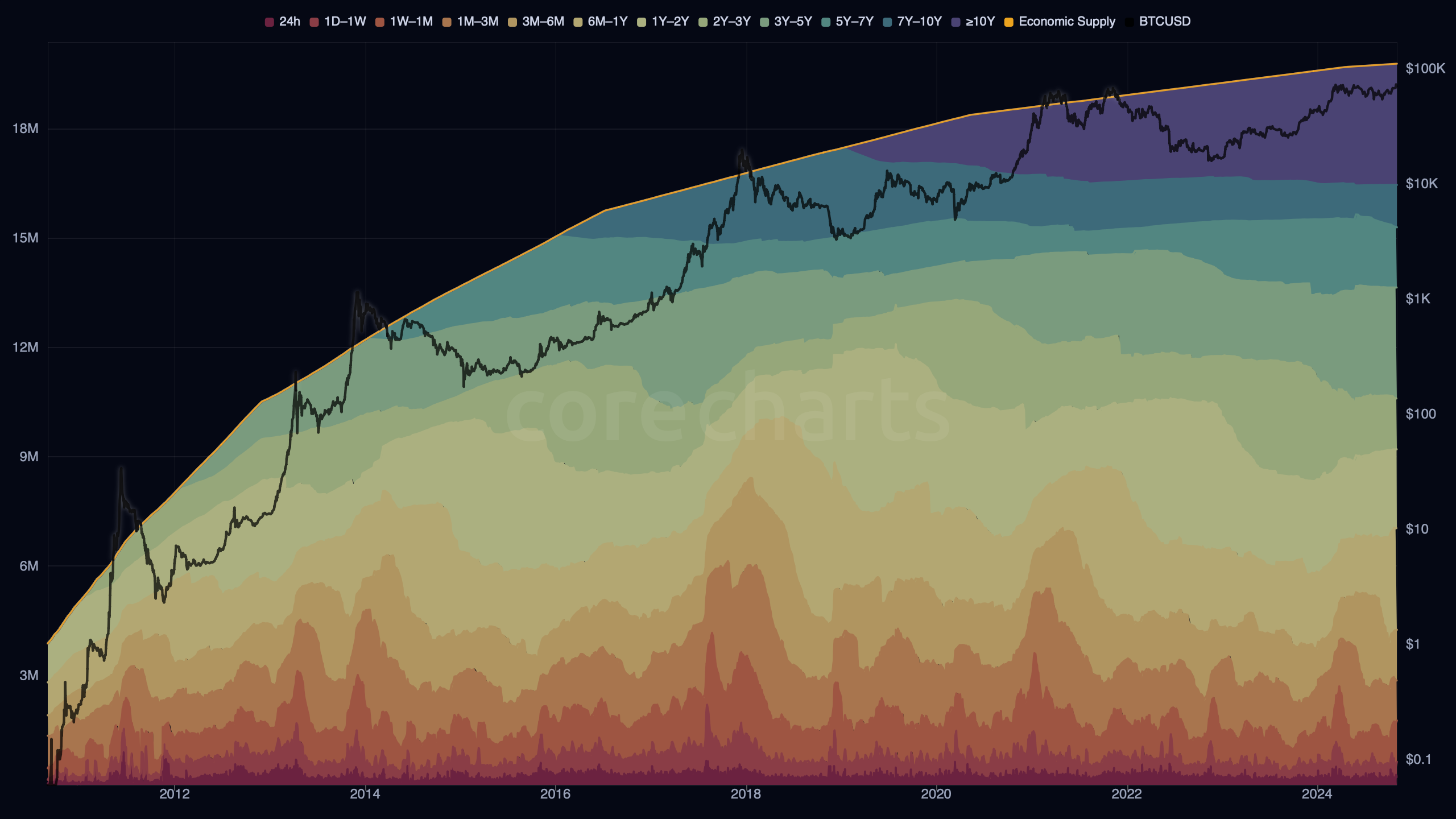
Bitcoin HODL Waves, BTC use the same age buckets as the standard HODL Waves chart, but change the unit from share of supply to BTC held in each band.
The standard chart answers:
What percentage of supply sits in each age band?
This chart answers:
How many BTC sit in each age band?
The age structure is unchanged. The difference is that this version removes the percentage normalization and shows the underlying coin inventory directly.
Why The BTC Version Matters
The percentage view is best for reading composition. The BTC view is best for reading scale.
A percentage band can rise because another band shrank faster. In that case, the mix changed, but the actual amount of BTC in the band may have changed only slightly. The BTC version removes that ambiguity.
This makes it more useful for questions such as:
- How many BTC currently sit in the 1y–2y band?
- Is the 3m–6m cohort actually growing, or only taking a larger share of the total?
- How much old supply has remained dormant in absolute terms?
How To Use It
Use the BTC version when the analytical focus is on inventory.
Build-up of dormant supply
When older bands rise in BTC terms, more actual coin volume has aged into those cohorts. That gives a clearer read on long-term holder persistence than a percentage move alone.
Release of old supply
When an old band falls in BTC terms, coins from that cohort have left dormancy and reset into younger age bands. In macro analysis, that is often more important than a simple decline in percentage share.
Medium-term holder inventory
The middle cohorts, especially 1m–3m, 3m–6m, and 6m–1y, often expand and contract with market participation cycles. In BTC terms, they show how much coin inventory is sitting with medium-duration holders rather than older dormant supply.
What It Can Say About Market Structure
The BTC version is particularly useful when you want to judge whether a supply shift is small, broad, or materially large in coin terms.
A rising old-age band in percentage terms may or may not matter much. A rising old-age band in BTC terms tells you that a larger stock of supply is now sitting inactive in that cohort.
A falling old-age band in BTC terms tells you that dormant inventory has actually re-entered circulation.
Historical Background
This chart is an absolute-BTC version of the HODL Waves framework. The classic HODL Waves view is usually shown as a 100% stacked age distribution because that makes structural shifts easy to read. The BTC version keeps the same age logic but removes the normalization.
Used together, the two views answer different questions:
- HODL Waves — how supply is distributed
- HODL Waves, BTC — how large each age cohort actually is