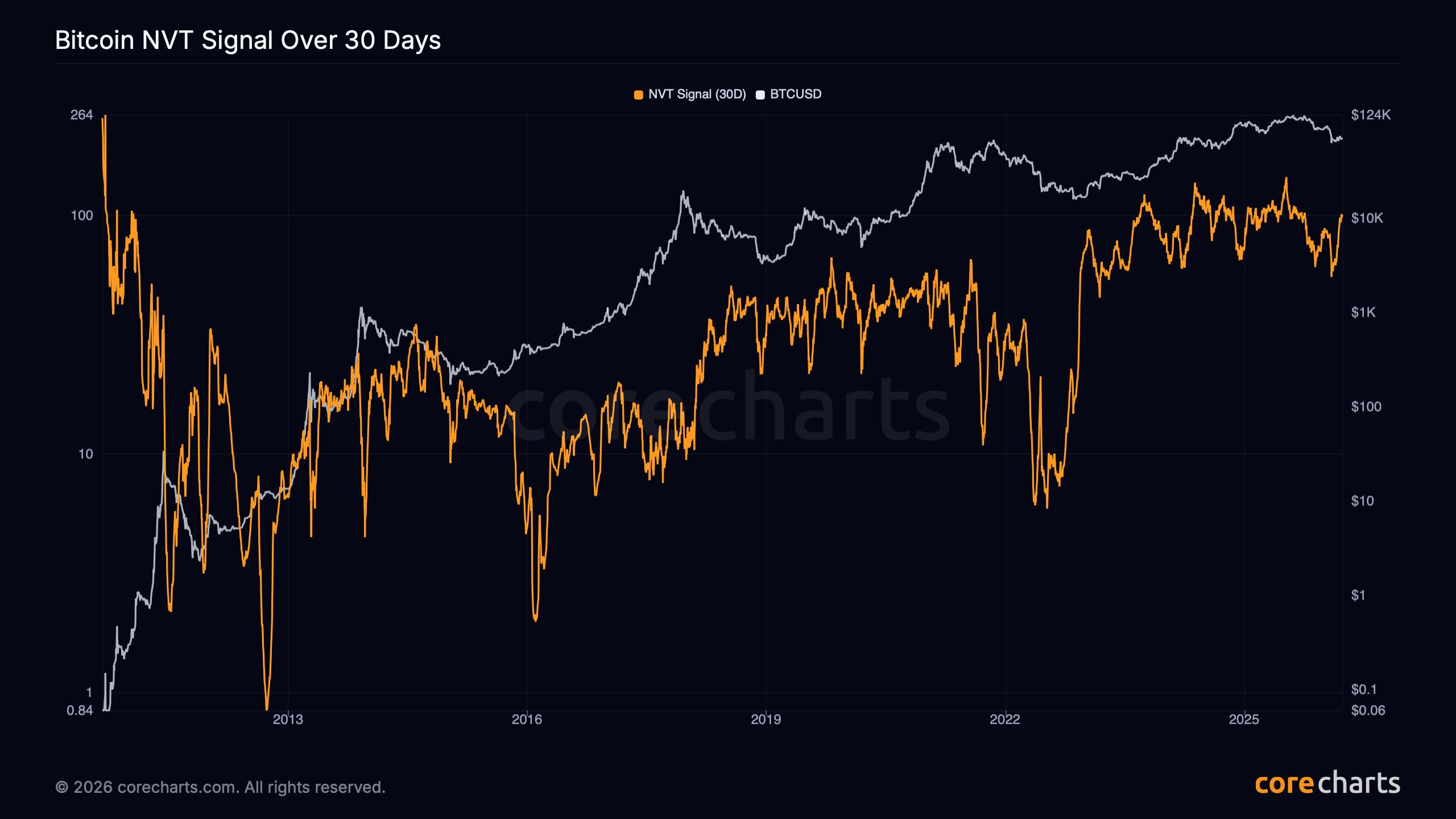
Bitcoin NVT Signal Over 30 Days
Definition
Bitcoin NVT Signal 30 compares Market Cap with the 30-day average of adjusted transfer volume.
The numerator is current market value. The denominator is not today's adjusted transfer flow, but its 30-day mean. That short rolling window reduces day-to-day noise while preserving sensitivity to recent shifts in on-chain demand.
Among the standard NVT Signal windows, this is the fastest version. It reacts sooner when transfer conditions change.
Interpretation
A rising NVT Signal 30 means market value is expanding faster than recent adjusted transfer activity. A falling reading means adjusted transfer flow is improving relative to market cap, or price is cooling.
Because the averaging window is short, this version responds quickly to regime shifts. It can turn earlier near local overheating and earlier in recovery phases. The trade-off is higher sensitivity to temporary fluctuations.
That speed makes the metric well suited to intermediate cycle analysis. It is less noisy than raw NVT Ratio, yet still responsive enough to catch shifts that a 60-day or 90-day signal may absorb more slowly.
Market use
NVT Signal 30 works best as a fast valuation-pressure gauge. During aggressive advances, sharp expansion in the signal can show that price is outrunning adjusted settlement demand. In post-capitulation recovery, contraction often suggests that network activity is rebuilding faster than valuation.
It can also help judge whether a breakout is being confirmed on-chain. If price rises but the 30-day signal remains contained or falls, transfer flow is keeping pace. A sharp spike during the same move suggests a more fragile advance.
This is the most reactive member of the NVT Signal family. It notices change first. It is also the easiest to overread during short-lived swings.
Relationship to other metrics
NVT Signal 60 and 90 use the same logic with longer smoothing windows. They sacrifice speed for stability. NVT Ratio Adjusted uses today's adjusted transfer volume without a moving average, so it moves more sharply from one day to the next.
Velocity Adjusted carries the same denominator family but in inverse form. When adjusted velocity rises, NVT-style valuation pressure usually falls.
Historical note
NVT Signal became popular as analysts tried to smooth transaction-based valuation metrics and make them more cycle-readable. The 30-day version sits at the fast end of that spectrum. It is built for shorter regime turns, not for deep macro filtering.