Bitcoin Long-Term Holder Economic Supply Share
What It Measures
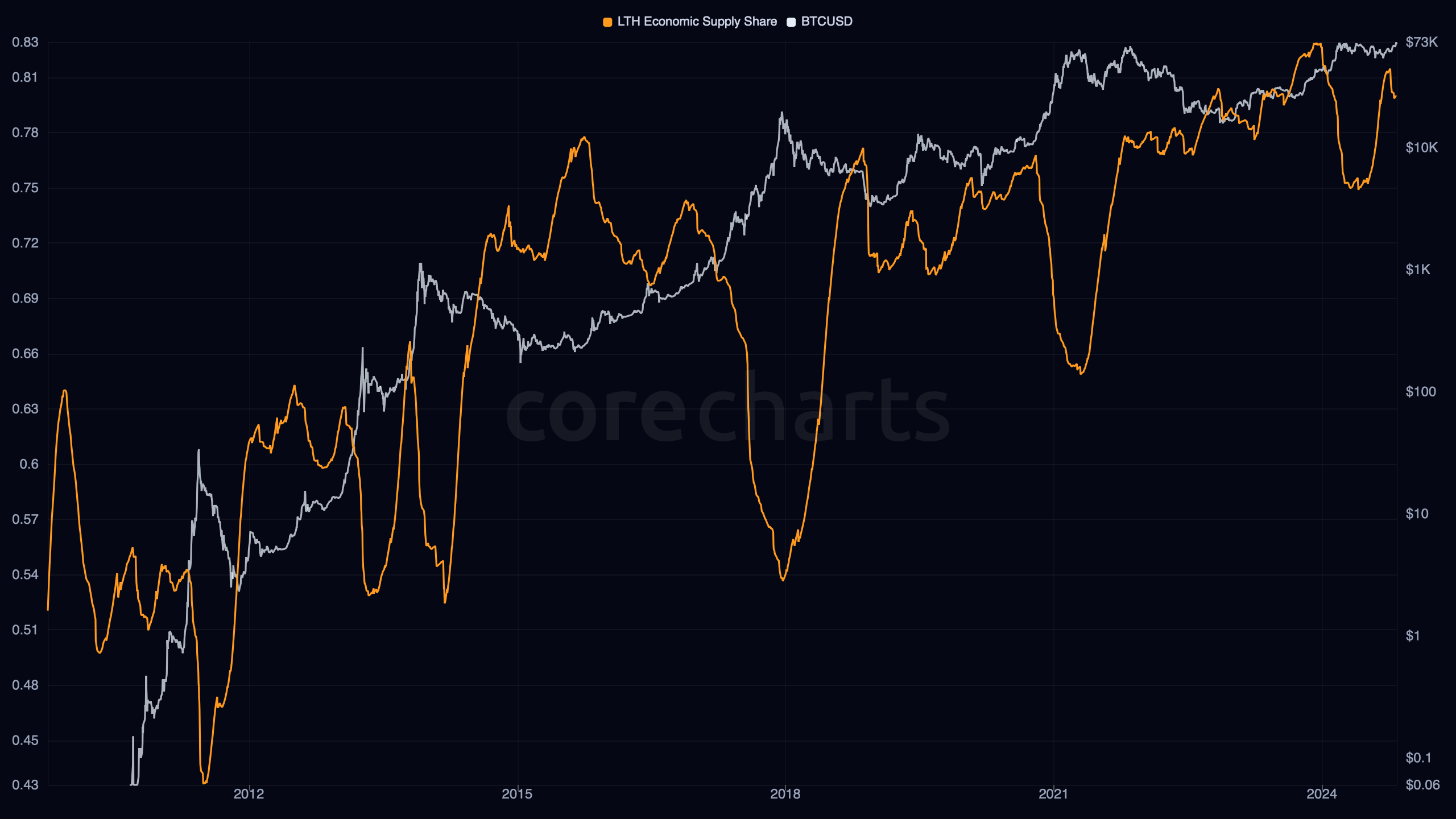
Bitcoin Long-Term Holder Economic Supply Share shows what percentage of Bitcoin’s economic supply is currently held by long-term holders.
It answers the complementary compositional question:
What share of the economic supply base is currently in older-holder hands?
In simplified form:
This is the share version of the absolute LTH supply series.
That means:
- LTH Economic Supply shows absolute older-holder inventory in sats;
- LTH Economic Supply Share shows how large that inventory is relative to the full economic supply base.
How To Use It
This metric is useful when the focus is on the balance of held supply, not on raw BTC quantity.
It helps answer questions such as:
- Is older-held supply becoming a larger or smaller share of the total?
- Is the economic supply base becoming more mature?
- Has the market shifted toward persistent holding rather than recent turnover?
A rising LTH share means long-term holders make up a larger fraction of the economic supply base. A falling share means their relative footprint is shrinking.
This metric is especially useful next to:
- STH Economic Supply Share
- LTH Economic Supply
- Economic Supply Spread: Short-Term vs Long-Term Holders
What It Can Say About Price And Market Regime
LTH share is one of the clearest regime markers in the holder-age family.
Rising LTH share
When the LTH share rises, more of the economic supply base is sitting with older holders. That usually points to supply maturation and stronger persistence in holding behavior.
Falling LTH share
When the LTH share falls, older-held inventory is becoming a smaller part of the total. That usually means mature supply has been spent and reset into newer cohorts.
Why the share version matters
The share chart is the cleanest way to see whether older supply is becoming more or less dominant inside the total economic supply base. It expresses the balance of holder structure directly.
Historical Background
The LTH share series emerged naturally from the broader STH/LTH framework. Once the supply base was split into recent and older holders, the absolute inventory view and the percentage-balance view became complementary ways of reading the same underlying structure.