Bitcoin Thermo Cap
What It Measures
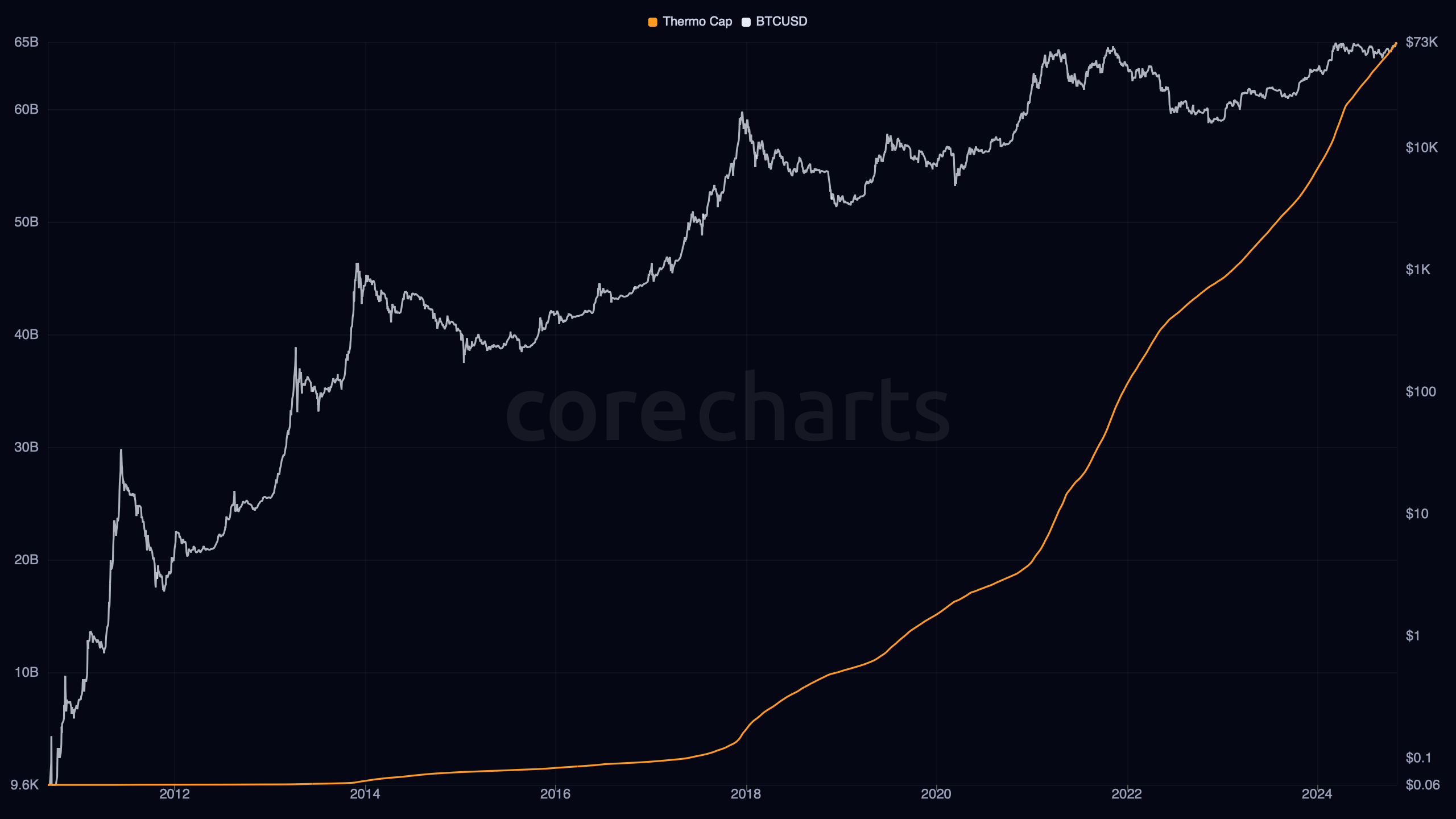
Bitcoin Thermo Cap is the cumulative USD value of all block subsidies paid to miners across Bitcoin’s history.
It answers a specific monetary question:
How much value, in dollar terms, has the protocol paid miners through issuance over the full life of the network?
In CoreCharts, Thermo Cap is built as a running total of daily issuance translated into USD at the market price of each day. The logic is:
This metric includes the issuance side of miner compensation. It does not include transaction fees.
That distinction matters. Thermo Cap is not a measure of current miner revenue, and it is not a measure of Bitcoin’s current market value. It is a cumulative record of the historical dollar value of coins issued to miners by the protocol.
A rising Thermo Cap simply means more subsidy has been distributed through time. Since subsidy is paid every day, the series grows continuously, though its growth rate slows after each halving.
How To Use It
Thermo Cap is useful when the goal is to compare Bitcoin’s current market valuation with the historical value of coins paid to miners.
It helps answer questions such as:
- How large is Bitcoin’s market value relative to the cumulative dollar cost of issuance?
- Is the market trading far above or close to the historic value transferred to miners through subsidy?
- How does current market valuation compare with Bitcoin’s long-run issuance history?
On its own, Thermo Cap is a cumulative base series. In practice, it is most useful alongside:
- Market Cap
- Thermo Cap Multiple
- Miner Revenue
- Block Subsidy
Thermo Cap provides the historical benchmark. The Multiple built on top of it is usually the more active analytical tool.
What It Can Say About Price And Market Regime
Thermo Cap by itself is not a timing oscillator. Its main value is contextual.
Long-run issuance benchmark
Because the series accumulates the dollar value of all past block subsidies, it acts as a reference line for how much economic value Bitcoin has historically transferred to miners through issuance.
That makes it useful for asking whether the market is pricing Bitcoin far above that historical issuance base or not much above it.
Slowing growth after halvings
Thermo Cap continues to rise after each halving, but more slowly than before, because the subsidy component declines. That means the benchmark itself becomes less steep over time, even if market value remains highly variable.
Why the metric matters
Thermo Cap is one of the few ways to frame Bitcoin’s valuation against the historical economic cost of issuance rather than against balance-sheet style accounting measures or purely market-based benchmarks.
It is best understood as a cumulative miner-issuance benchmark, not as a direct signal on its own.
Historical Background
Thermo Cap is associated with Willy Woo and became known as a long-horizon valuation framework built around the value historically paid to miners through subsidy. The intuition is straightforward: miners are the original sellers of newly issued supply, so the cumulative value of issuance provides a useful monetary reference point for Bitcoin’s long-run market capitalization.
That framing led naturally to the more widely used derivative metric, Thermo Cap Multiple.