Bitcoin Realized Capitalization in US Dollars
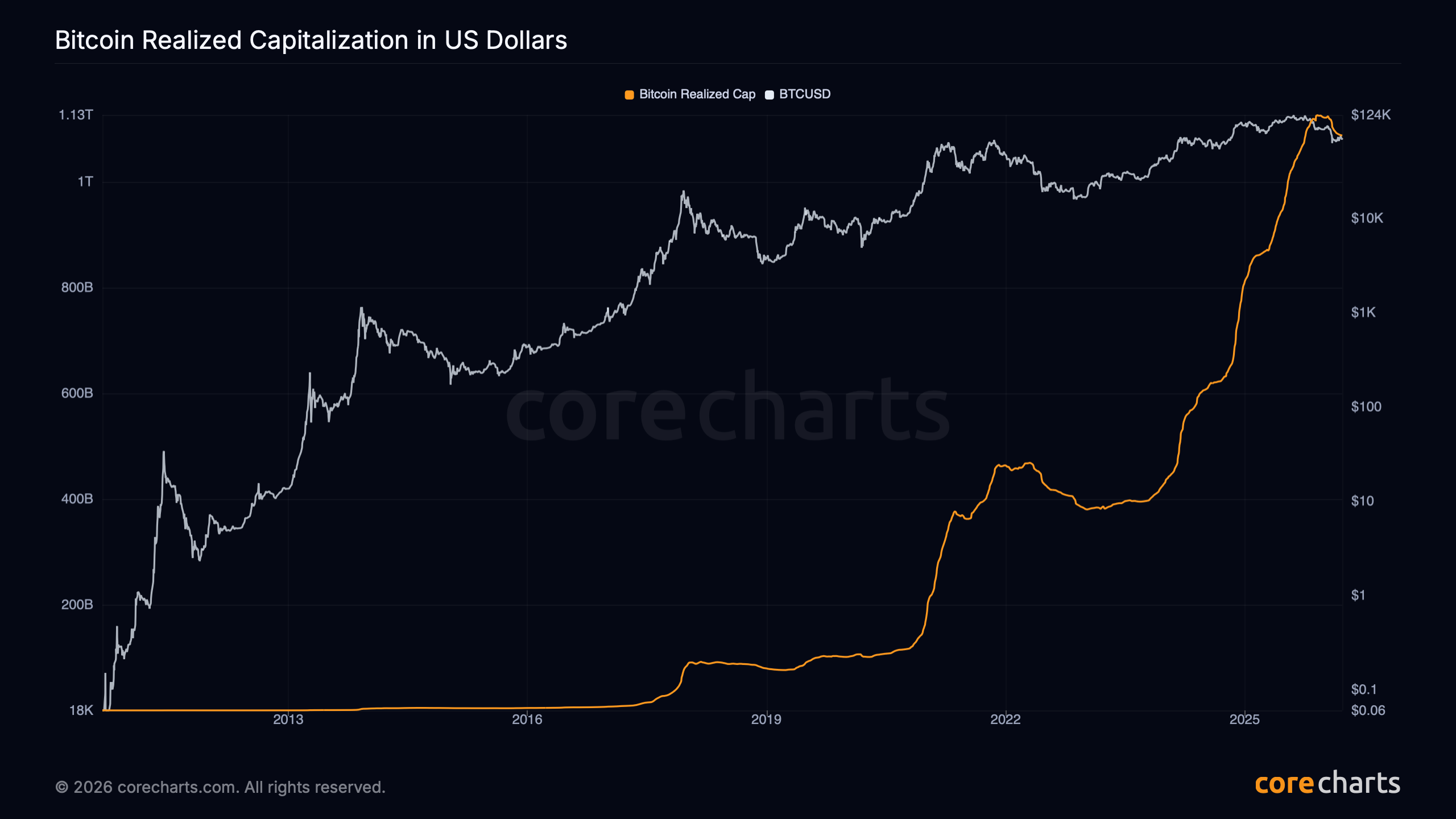
Bitcoin Realized Capitalization in US Dollars values each coin at the market price when it last moved on-chain, then sums that value across the current UTXO set.
In practical terms, Realized Cap is an aggregate on-chain cost basis.
A coin that last moved when BTC traded at $20,000 contributes less to Realized Cap than the same coin moving at $60,000. A coin that does not move keeps its prior valuation. Because of that, the series changes only when supply is repriced through actual on-chain transfer activity.
Interpretation
Realized Cap answers a different question from Market Cap. It asks: what is the dollar value of current supply at the prices where that supply last turned over?
That makes it much slower and more path-dependent than Market Cap. Strong inflow periods push it higher as coins are repriced upward. Deep bear markets can still raise Realized Cap if enough supply changes hands at lower but still meaningful prices. Large underwater resets often flatten it. Sharp declines are rare because the UTXO set is repriced transaction by transaction, not marked down wholesale at spot.
In regime work, Realized Cap is often read as a measure of capital stored in the network at historical acquisition prices. When it rises quickly, capital rotation is repricing the supply base. When it stalls, older cost bases dominate and less supply is being reset.
Relationship to Other Metrics
This is the anchor for Realized Price and for MVRV-style ratios.
Market Cap is a spot valuation. Realized Cap is a historical-cost valuation of the held supply. The spread between them reflects the aggregate distance between market value and on-chain cost basis.
Realized Price is simply Realized Cap divided by circulating supply. That turns this aggregate stock measure into a per-BTC reference level.
Limits
Realized Cap depends on on-chain movement. Coins that stay dormant for years keep an old valuation even if their economic owner has changed off-chain. Exchange internal accounting, custodial reshuffling, and consolidation can also reset cost basis mechanically without representing the same kind of market behavior as open-market transfer.
It is still one of the cleanest balance-sheet style metrics in Bitcoin, but it should be read as an on-chain repricing measure, not a perfect record of every investor’s actual entry price.
The concept is closely associated with Coin Metrics and later became standard across Bitcoin market analysis.