Bitcoin Active Addresses
Definition
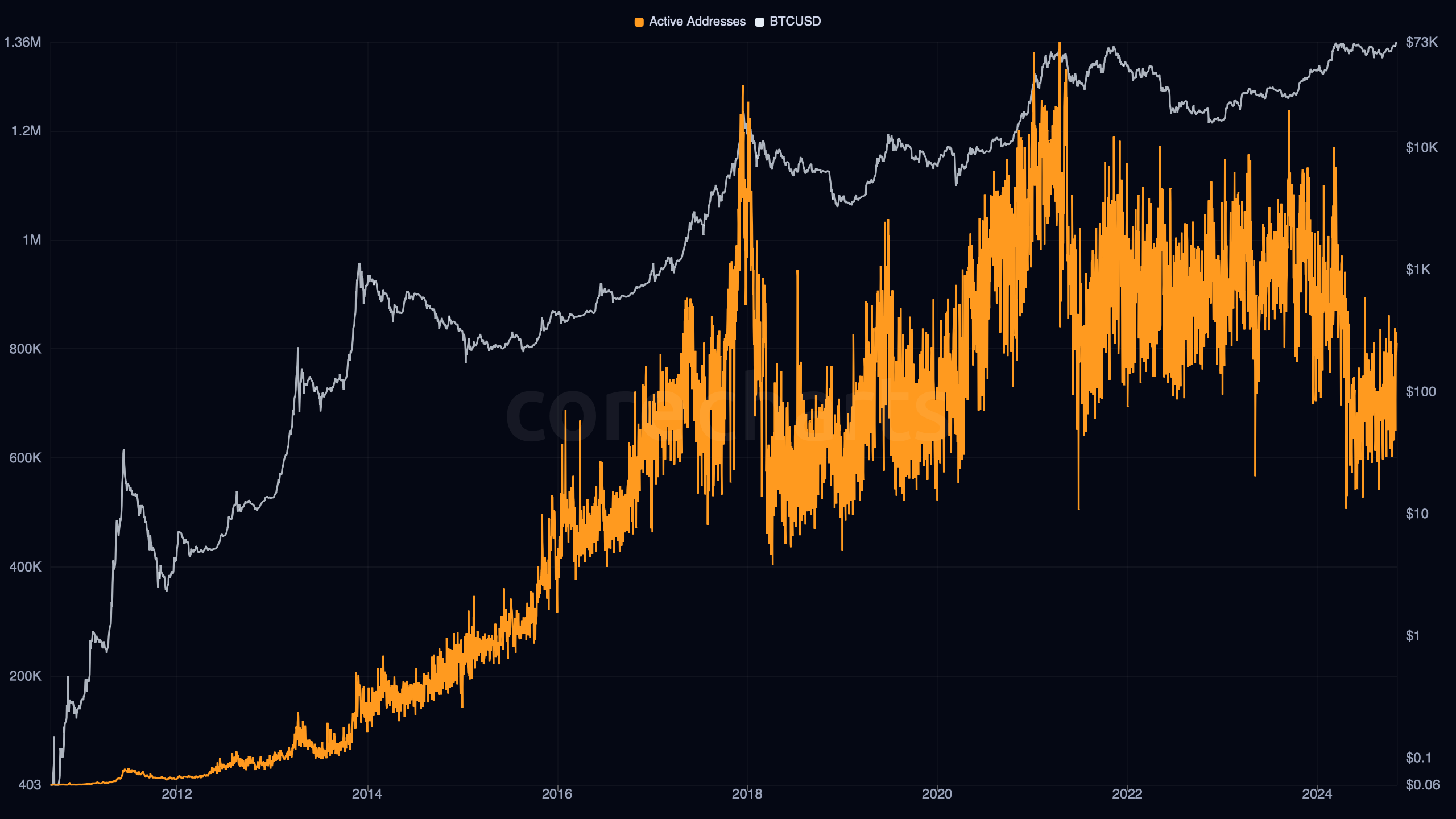
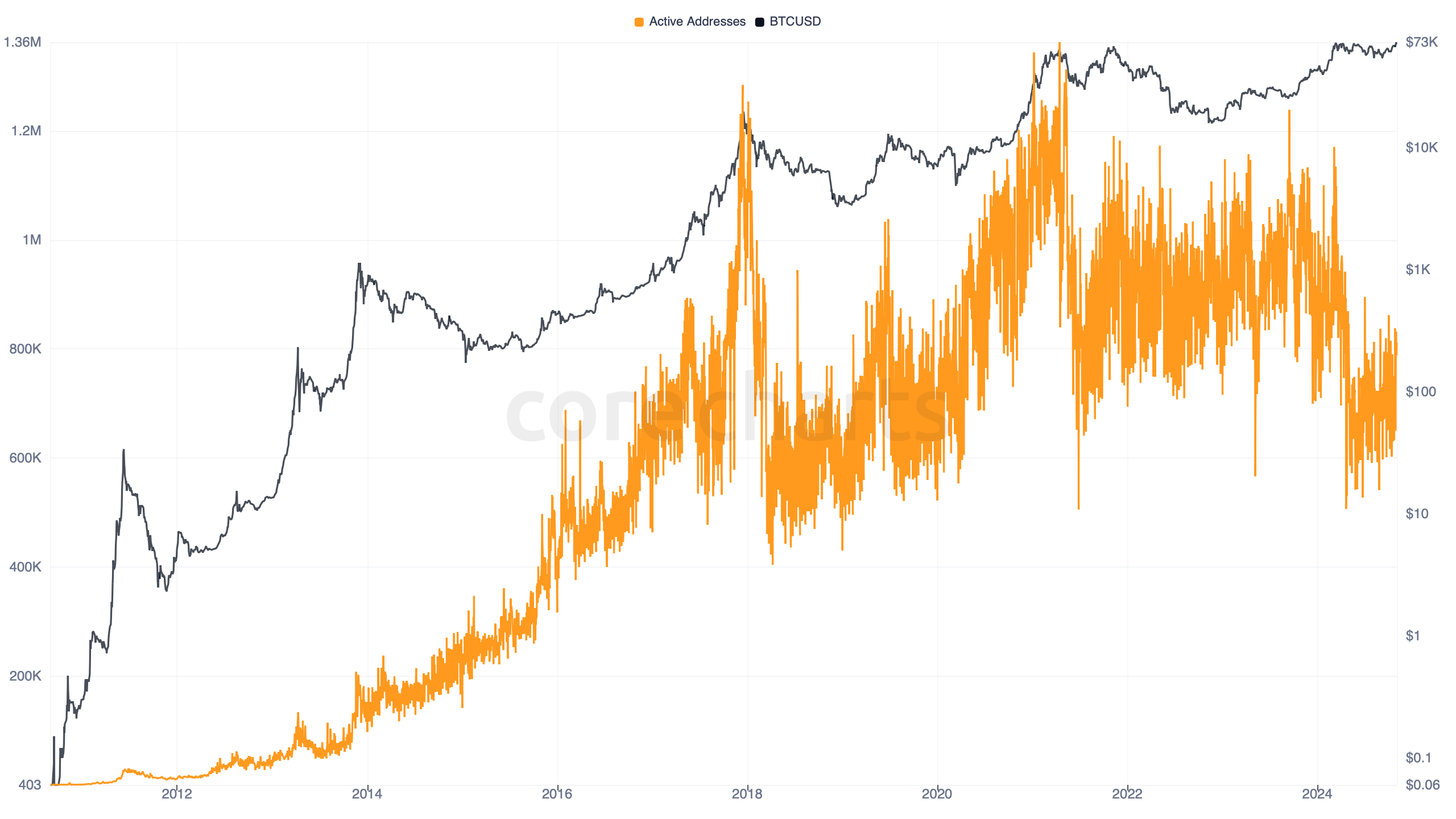
Bitcoin Active Addresses counts the unique addresses that participated in transactions during the day as either senders or receivers.
It answers the broadest participation question in this family: how many distinct addresses touched the transaction set today.
The metric is built as a union count. If an address appeared on both sides of transactions during the same day, it is still counted once. That makes the series a measure of overall on-chain reach rather than a simple sum of sender and receiver counts.
How to interpret it
A higher reading means the day’s transaction activity reached a broader address set. More distinct addresses took part somewhere in the flow of coins.
A lower reading means the address footprint was narrower. Coins may still have moved in meaningful size, but across fewer participating addresses.
This makes Active Addresses a breadth metric, not a value metric. It does not show turnover in BTC terms and it does not tell you whether activity came mostly from spending or from receiving. It compresses both sides into one participation count.
That makes it a good first read on network reach, but not the final one.
Address counts are not the same as user counts. One entity can control many addresses, and the union structure does not show whether breadth came from senders, receivers, or both.
Market behaviour and regime reading
Active Addresses is not a direct price model. It is better treated as a participation backdrop.
When the series rises with other activity measures, on-chain usage is spreading across a wider share of addresses. In stronger phases, that can accompany broader engagement, heavier transfer activity, or wider distribution of coins.
When it remains soft, transaction activity is reaching fewer distinct addresses. That can describe quieter conditions even if some other metrics remain elevated.
The signal becomes sharper when compared with its two companion series. Broad activity can come from many senders, many receivers, or both. Active Addresses alone does not separate those cases.
Relationship to the other address metrics
Sending Addresses measures spend-side breadth only.
Receiving Addresses measures destination breadth only.
Active Addresses sits above both as the union measure. It answers the widest participation question in the family, while the other two explain where that participation came from.
That hierarchy matters: - Sending Addresses focuses on spend-side involvement. - Receiving Addresses focuses on receive-side involvement. - Active Addresses captures the full address footprint of daily transaction activity.
Historical note
Active address counts became one of the standard participation measures in Bitcoin because they offered a broader alternative to transaction count. A single transaction can involve many addresses, while a large number of transactions can still come from a relatively narrow participant set. The active-address view made that difference visible.