Bitcoin Cumulative Supply Days
What It Measures
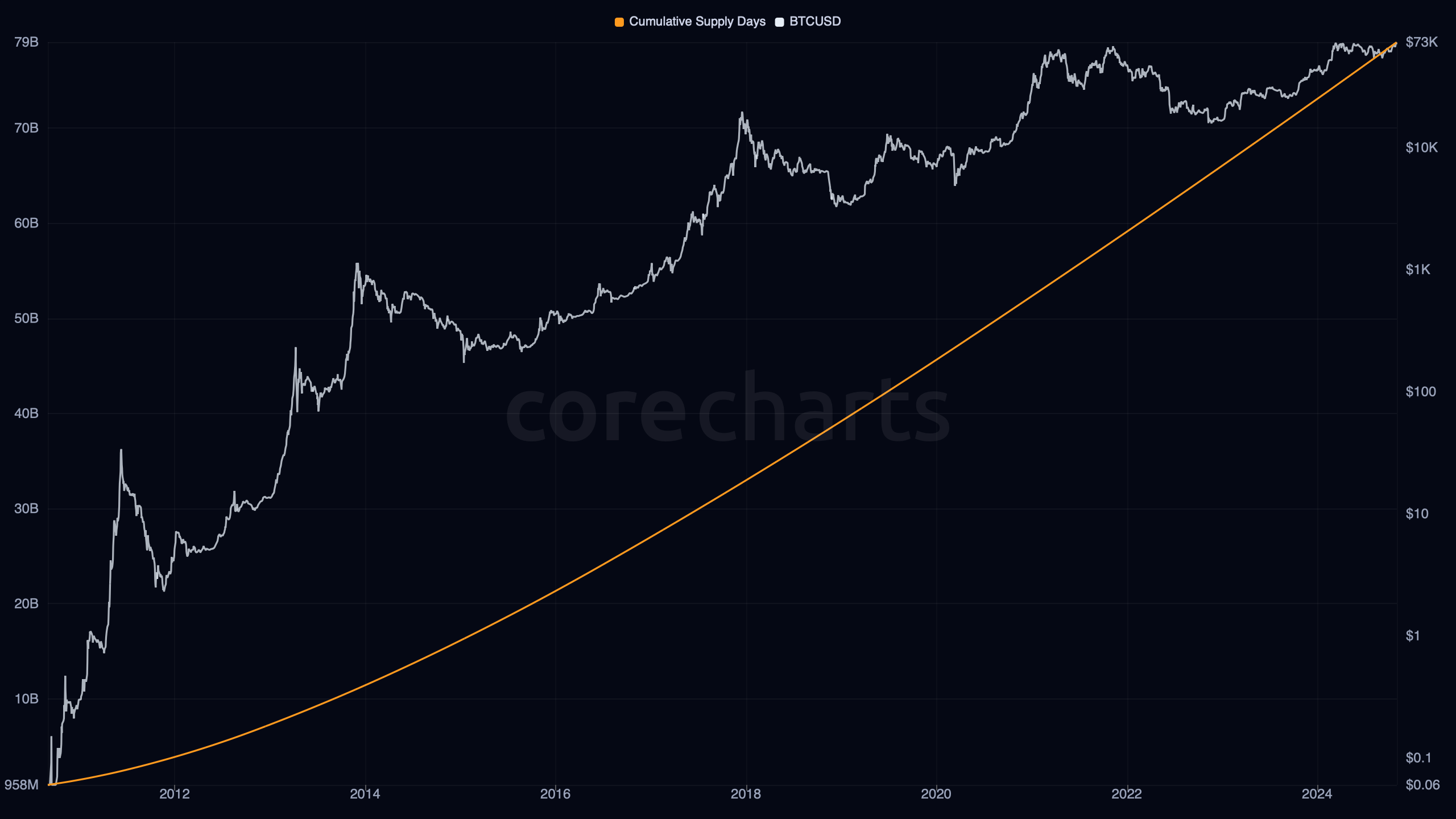
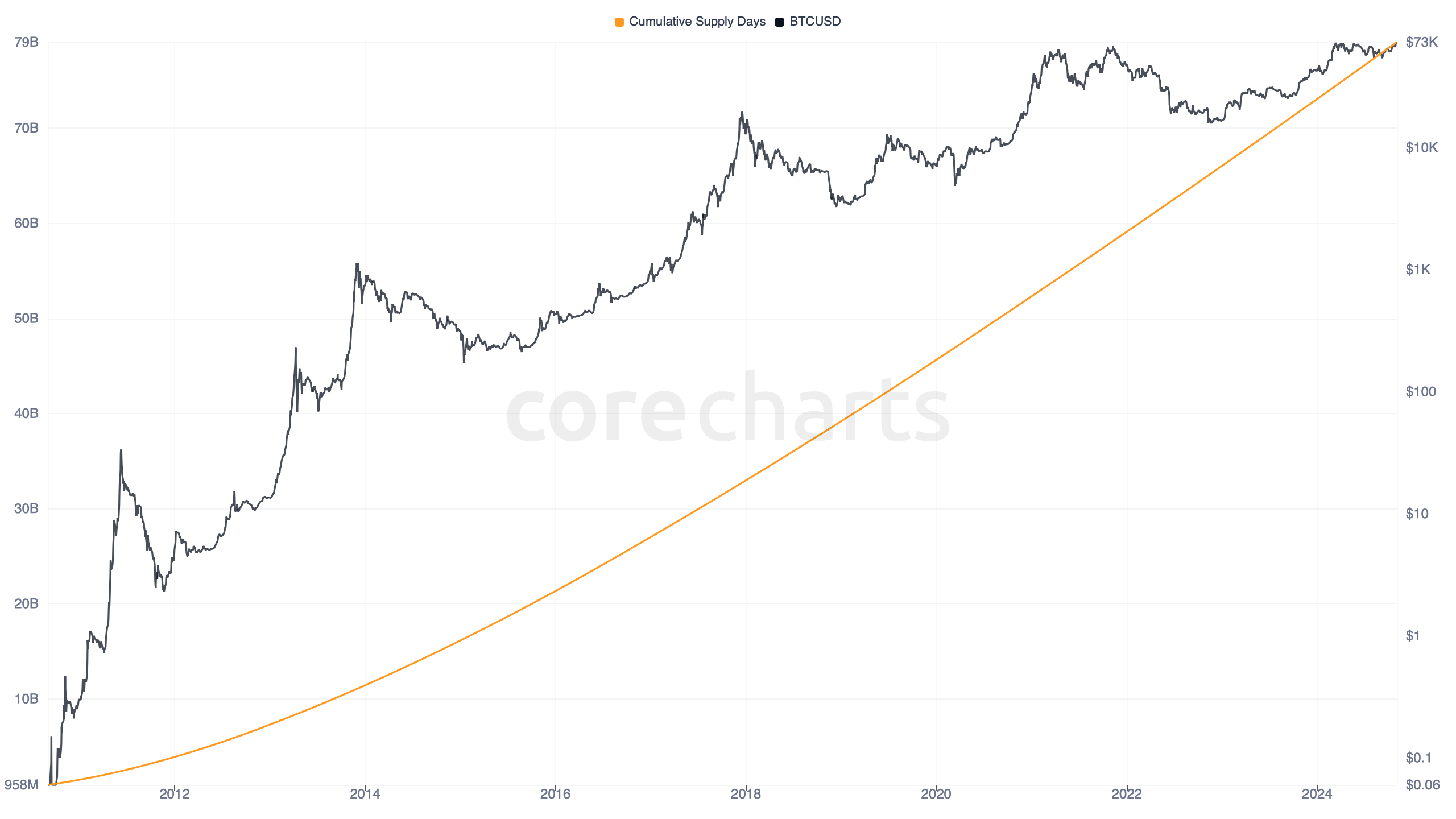
Bitcoin Cumulative Supply Days is the running total of supply-days accumulated by Bitcoin over time. It answers a simple structural question:
How many coin-days could the network have accumulated in total, given the supply that existed on each day?
For each day, the metric adds that day’s average circulating supply to the historical total. The logic is:
The unit is coin-days. One bitcoin held for one day contributes one coin-day. Ten bitcoin held for one day contribute ten coin-days.
This is not a behavioral metric. It does not tell you whether coins were active or dormant. It is the maximum stock of potential coin-age the network could have built up through time if nothing had ever been spent.
That is why this series matters mostly as the denominator for other age-based metrics, especially Liveliness.
How To Use It
On its own, Cumulative Supply Days is not a timing metric. It rises almost continuously as Bitcoin supply exists through time and as newly issued coins begin contributing coin-days.
Its main analytical use is as a reference stock of possible accumulated age.
That makes it useful for one specific purpose:
- comparing the coin-age that has been destroyed through spending with the total coin-age the network could have accumulated.
In practice, this metric is most useful when viewed together with:
- CDD
- Cumulative Coin Days Destroyed
- Liveliness
If Cumulative Supply Days is the total age that could have been stored, then Liveliness shows how much of that age has historically been destroyed by spending.
What It Can Say About Market Structure
By itself, the series does not forecast price or call market turns. It is too structural and too monotonic for that.
Its value comes from the framework it supports.
When used with Coin Days Destroyed, it helps distinguish between two very different states:
- a market where more supply-age is being preserved than destroyed;
- a market where historical dormancy is being spent away more aggressively.
That distinction becomes visible through Liveliness, not through Cumulative Supply Days alone.
So the practical interpretation is indirect:
- rising Cumulative Supply Days means the network continues building its stock of potential dormant age;
- when spending activity rises enough to destroy a larger share of that stored age, the change shows up in ratios built on top of this series.
Historical Background
The concept comes from the broader coin-age framework in Bitcoin analysis. Once analysts began using coin days destroyed to measure spent dormancy, the natural counterpart was the total stock of coin-days that the network could accumulate through time.
Cumulative Supply Days is that counterpart. It is not usually discussed as a standalone headline metric, but it is an important foundation for age-destruction metrics and for Liveliness, which was introduced by David Puell and Murad Mahmudov as a way to compare destroyed age with the age the network had available to accumulate.