Bitcoin Transfer Volume
What It Measures
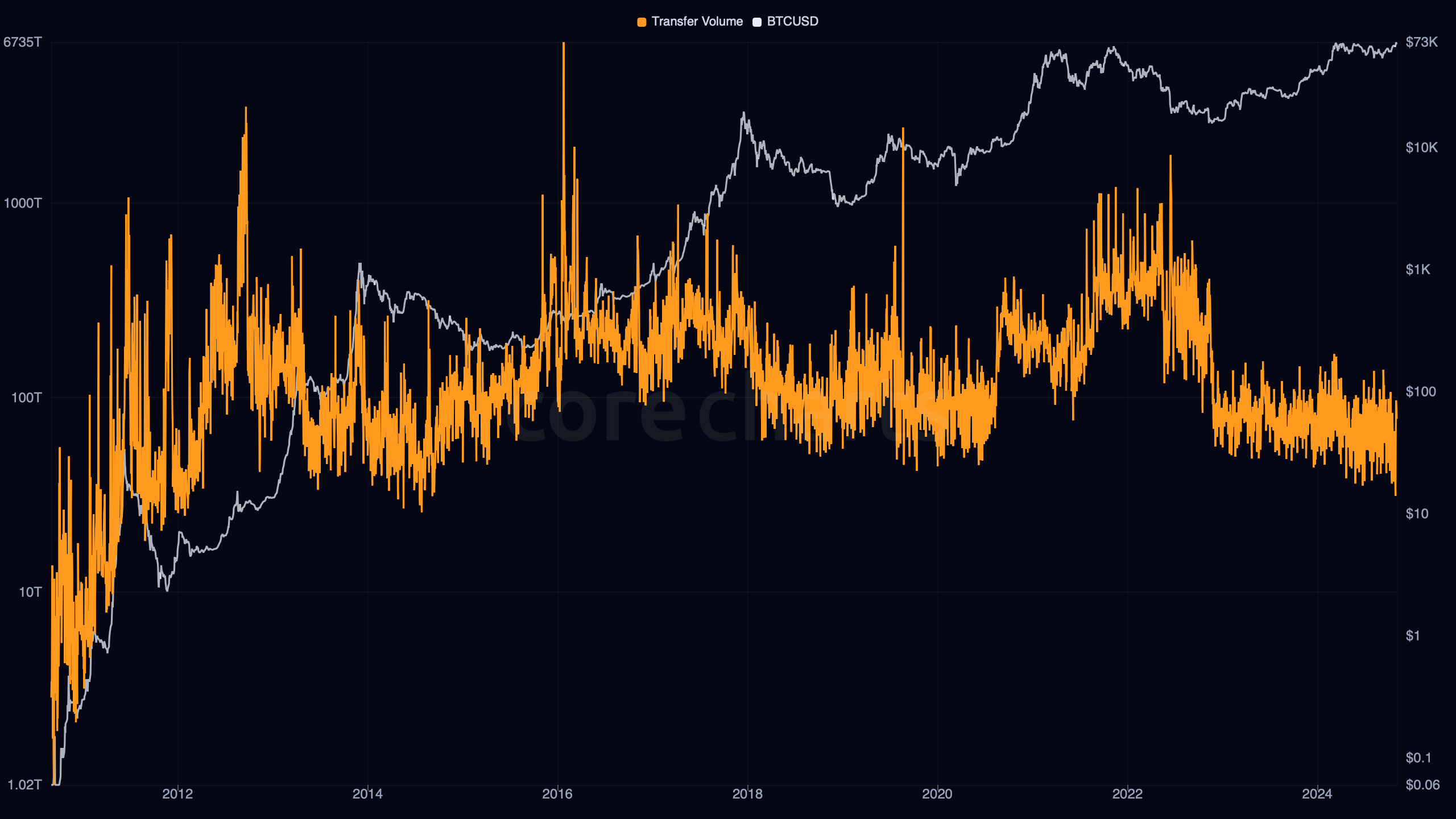
Bitcoin Transfer Volume shows the daily BTC volume represented by spent transaction inputs.
It answers a direct question:
How much BTC was actually consumed on the input side of transactions today?
In CoreCharts, this metric is built from spent inputs rather than outputs. That distinction matters. Output-side volume can be inflated by change outputs and by transaction structures that create more output value than the amount that economically changed hands. Input-side spent volume is a cleaner base for transfer-volume analysis because it starts from coins that were definitively spent.
In simplified form:
The result is shown in satoshis, and in USD-derived companion metrics when combined with price.
This is not a transaction count metric and not a payments-only metric. It is a monetary throughput metric based on spent inputs.
How To Use It
Transfer Volume is useful when the analytical goal is to measure how much BTC moved through the network in value terms, rather than how many transactions occurred.
That makes it helpful for questions such as:
- Is economic throughput expanding or contracting?
- Is the network moving large value even if transaction count is flat?
- Is market activity broadening in value terms?
A rise in Transfer Volume means more BTC was spent on the input side that day. A decline means less BTC was consumed by spending.
This metric is especially useful next to:
- Market Cap
- NVT
- Velocity
- CDD
- Dormancy
Transfer Volume tells you the value base. The other metrics tell you how meaningful or unusual that value flow was.
What It Can Say About Price And Market Regime
Transfer Volume becomes more informative when read against price and valuation metrics.
High price with weak transfer volume
If price rises while transfer volume remains subdued, the market cap is growing faster than the value moving through the chain. That often leads to richer NVT-style readings and can point to a market where valuation is running ahead of on-chain throughput.
Rising transfer volume during strong markets
If transfer volume expands with price, the market is seeing stronger on-chain value movement alongside rising valuation. That usually reflects broader participation or more active capital rotation.
Why this metric is not enough on its own
Transfer Volume measures throughput, not intent. It does not tell you whether the flow came from exchange activity, rebalancing, internal reshuffling, or outright distribution. It tells you that value was spent.
That is why it works best as the value base for derived metrics rather than as a standalone cycle signal.
Historical Background
Transfer-volume metrics have been part of Bitcoin analysis since the early years of on-chain research. Once analysts moved beyond simple transaction counts, the obvious next question was how much value the network was moving. Different providers and researchers have implemented different transfer-volume definitions over time, often differing in whether they start from outputs, inputs, or adjusted heuristics.
CoreCharts uses input-side spent volume for this base series because it gives a cleaner measure of spent value than raw output-side totals.