Bitcoin Median Spent Output Lifespan (MSOL)
What It Measures
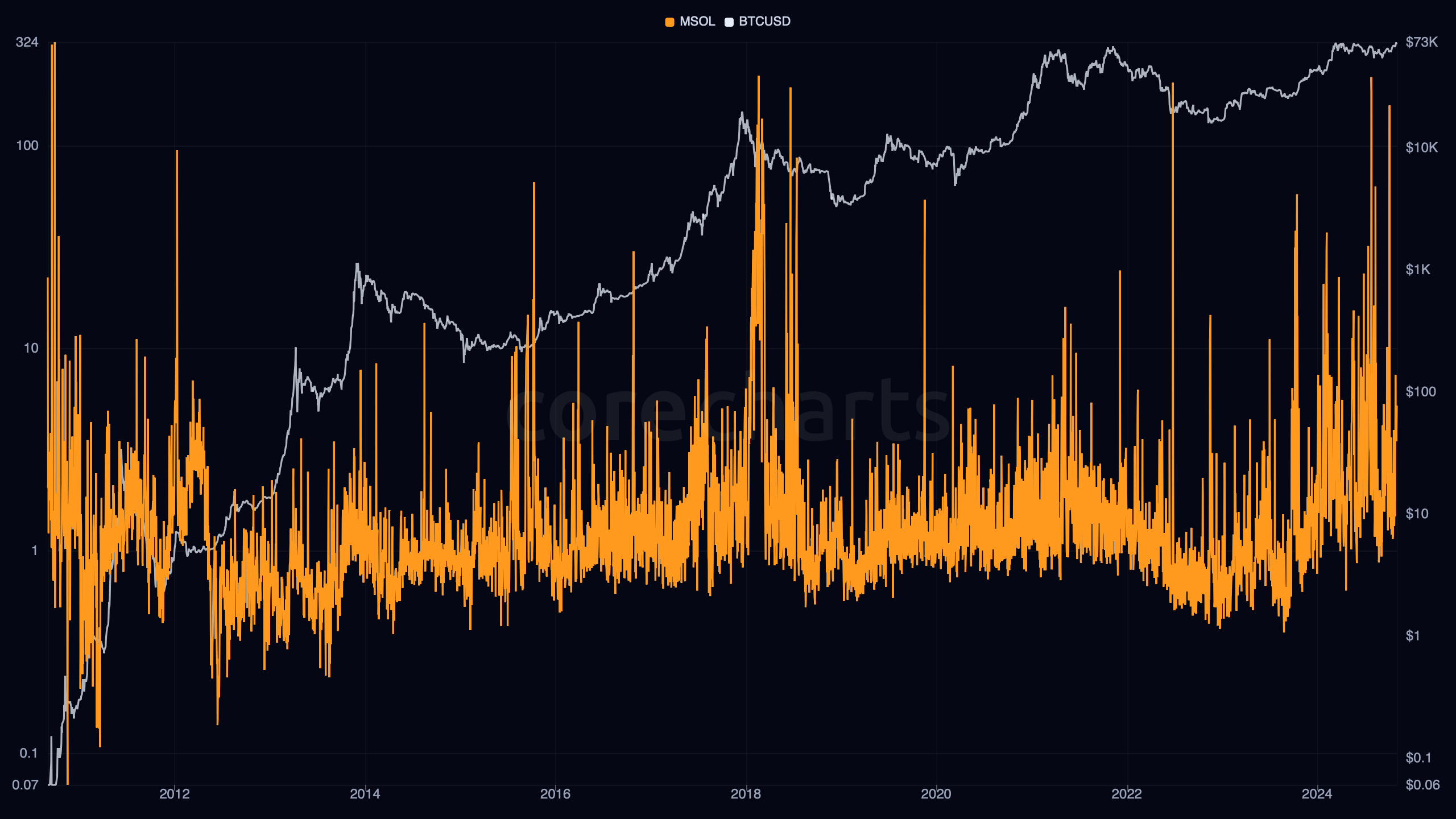
Bitcoin Median Spent Output Lifespan shows the median age of outputs spent on a given day.
It answers a different question from ASOL:
What was the midpoint age of the spent outputs today?
That means half of the spent outputs were younger than this value, and half were older.
In simplified form:
The result is shown in days.
Like ASOL, this is a spent-side age metric. It tracks the age of outputs that were actually spent on the day, not the age of coins still being held.
The key distinction is that MSOL uses the median, not the average. That makes it much less sensitive to a small number of very old spent outputs.
How To Use It
MSOL is useful when you want the typical spent-output age rather than the average spent-output age.
If MSOL stays low, then the middle of the spent distribution is still dominated by younger outputs, even if a few old coins were also spent.
If MSOL rises meaningfully, then old-coin participation is no longer confined to isolated outliers. It has moved into the center of the day’s spent-output distribution.
This is why MSOL is often the better companion to ASOL.
- ASOL tells you whether the average age was pulled higher.
- MSOL tells you whether the typical spent output also became older.
That distinction helps answer a very practical question:
Was old-coin spending broad, or was it driven by a relatively small number of very old outputs?
What It Can Say About Market Regime
MSOL is especially useful when judging whether older supply is participating in a broad way.
Routine turnover
When MSOL remains low, the typical spent output is still young. Even if ASOL rises on the same day, that combination often means the move was driven by a minority of old outputs rather than by broad old-coin release.
Broad participation from older supply
When MSOL rises together with ASOL, the interpretation is stronger. The spent distribution itself has shifted older. That usually means older supply is participating more broadly rather than through a few isolated transactions.
Distribution and cycle pressure
In overheated market phases, older holders often begin spending into strength. If that activity becomes broad enough, MSOL starts to move higher. That can be more informative than ASOL alone, because it shows the change is reaching the center of the spent-output set.
Why MSOL matters next to ASOL
MSOL is not “better” than ASOL. It answers a different question.
- If ASOL rises but MSOL stays muted, very old outputs influenced the average, but the typical spent output remained relatively young.
- If ASOL and MSOL both rise, the day’s spent-output profile became broadly older.
That is the cleanest way to separate isolated old-coin events from a wider shift in spending behavior.
Historical Background
Median spent-output lifespan is part of the same spent-age framework that produced ASOL and other coin-age measures. Once analysts began tracking the age of spent outputs, the need for a median measure became obvious: averages can be distorted by a small number of very old coins.
MSOL became useful precisely because it stabilizes that view and gives a cleaner read on the center of the spending distribution.