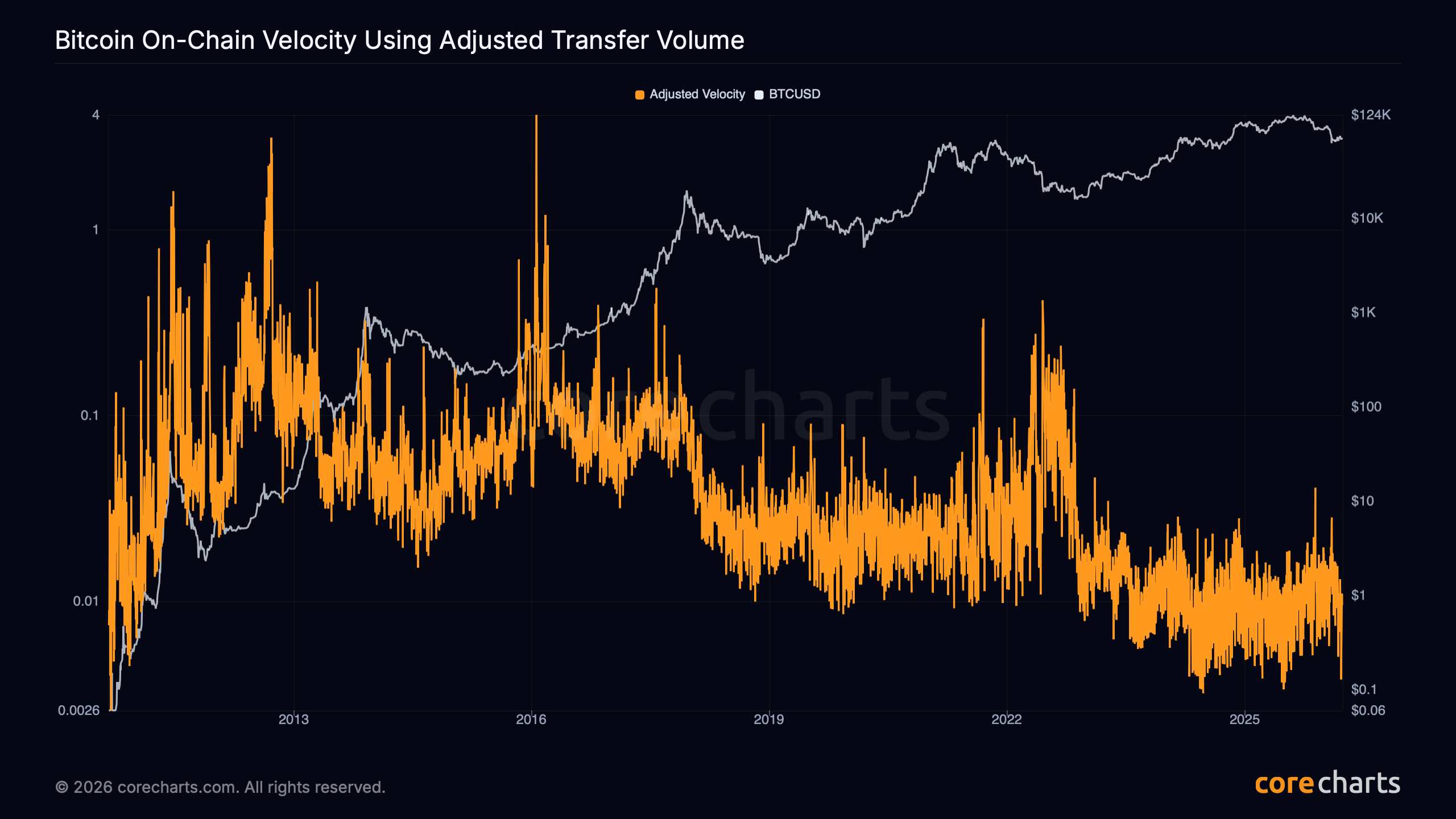
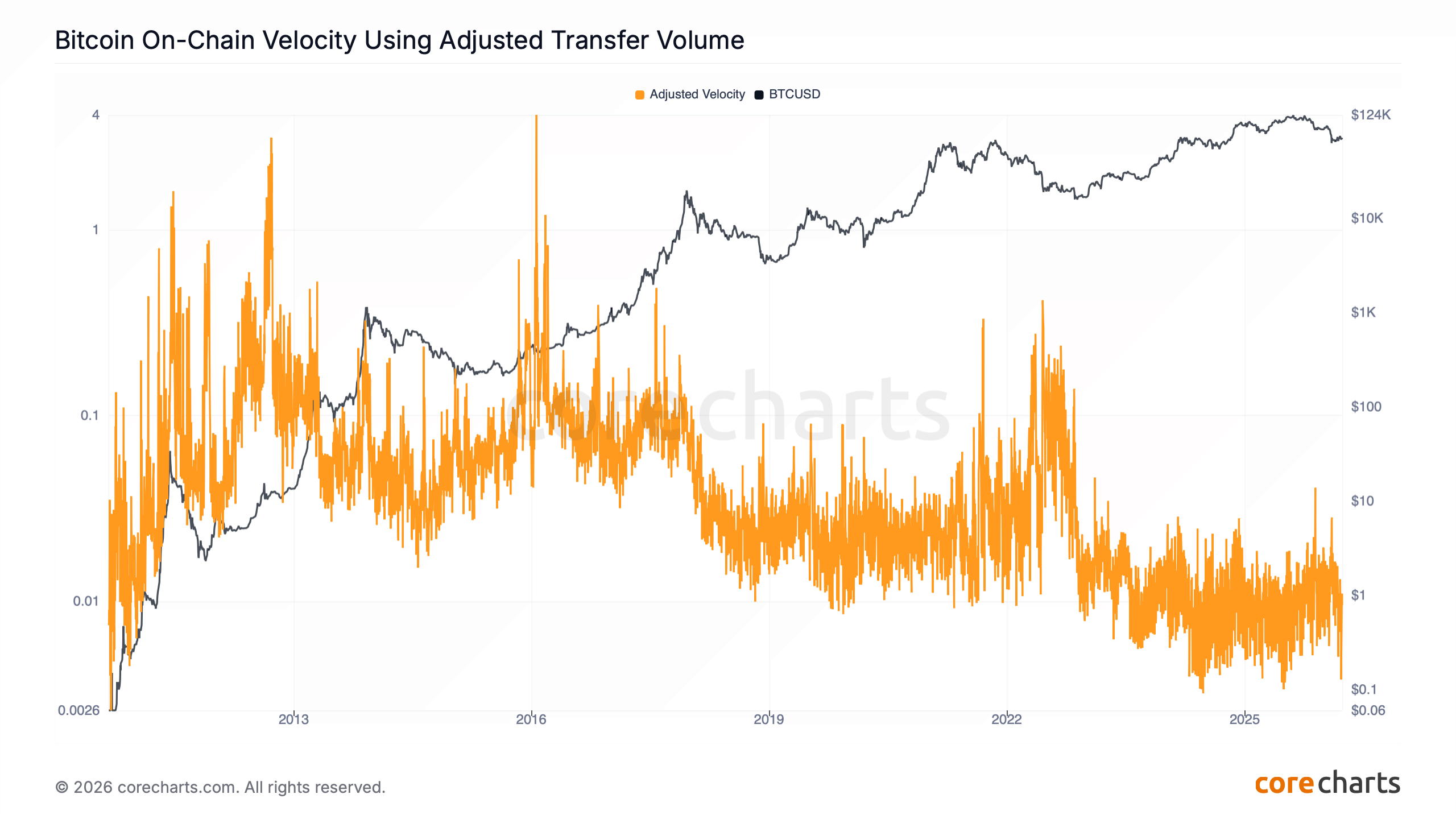
Bitcoin On-Chain Velocity Using Adjusted Transfer Volume
Definition
Bitcoin Adjusted Velocity measures adjusted transfer volume relative to Market Cap.
The difference from raw velocity lies in the numerator. CoreCharts uses an adjusted transfer estimate intended to reduce noise from flows that do not reflect clean economic settlement. The denominator remains Market Cap.
This version asks how much filtered on-chain value transfer the network is producing for its current valuation.
Interpretation
Raw velocity can be distorted by activity that inflates transfer counts without saying much about real demand. Adjusted velocity strips part of that noise away. As a result, it often gives a cleaner read on whether valuation is supported by economically meaningful throughput.
A rising adjusted velocity points to stronger transfer flow relative to market value. When the reading falls, valuation is typically outrunning filtered settlement activity.
Divergence from raw velocity can matter on its own. If raw velocity looks strong while adjusted velocity stays weak, a large share of the apparent activity may come from internal transfers or other non-economic flow.
Market use
Adjusted velocity is often most effective as a confirmation measure. During constructive phases, price can rise while adjusted velocity stays stable or improves. That usually points to healthier support from on-chain activity. When price expands and adjusted velocity drops sharply, valuation is getting ahead of transfer demand.
The series is also informative after large drawdowns. If market cap remains compressed while adjusted flow recovers, adjusted velocity will rise and the network may be rebuilding before price fully reflects it.
It is less jumpy than raw velocity in periods with operational churn. That usually makes it the better version for valuation work.
Relationship to other metrics
Velocity is the raw version of the same idea. NVT Ratio Adjusted is the inverse formulation using the same adjusted transfer denominator and Market Cap in the numerator.
NVT Signal 30, 60, and 90 also rely on adjusted transfer volume, but they smooth it before forming the ratio. Those signals are better for regime persistence. Adjusted velocity stays closer to current conditions.
Historical note
Adjusted velocity applies the same transfer filtering logic used across the NVT family, but expresses the result as throughput relative to valuation rather than the reverse.