Bitcoin Addresses with Net Inflow
What It Measures
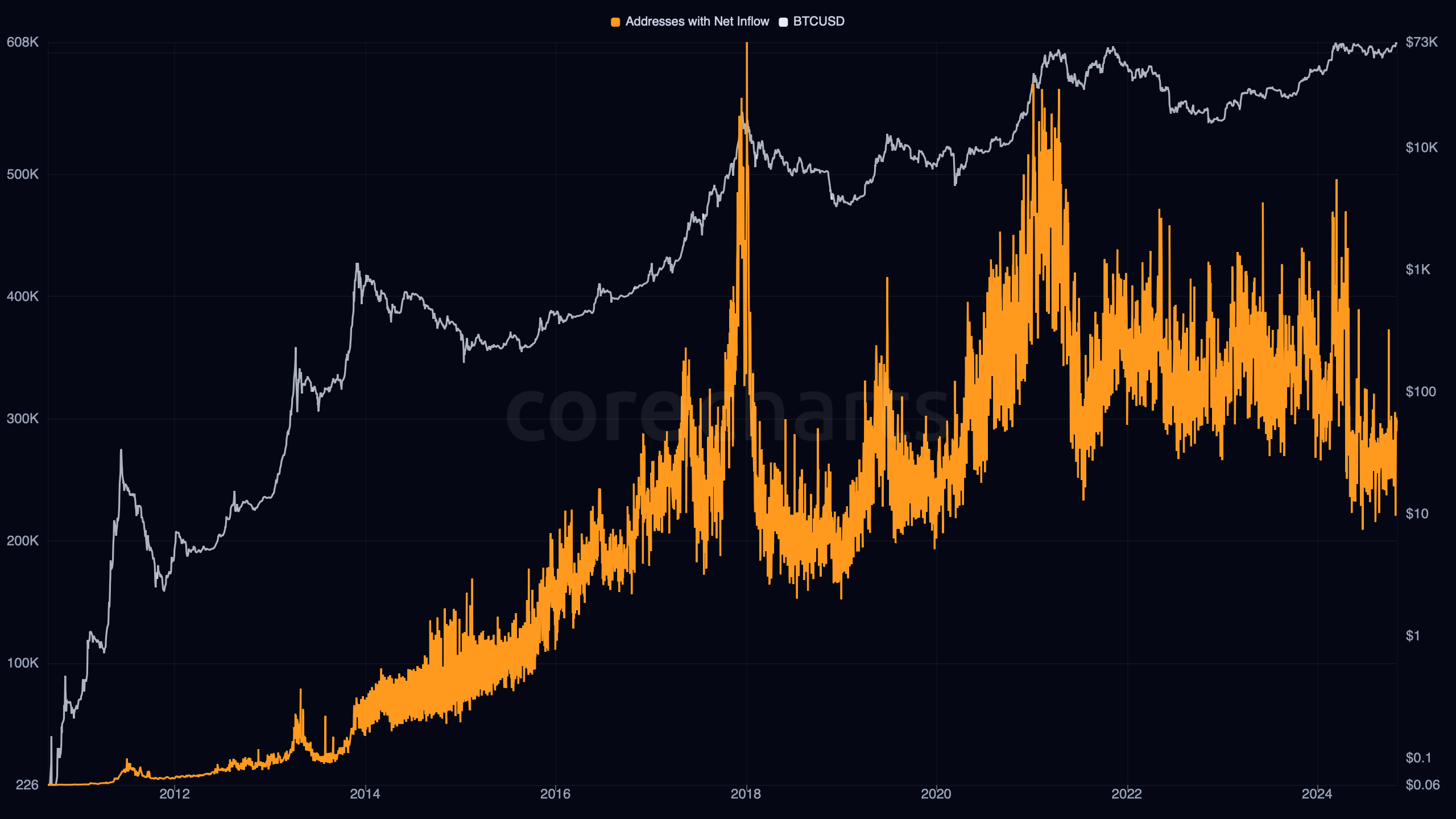
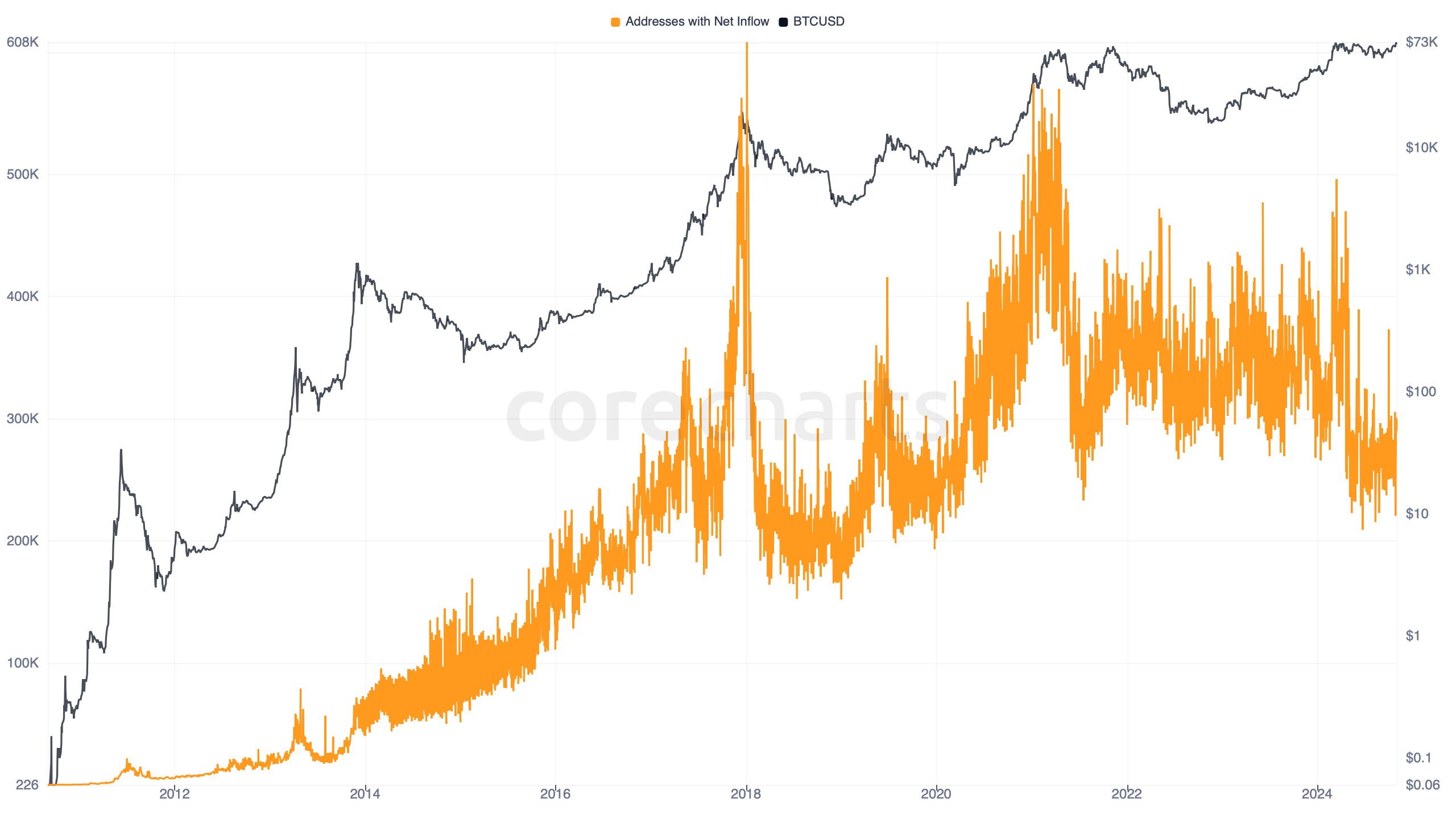
Bitcoin Addresses with Net Inflow counts addresses whose net balance change over the observed day was positive.
The metric is derived from daily address deltas. An address is counted only if it finished the period with more BTC than it started with.
In simplified form:
The unit is addresses.
This is not the same as counting all receiving addresses seen on transaction outputs. An address can receive coins during the day and still end flat or negative after offsetting spends. This series keeps only the addresses that closed the day with net inflow.
For closed historical rows, the period is the UTC day. The tail row is based on a rolling last-24-hour window.
How To Use It
This metric answers a direct question: how broad was positive balance change across addresses.
A higher reading means more addresses ended the day with net accumulation. A lower reading means positive balance change was narrower.
It is most informative when read next to Spending Addresses and Addresses with Balance Change. That comparison shows whether daily redistribution leaned more toward net receivers, toward net spenders, or remained balanced across both sides.
The metric can also be paired with transfer-value measures. A large amount of value can flow to a relatively small set of addresses. The opposite can also happen, with modest value distributed across a wide destination set.
Reading the Series
Broad positive balance change
When the series rises, more addresses are closing the period with added BTC. That usually indicates wider dispersion of net inflow across the address set.
In quieter phases, that can simply reflect a broader receiving footprint. During stronger activity, it can accompany wider balance redistribution.
Narrower accumulation footprint
When the reading falls, positive balance change is reaching fewer addresses. The network may still be active, but the set of addresses ending the day higher is smaller.
What the metric does not resolve
Net inflow by address is not the same as economic demand. It also does not identify new participants. Existing holders, internal wallet operations, or service-level address management can all contribute to the count.
Addresses are not entities. One service can generate many addresses and widen the series without the same widening in underlying ownership.
Relationship to Other Metrics
Spending Addresses captures the opposite side of the same daily net-change logic.
Addresses with Balance Change combines both positive and negative daily balance change into one non-zero total.
This metric is therefore best read as one half of a signed pair. On its own it shows breadth of net inflow. In family context it shows whether balance redistribution was tilted toward addresses ending the day higher.
Historical Background
Address metrics based on net inflow grew out of event-based balance accounting. Analysts needed a way to separate addresses that merely appeared on transaction outputs from addresses that actually finished the period with more BTC.
That distinction made the receive side more analytically precise, especially when same-day receiving and spending activity became common.