Bitcoin Addresses with Balance Change
What It Measures
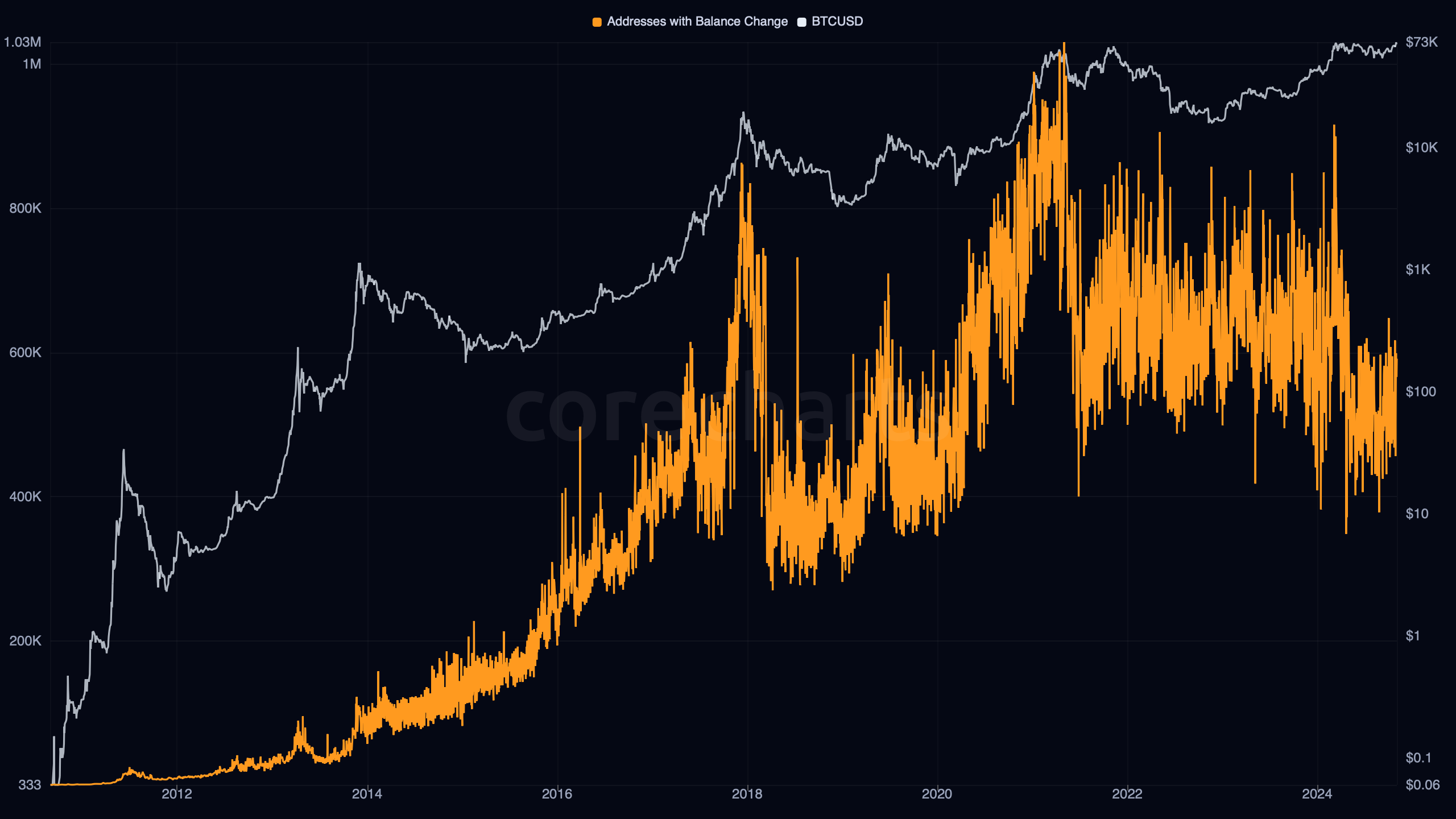
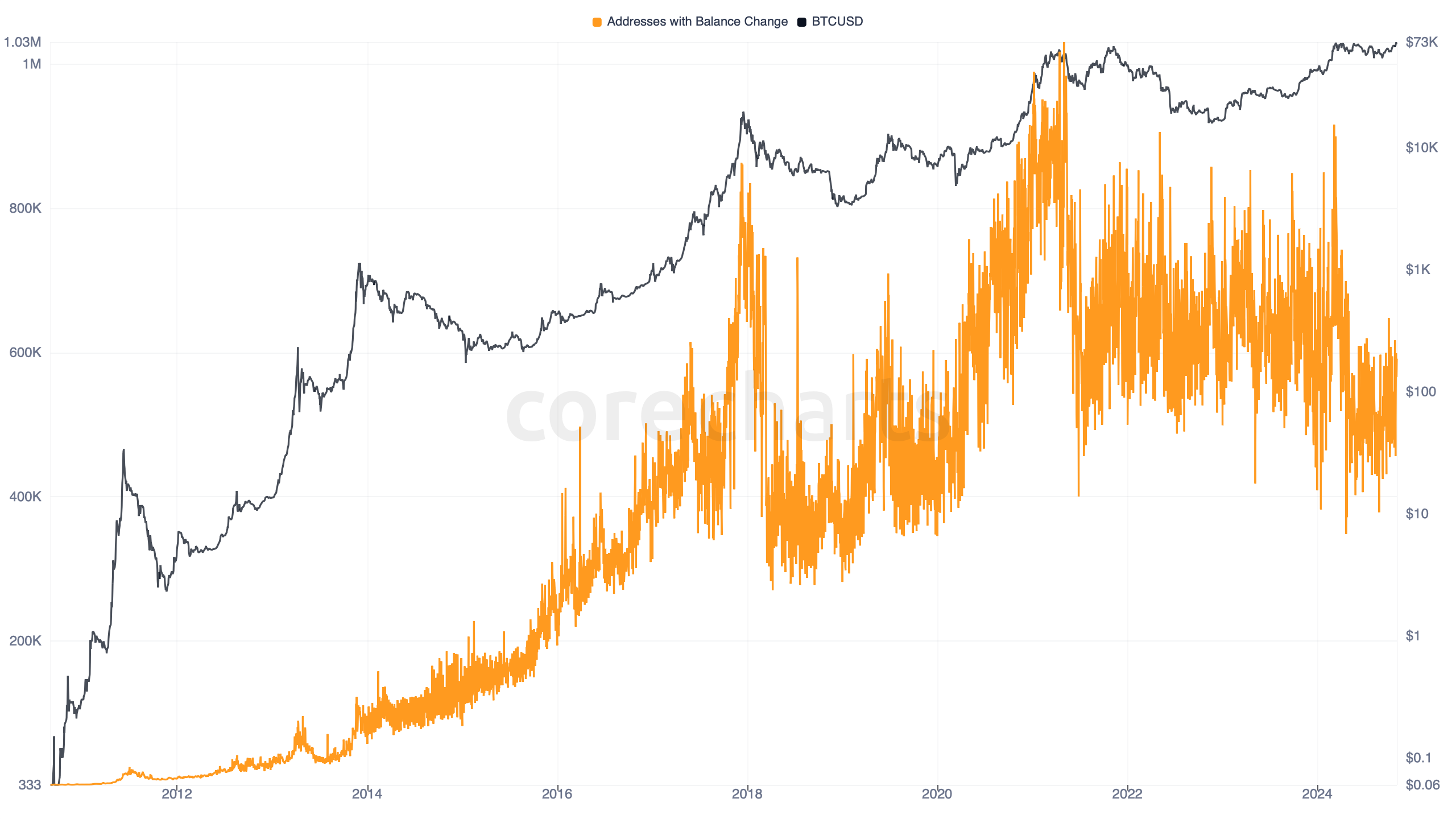
Bitcoin Addresses with Balance Change counts addresses whose net balance changed over the observed day.
The metric is built from daily net deltas at the address level. An address is included only if its balance change for the day is non-zero. That makes it different from a simple transaction-participation count. An address that sent and received within the same day but ended flat is excluded.
In plain form, the condition is:
The unit is addresses.
This is an events-based address metric. It does not measure how much BTC moved. It does not count every address that touched a transaction. It isolates addresses whose balance state actually changed over the period being measured.
For closed historical days, the series follows the UTC day. The tail row is handled as a rolling last-24-hour window rather than a finished calendar day.
How To Use It
This metric answers a narrow question: how many addresses ended the day in a different balance state from where they began.
A rising reading means net-active balance change was spread across more addresses. A lower reading means fewer addresses finished the period with a non-zero change.
That makes the series most informative when the distinction between raw participation and net balance change matters. It is often read next to Receiving Addresses and Spending Addresses, which split the same net-change logic by sign, and next to broader transaction-participation counts, which include addresses that may have churned coins without ending the day higher or lower.
The metric is especially helpful when the analyst wants to filter out same-day in-and-out activity and focus on addresses whose end-of-period balance actually moved.
Reading the Series
Rising net-active breadth
When the series expands, more addresses are finishing the day with a changed balance. That usually points to wider balance redistribution across the network.
The interpretation becomes sharper when the move is compared with the inflow and outflow sides. A rise driven mainly by Receiving Addresses looks different from one driven mainly by Spending Addresses.
Narrower daily balance change
When the series contracts, fewer addresses are ending the day with net balance movement. Coins may still be moving on-chain, but more of that activity may be offsetting within the day or concentrated in a smaller address set.
What it does not say
This is not a price-timing metric. It is also not a value metric. A high reading does not tell you whether the balance changes were large or small. It tells you that the footprint of net balance change widened.
Address counts should also not be read as entity counts. One holder, service, or exchange can control many addresses.
Relationship to Other Metrics
Receiving Addresses counts addresses with positive net daily balance change.
Spending Addresses counts addresses with negative net daily balance change.
Addresses with Balance Change sits above both as the combined non-zero set. In that sense it is a net-state metric family, not a raw transaction family.
It also differs from transaction-side active-address measures. Those count addresses that appeared in transactions. This series is stricter. It only counts addresses that finished the day with a changed balance.
Historical Background
Address-level balance-change metrics emerged as analysts moved beyond transaction counts and asked a more specific question: which addresses actually ended a period with more or less BTC than they started with.
That distinction matters in Bitcoin because a large amount of transaction activity can still net to zero for part of the address set. Net-change metrics were developed to separate that churn from genuine balance redistribution.