Bitcoin Network Hash Rate
What It Measures
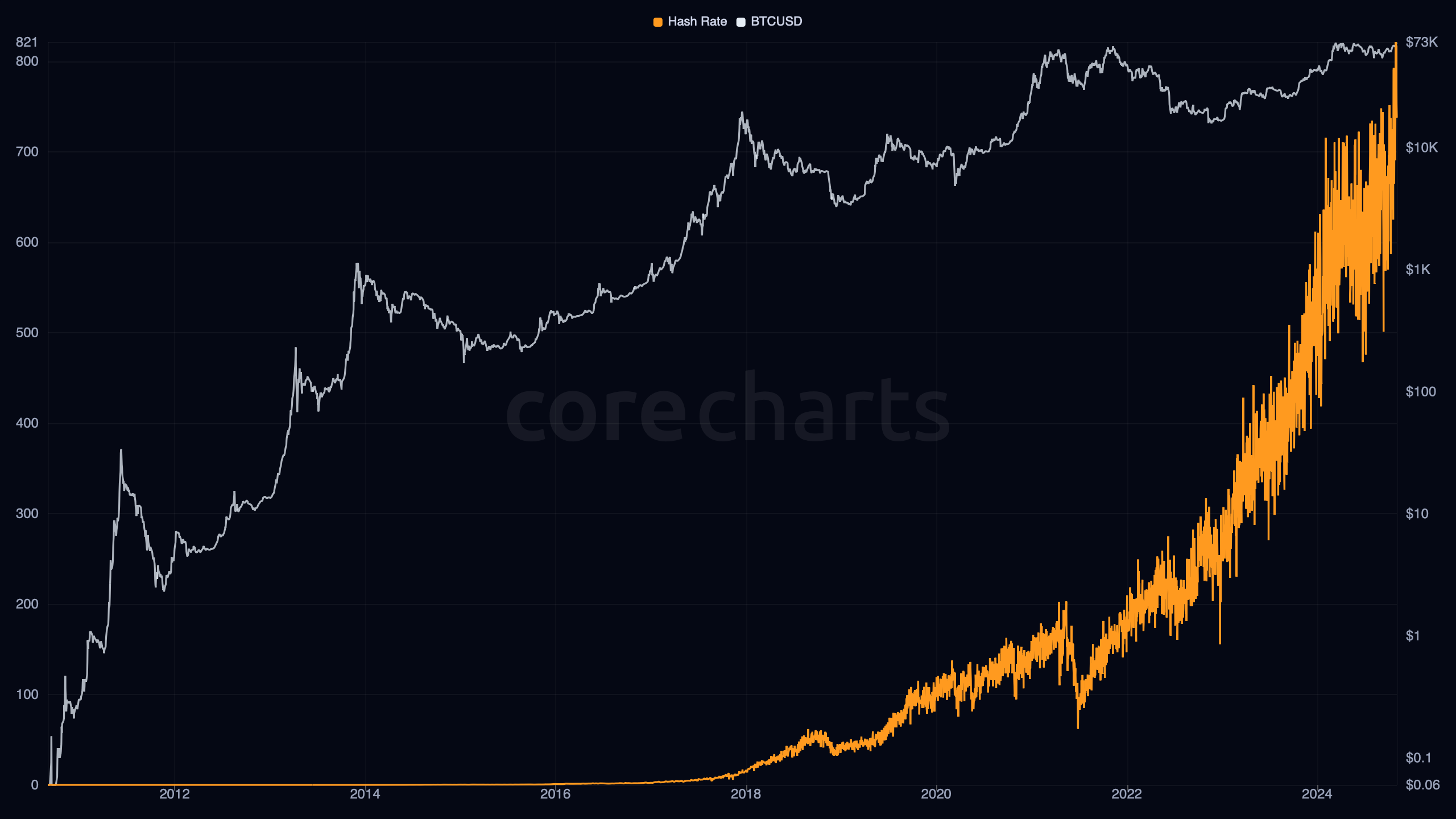
Bitcoin Network Hash Rate estimates how much computational work miners are collectively deploying on the Bitcoin network.
It answers a direct question:
How much hashing power is currently being used to compete for Bitcoin blocks?
In CoreCharts, the estimate is derived from the observed block interval and the current mining difficulty. The result is shown in exahashes per second (EH/s).
In simplified form, the logic is:
The metric is an estimate, not a direct count of physical machines. Bitcoin does not report miner hardware output explicitly. Hash rate is inferred from the difficulty target and the speed at which blocks are being found.
A rising reading means the network is committing more computation to mining. A falling reading means less computation is being applied.
How To Use It
Hash Rate is useful when the goal is to track the strength of mining participation and the broader resource commitment behind Bitcoin’s security model.
It helps answer questions such as:
- Are miners adding or removing capacity?
- Is the network becoming harder to attack in raw computational terms?
- Is miner participation expanding with price, or retrenching under pressure?
This metric is especially useful next to:
- Mining Difficulty
- Miner Revenue
- Hash Price
- Security Budget
Difficulty shows the protocol’s adjustment mechanism. Hash Rate shows the scale of miner participation around that mechanism.
What It Can Say About Price And Market Regime
Hash Rate is not a price-timing indicator in the short-term sense, but it is highly informative about the economic condition of the mining sector.
Expanding hash rate
When hash rate rises steadily, miners are adding capacity or keeping more machines online. That usually happens when mining economics are favorable enough to support continued participation.
This often appears during stronger market phases, but it can also continue during quieter periods if miners expect future profitability.
Falling hash rate
When hash rate falls, part of the mining fleet is likely becoming uneconomic or temporarily disconnected. That often happens when margins compress, difficulty remains high relative to revenue, or operational conditions worsen.
Why the metric matters structurally
Hash Rate is one of the clearest long-run measures of how much real-world energy and hardware the network is attracting. That makes it a core structural metric for Bitcoin’s security environment, even when it says little about near-term price direction.
Historical Background
Hash-rate estimation has been part of Bitcoin analysis from the start because the network’s proof-of-work design makes computational competition central to block production. Once difficulty and block timing were observable, it became straightforward to estimate the network’s aggregate hashing effort.
Over time, hash rate became one of the standard indicators of miner participation and network security.