Bitcoin Revived Supply N+ Years
What This Metric Family Shows
Bitcoin Revived Supply N+ Years measures how many coins were spent on a given day after remaining inactive for at least a chosen age threshold.
The family includes five variants:
- Revived Supply 1+ Years
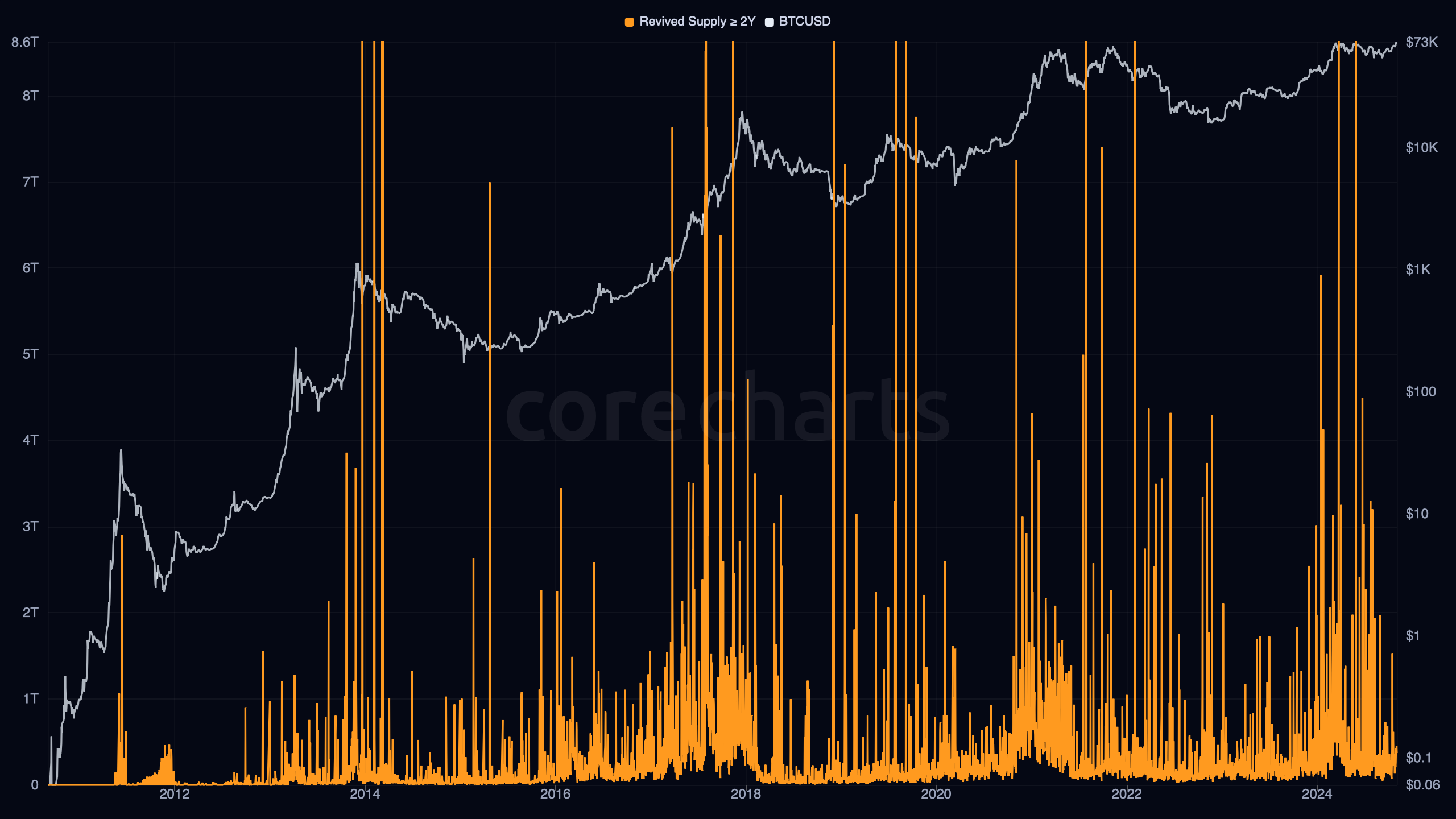
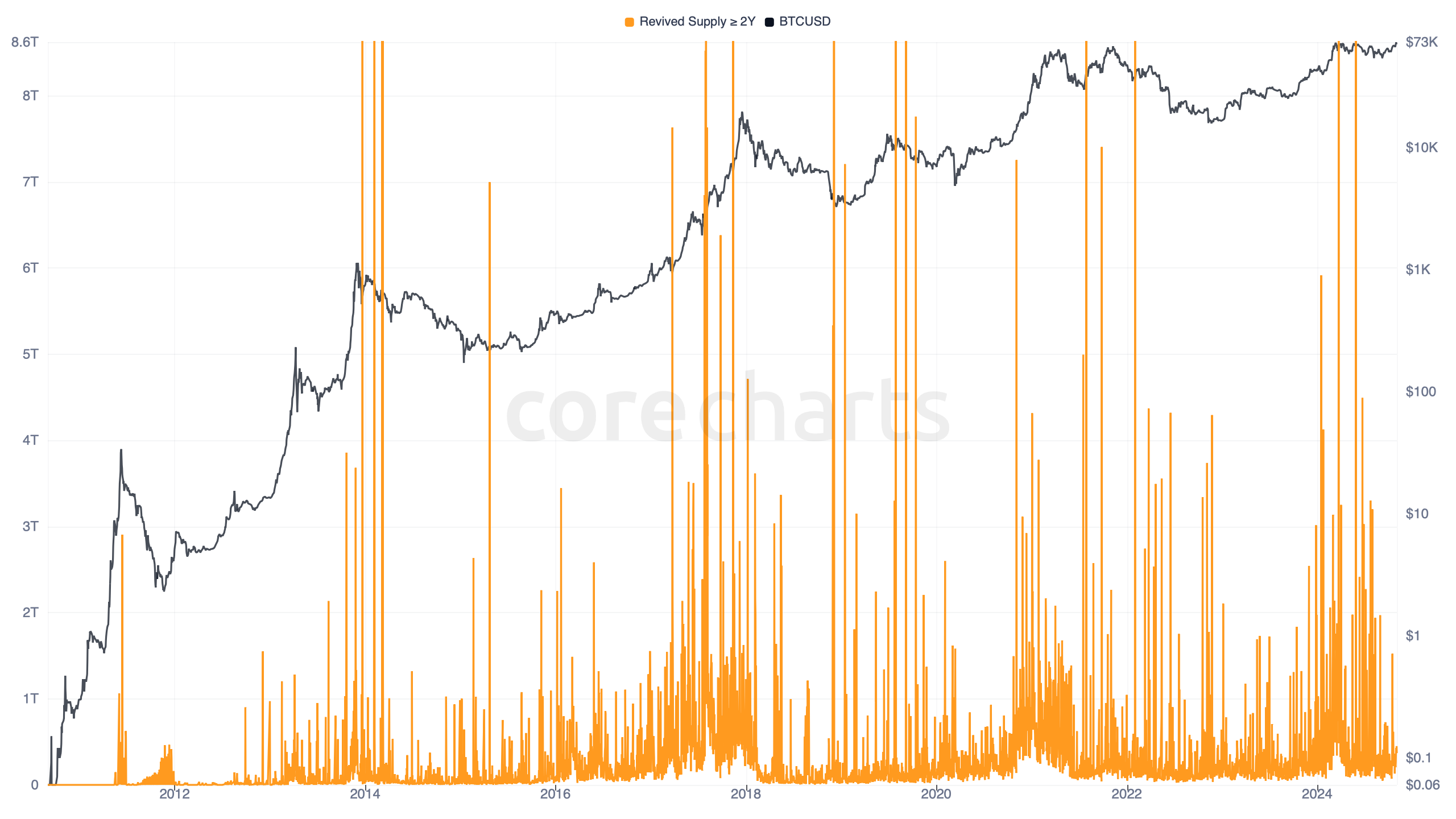
- Revived Supply 2+ Years
- Revived Supply 3+ Years
- Revived Supply 5+ Years
- Revived Supply 10+ Years
Each version answers the same question at a different depth of dormancy:
How much BTC was reactivated today from coins that had not moved for at least N years?
This is a spent-side metric. It does not describe where supply is currently sitting. It describes old supply that stopped being dormant and moved today.
For each threshold, the metric sums the spent volume from all age cohorts at or above that level. In simplified form:
So the thresholds are cumulative:
- 1+ Years includes all spent coins aged at least 1 year;
- 2+ Years includes all spent coins aged at least 2 years;
- 3+ Years includes all spent coins aged at least 3 years;
- 5+ Years includes all spent coins aged at least 5 years;
- 10+ Years includes all spent coins aged at least 10 years.
The unit is BTC spent, not percentage share.
How To Use It
This metric family is useful when the analytical question is about old supply coming back into circulation.
A higher reading means more long-dormant coins were spent on that day. A low reading means very little older supply was reactivated.
The threshold determines how selective the signal is.
Revived Supply 1+ Years
This is the broadest old-supply threshold. It is useful for detecting whether the market is drawing in supply that has already sat inactive for a full year or more.
It reacts more often than the deeper thresholds and is the best broad measure of older-coin participation.
Revived Supply 2+ Years
This version filters out part of the younger old-supply range and focuses on coins that remained dormant across a longer period.
It is useful when you want a cleaner read on more mature supply reactivation.
Revived Supply 3+ Years
This threshold begins to isolate more selective, deeper dormancy. It is less affected by ordinary one-year aging and better at capturing materially older supply coming back to market.
Revived Supply 5+ Years
This is a stricter signal. When it rises meaningfully, coins that have sat inactive through multiple market phases are being spent.
That usually carries more structural significance than a rise in the lower thresholds.
Revived Supply 10+ Years
This is the rarest and deepest threshold in the family. It isolates ultra-old supply that had remained untouched for a decade or more.
It is not a frequent signal, but when it moves, it tells you that very old dormant inventory has re-entered circulation.
What The Thresholds Say About Market Behavior
These thresholds work best as a hierarchy.
- 1+ Years tells you whether broad old supply is active.
- 2+ Years and 3+ Years tell you whether that activity reaches deeper into the age structure.
- 5+ Years and 10+ Years show whether very old, long-isolated supply is being released.
This matters because not all old-coin spending means the same thing.
A spike in 1+ Years can happen during stronger market turnover without implying that very deep dormancy was broken. A spike in 5+ Years or 10+ Years is much rarer and usually more meaningful.
What It Can Say About Price And Market Regime
Revived Supply is not a short-term price indicator on its own, but it is highly informative about who is supplying the market.
Strong market phases
In a rising market, older holders are more likely to spend into strength. When revived-supply thresholds begin to rise, especially the lower and middle ones, that often shows older cohorts taking advantage of higher prices.
That does not automatically imply a top, but it does tell you that supply is no longer coming only from recent buyers.
Late-cycle distribution
When multiple revived-supply thresholds rise together, the market is pulling in coins from progressively older cohorts. That usually means distribution is broadening and reaching deeper-held inventory.
The deeper the threshold that moves, the stronger that signal becomes.
Quiet or accumulation phases
When revived supply stays muted, older dormant supply is largely staying inactive. That usually fits markets where long-term holders are not supplying much coin back into circulation.
Why the family matters
These metrics help answer a question that price alone cannot answer:
Is the market being supplied by recent coins, or by coins that have sat dormant for years?
That is what makes revived supply useful in regime analysis.
Relationship To Other Age Metrics
This family is closely related to spent-age metrics, but it is more focused than broad spent-age summaries.
- Spent Volume Age Bands show the full distribution of spent volume across age buckets.
- ASOL and MSOL summarize spent-output age with an average or median.
- Revived Supply N+ Years isolates only the old-supply tail above a chosen threshold.
So if spent-age bands tell you the whole age structure of spending, revived supply tells you how much very old supply crossed back into activity.
Historical Background
Revived-supply style metrics emerged from the broader Bitcoin coin-age framework. Once analysts began measuring spent-output age, it became natural to isolate thresholds such as 1 year, 2 years, 5 years, or 10 years and ask how much dormant supply above those cutoffs was being spent.
These threshold views became useful because they are easier to interpret in market context than a full age distribution. They translate a detailed spent-age profile into a direct structural question: how much long-dormant supply was revived today?