Bitcoin Transaction Fees per Block
What It Measures
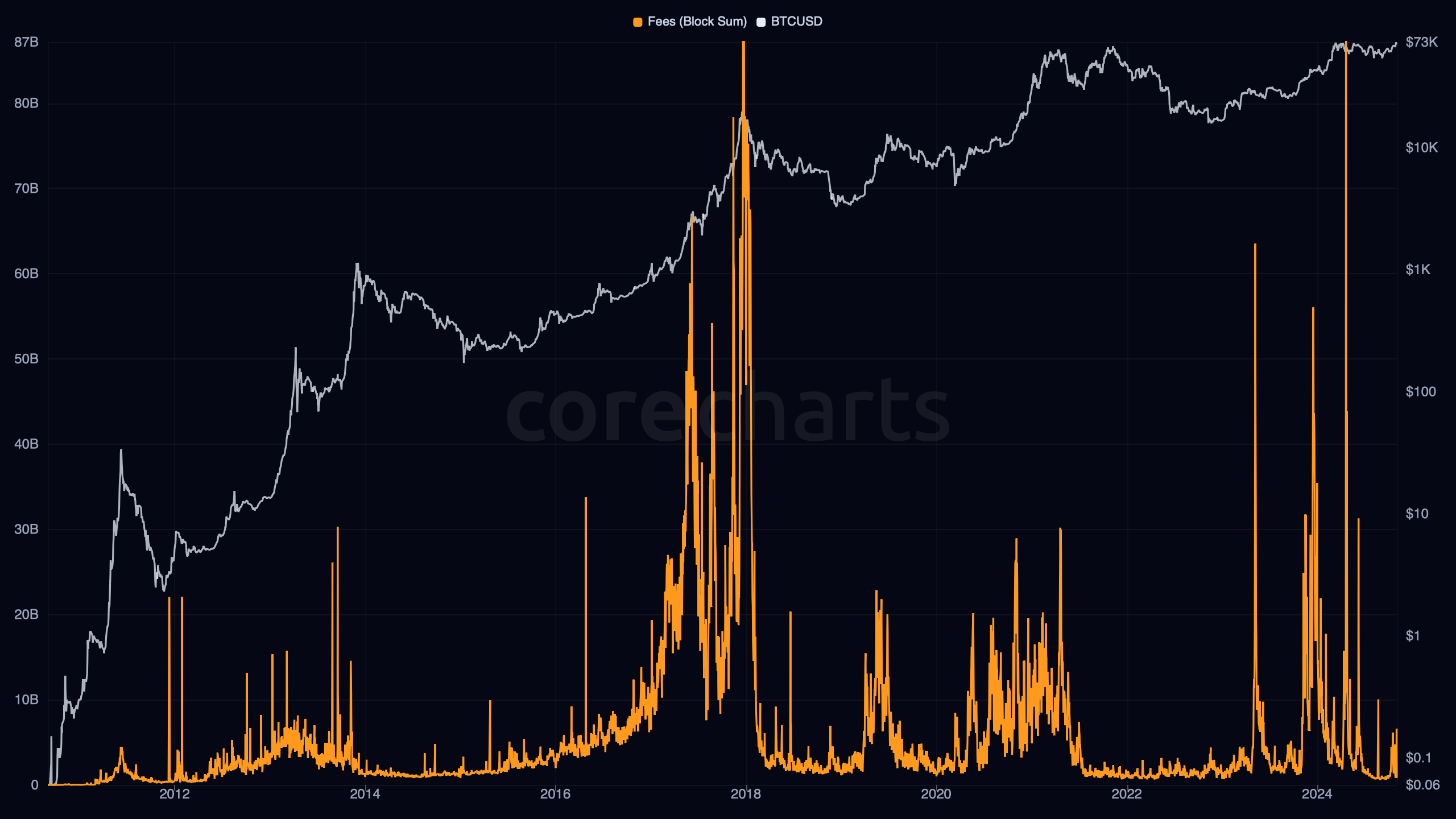
Bitcoin Transaction Fees per Block shows the total transaction fees paid to miners over the observed day, measured in satoshis.
It answers a direct question:
How many satoshis did users pay in fees to get transactions included in blocks today?
This metric reflects only the fee component of miner compensation. It excludes newly issued subsidy.
In simplified form:
The result is shown in satoshis per day.
A higher reading means users collectively paid more to access block space. A lower reading means block-space demand was weaker or cleared at lower fee levels.
How To Use It
This metric is useful when the analytical focus is on block-space demand and the fee-driven part of miner revenue.
It helps answer questions such as:
- Is on-chain demand strong enough to push total fees higher?
- How important are fees relative to subsidy right now?
- Is miner revenue being supported by market activity or mostly by issuance?
This metric is especially useful next to:
- Block Subsidy
- Miner Revenue
- Fee Rate Percentiles
- Security Budget
The fee total shows how much users actually paid in aggregate, while fee-rate metrics show the pricing environment behind that total.
What It Can Say About Price And Market Regime
Transaction fees often become more important during periods of congestion or elevated on-chain demand.
High-fee environments
When total fees rise sharply, block space is being priced more aggressively. That often happens during strong market activity, speculative bursts, heavy settlement demand, or other periods when more users compete for limited space.
Low-fee environments
When fees remain subdued, the network may still be processing transactions, but demand for priority inclusion is not intense enough to generate large fee totals.
Why this metric matters for miners
As subsidy declines over time, fee income becomes more important. This metric shows how much of miner compensation is being funded by actual network usage rather than by protocol issuance.
That makes it one of the most important long-run indicators of whether fee demand is becoming economically meaningful.
Historical Background
Transaction fees have always been part of Bitcoin’s block reward structure, but their relative importance has changed over time. In the early network, subsidy dominated miner compensation almost completely. As halvings reduced issuance and on-chain usage expanded, fees became a more important variable in mining economics.
Fee totals are now a standard way to track the realized demand for block space.