MVRV Ratio Deviation from Historical Norm
Definition
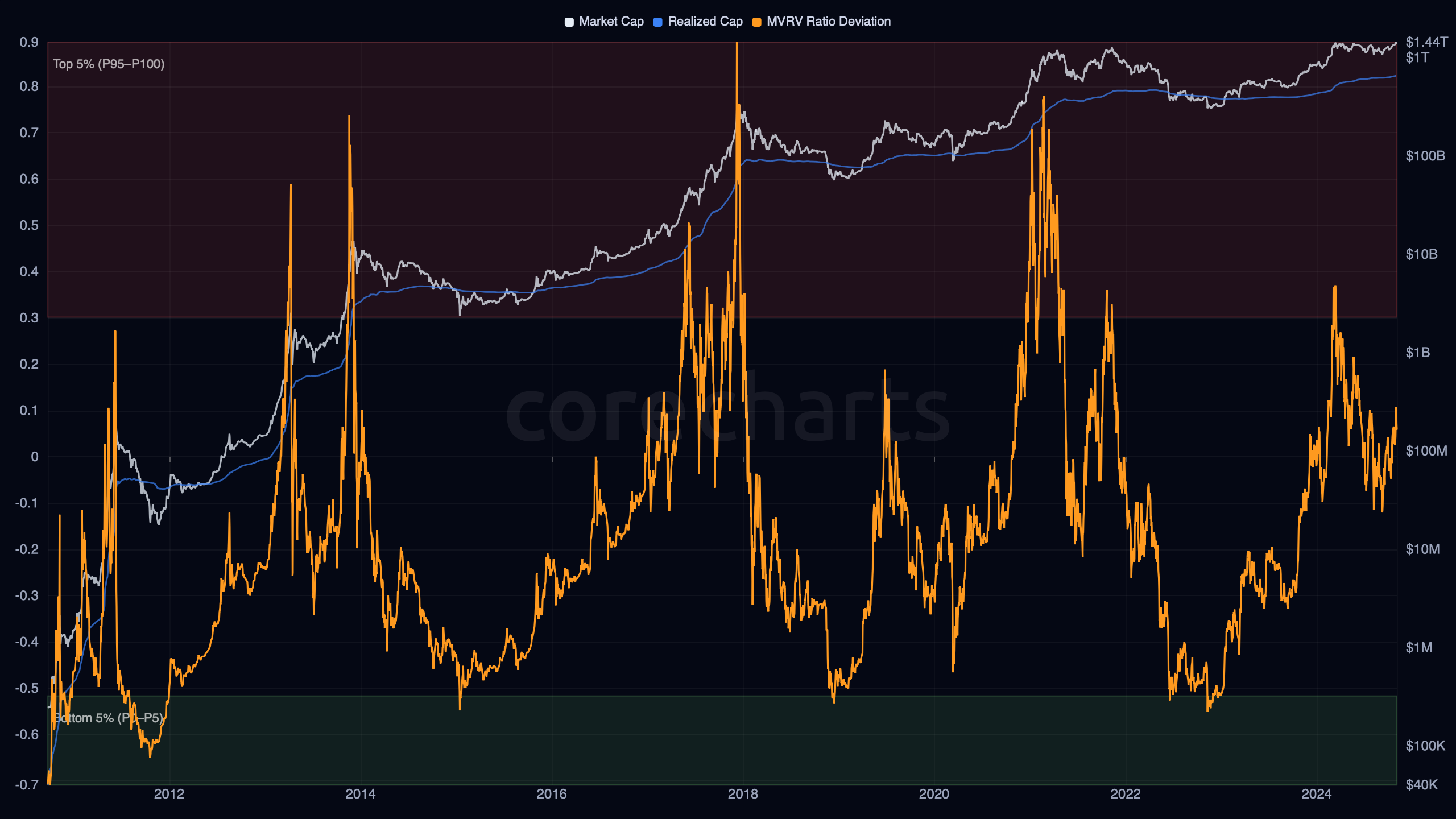
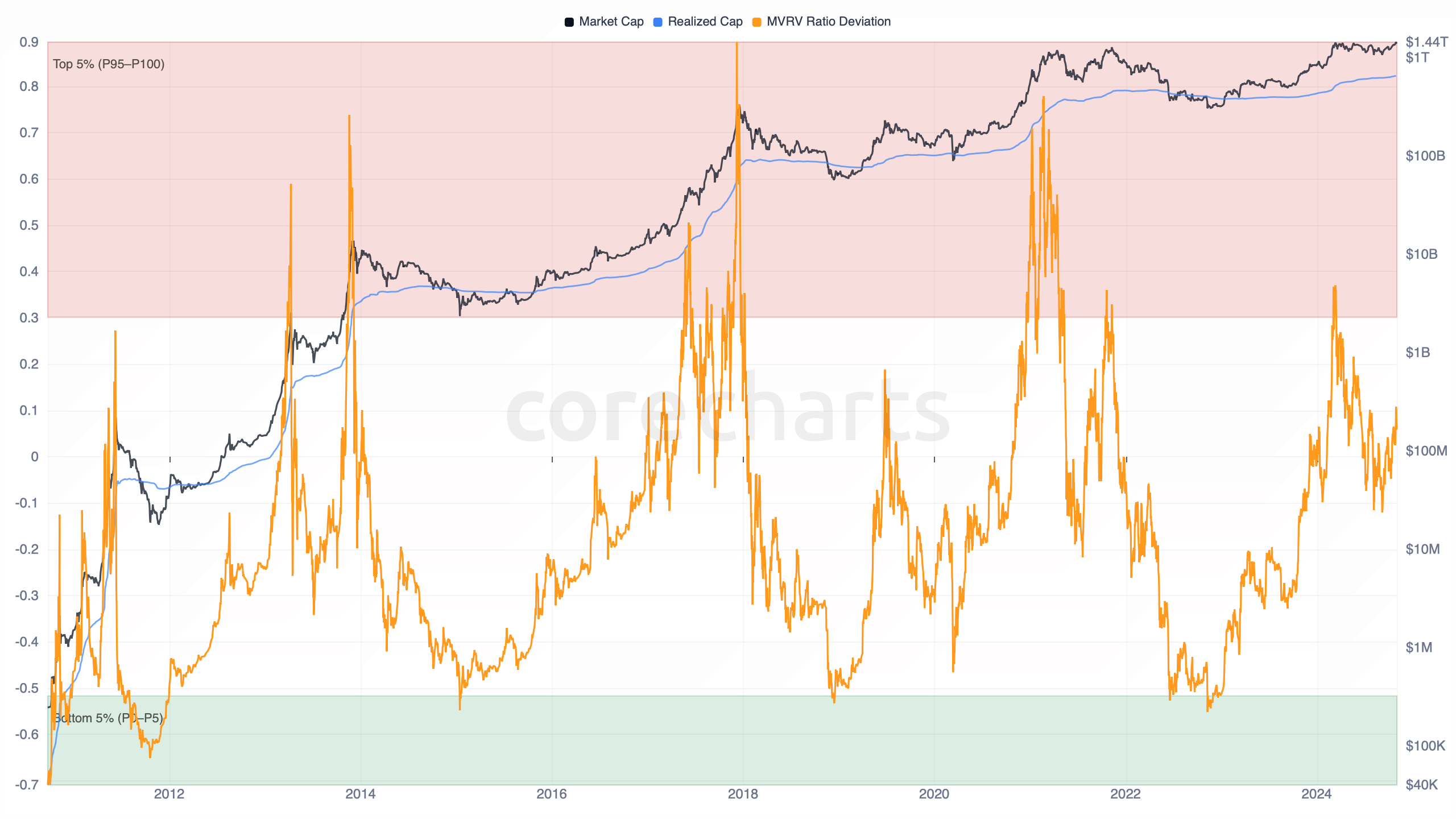
This series measures how far the current MVRV Ratio stands from its own historical mean.
It does not compare Market Cap directly with Realized Cap in dollar terms. It compares today’s MVRV Ratio with the ratio’s own past distribution. The result is a dimensionless deviation score.
A value near zero means MVRV is close to its historical norm. Positive values mean the ratio is running above its long-term average. Negative values mean it is below that average.
What this version is for
This variant answers a narrower question than raw MVRV Ratio. Not whether Bitcoin is in aggregate profit or loss, but whether the current valuation spread is unusually rich or unusually compressed relative to its own history.
That makes it helpful when the analyst wants regime distance rather than raw valuation level. A market can have MVRV above 1.0 for a long time. What matters here is whether the ratio itself has moved into statistically rare territory.
The signal is cleaner when the goal is to compare one cycle with another. Raw MVRV can look similar across periods that differ in market structure. A deviation score is better suited for judging extremity.
Regime interpretation
Strong positive readings point to expansion in unrealized profit beyond the norm of the series. Those conditions often appear during speculative excess, especially after long advances with broad mark-to-market gains across the UTXO set.
Negative readings mark compression. They tend to emerge in bear market basing phases, after major deleveraging, or during periods when price approaches realized cost basis.
This series is better at flagging stretch than timing reversals. Extreme positive values can persist in strong bull markets. Deeply negative readings can remain in place while sentiment is still deteriorating. The practical use is to judge asymmetry, not to call the exact turning point.
Relationship to other metrics
Raw MVRV Ratio is the underlying series. MVRV Ratio Deviation tells you how unusual that ratio is. MVRV Z-Score Market Cap Std takes a different route: it scales the market-minus-realized spread by the historical standard deviation of Market Cap itself. That makes the two Z variants related, but not interchangeable.
MVRV Delta stays in absolute dollar space. NUPL remains closer to unrealized profit share. Realized Price still anchors the break-even level of the network.
Historical note
The base MVRV framework comes from Murad Mahmudov and David Puell. This variant is a CoreCharts extension designed to measure how unusual the MVRV Ratio is relative to its own long-run distribution. That differs from the classic MVRV Z-Score, which standardizes the Market Cap–Realized Cap spread instead.