Bitcoin Average Coin Age
What It Measures
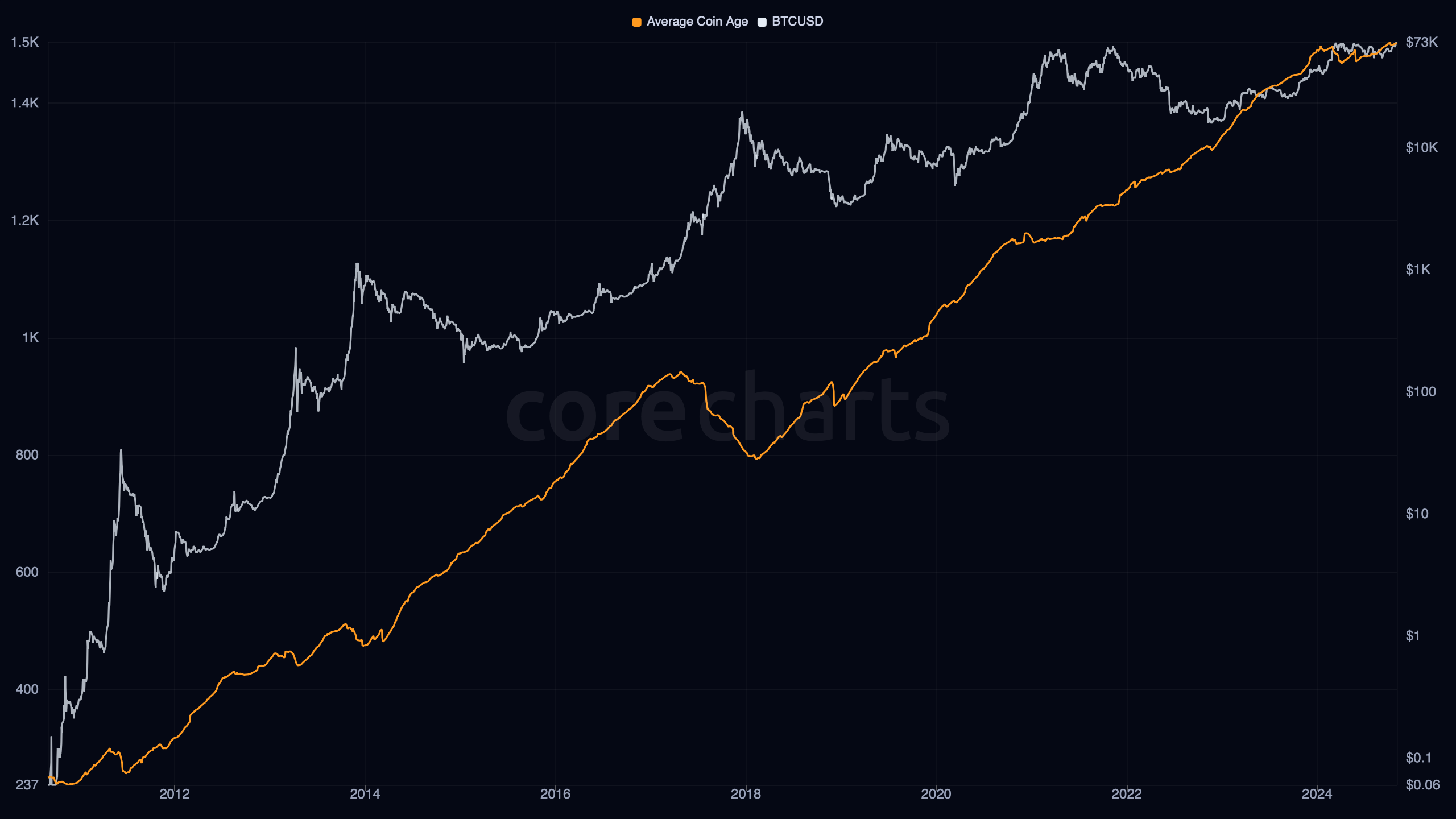
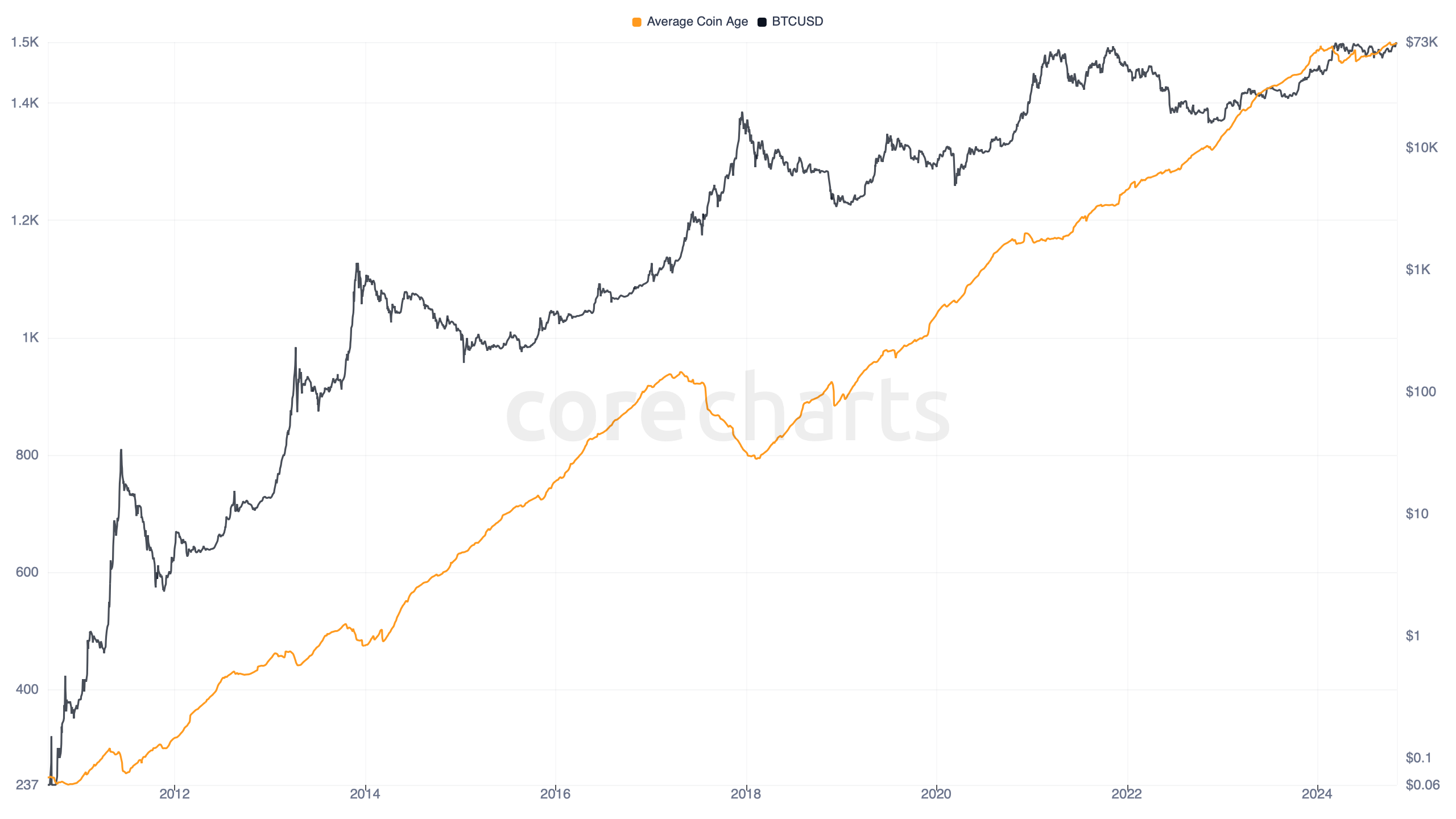
Bitcoin Average Coin Age estimates the average age of coins currently sitting in the held-supply distribution.
It answers a direct structural question:
How old is the average coin in the current age profile of held supply?
In CoreCharts, this estimate is derived from the HODL Waves distribution. Each age band is assigned a representative midpoint in days, and the chart computes a weighted average using the share of supply in each band.
The basic idea is:
Because the calculation is based on HODL Waves bands rather than exact per-coin ages, this is an estimate, not an exact mean over the entire UTXO set.
That distinction matters. The metric is designed to summarize the current held-supply age structure in one number. It is not meant to replace the full HODL Waves chart.
How To Use It
This metric is useful when you want a compact read on whether the supply profile is becoming younger or older overall.
A rising Average Coin Age means more supply is sitting in older cohorts, or existing cohorts are aging in place without being reset by spending.
A falling Average Coin Age means younger supply is taking a larger role in the held distribution. That usually happens when older coins move and reset into new age bands, or when turnover becomes more dominant across the market.
The metric is most useful as a summary of the broader HODL Waves structure. It helps answer questions like:
- Is the held-supply profile aging or rejuvenating?
- Has recent spending meaningfully reset supply age?
- Is the market accumulating dormant supply, or spending it down?
What It Can Say About Market Regime
Average Coin Age can be informative for broad regime shifts, especially when used with HODL Waves and spent-age metrics.
Rising average age
When the metric trends higher for an extended period, the held supply is becoming older. That usually points to stronger dormancy, slower turnover, and a market where coins are staying unspent across longer time spans.
This often appears in accumulation phases and in quieter parts of the cycle after heavy distribution has already occurred.
Falling average age
When the metric declines, the supply profile is becoming younger. That means more coins have moved recently and the held-supply structure has been reset toward shorter ages.
This tends to happen in periods of stronger activity, broader distribution, or major market transitions where previously dormant supply is being spent.
What it does better than a single threshold metric
Threshold metrics such as 1y+ or 5y+ supply shares are useful, but they focus on specific slices of the age curve. Average Coin Age compresses the entire held-age distribution into one summary number.
That makes it a convenient regime indicator, though it should still be read alongside the full HODL Waves chart, since different age-band shifts can sometimes produce similar averages.
Historical Background
The idea of measuring average coin age comes out of the broader Bitcoin coin-age framework. Once analysts began working with coin-age destruction, dormancy, and held-supply age distributions, a natural follow-up was to summarize the age structure of held supply in a single statistic.
CoreCharts derives this estimate from HODL Waves rather than presenting it as a raw exact-age calculation. That keeps the metric aligned with the same age-band framework used elsewhere in the held-supply section.