Bitcoin Median Inputs per Transaction
What It Measures
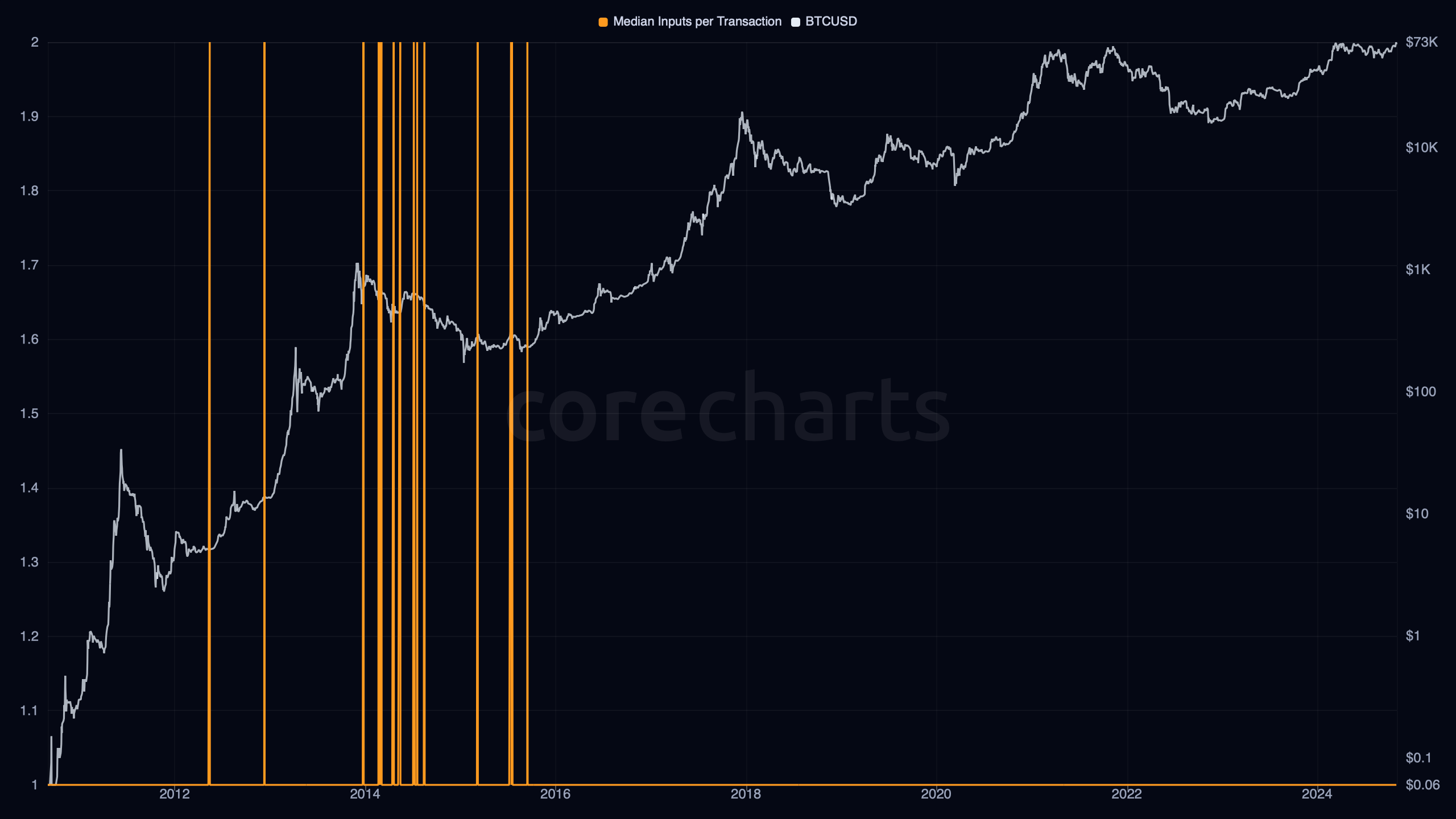
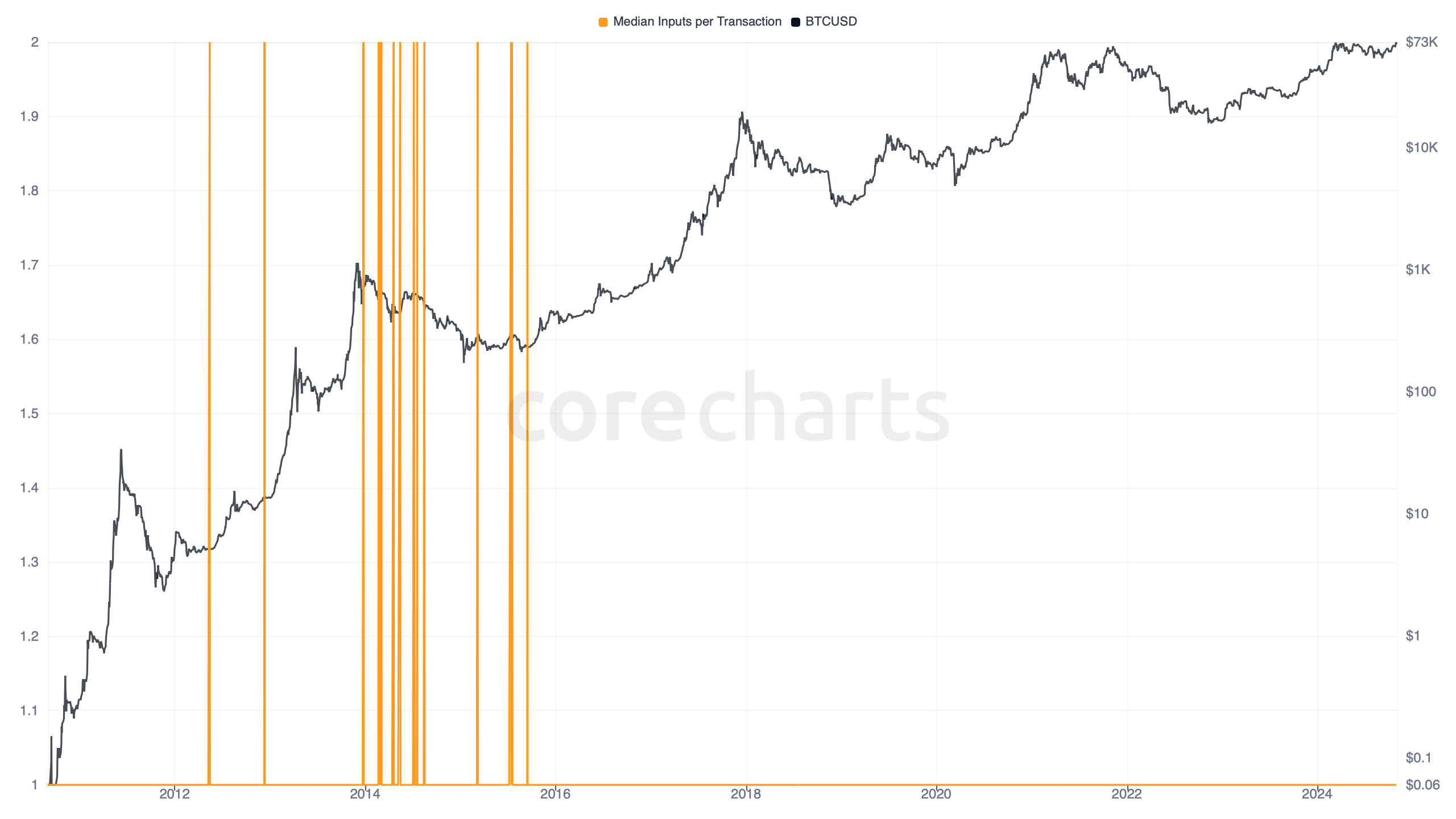
Bitcoin Median Inputs per Transaction shows the median number of inputs used by Bitcoin transactions on a given day.
It answers a more specific question than the average:
How many inputs did the typical Bitcoin transaction use today?
The median means that half of transactions used fewer inputs than this level, and half used more.
This is the typical-case version of the input-count family. It is not the canonical baseline series — that role belongs to the average — but it is the best measure of what the center of the distribution looked like.
How To Use It
This metric is useful when the question is not how the whole distribution averaged out, but how a typical transaction was structured.
It helps answer questions such as:
- Did the typical transaction actually become more input-heavy?
- Was the rise in average inputs broad, or caused by a smaller set of large transactions?
- Is the transaction population changing in the middle, not just in the tail?
This metric is best interpreted together with:
- Average Inputs per Transaction
- Inputs per Transaction (P90)
The comparison is the point:
- if the average rises but the median stays flat, a smaller high-input tail is pulling the average up;
- if average and median both rise, the structure of typical transactions has shifted as well.
What It Can Say About Market Regime
Median input count is useful when transaction complexity changes across the broad body of the network, not just in unusual transactions.
Stable median, rising average
This usually means the typical transaction did not change much, but a subset of larger or more complex transactions became more input-heavy.
Rising median
This means input complexity moved into the center of the distribution. The typical transaction itself is using more inputs.
That can matter more structurally than a simple rise in the average, because it points to broader change across transaction construction.
Historical Background
Median transaction statistics became important once analysts recognized that averages alone can be distorted by a minority of unusually large or unusually complex transactions. The median input count gives a cleaner read on what the typical transaction looked like on that day.