Bitcoin Stock-to-Flow
What It Measures
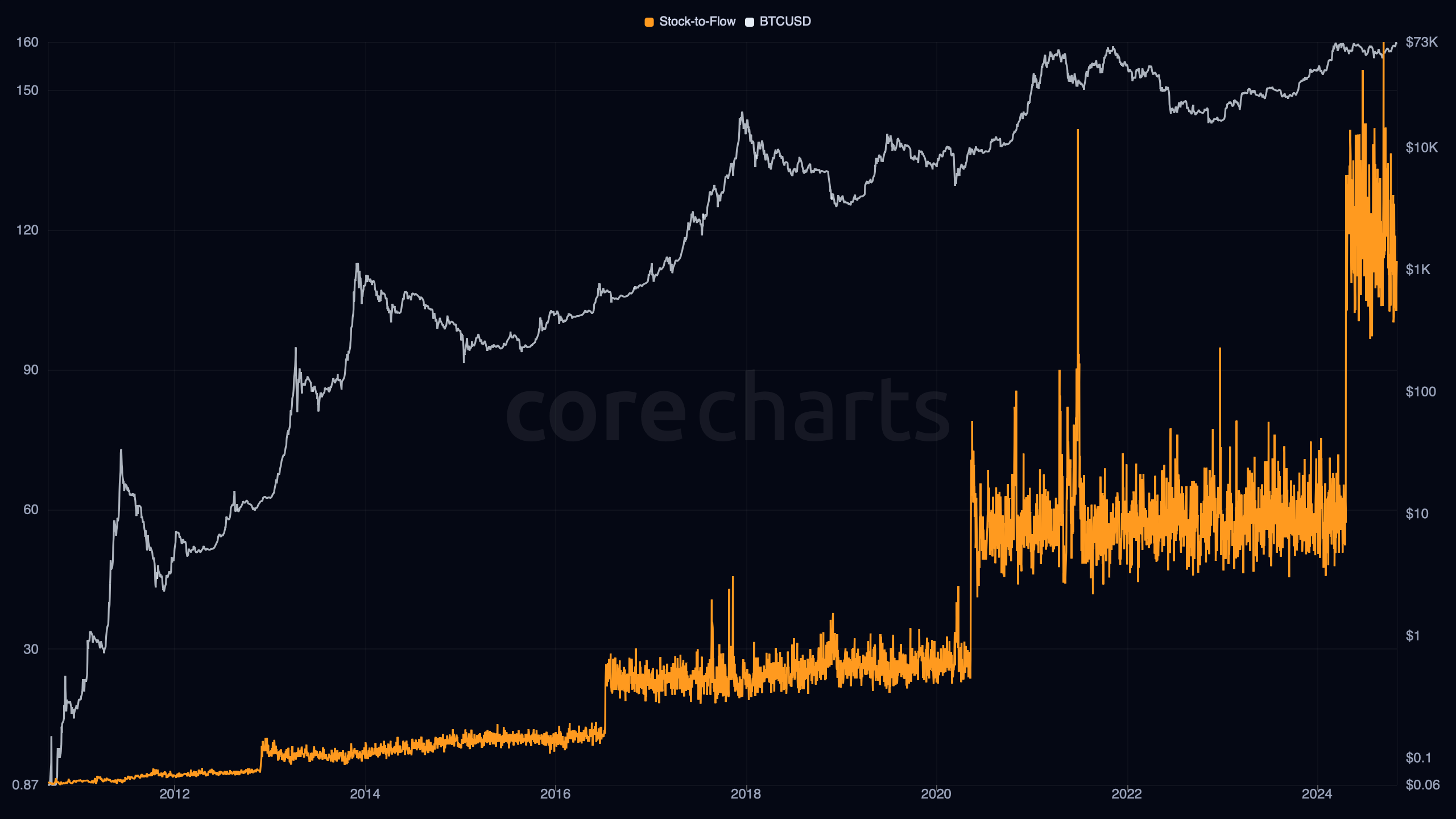
Bitcoin Stock-to-Flow compares Bitcoin’s existing circulating supply with the pace of new supply issuance.
It answers a direct scarcity question:
How many years of current issuance would be required to recreate today’s circulating supply?
In simplified form:
This is the canonical metric in this group.
The other halving-related metrics describe where Bitcoin is inside its issuance schedule.
Stock-to-Flow is the one that turns that schedule into a scarcity ratio.
A higher reading means Bitcoin’s outstanding supply is large relative to the amount of new BTC being issued each year. A lower reading means new issuance is still large relative to the existing stock.
Because annual issuance falls sharply after each halving, Stock-to-Flow rises in step-like fashion across Bitcoin’s history.
How To Use It
Stock-to-Flow is useful when the analytical focus is on Bitcoin’s programmed scarcity regime.
It helps answer questions such as:
- How scarce is Bitcoin under the current issuance schedule?
- How different is the present issuance regime from the previous halving era?
- How much has annual supply growth slowed relative to the total outstanding stock?
This metric is especially useful next to:
- Circulating Supply
- New Supply Issued
- Annualized Inflation Rate
- Halving Epoch
Within this group, the relationship is simple:
- Halving Epoch identifies the current issuance era,
- Blocks / Days to Next Halving show where the network sits inside that era,
- Stock-to-Flow expresses the scarcity profile of that era in a single ratio.
What It Can Say About Price And Market Regime
Stock-to-Flow is a structural scarcity metric, not a short-term trading signal.
Halving transitions
Its biggest changes come after halvings, when annual issuance drops while the outstanding stock remains large. That causes the ratio to jump higher and marks a new scarcity regime.
Long-cycle context
This metric is most useful for placing Bitcoin inside its long-run monetary path. It does not tell you whether price is about to rise or fall next week. It tells you how restrictive the current issuance regime is compared with earlier phases of Bitcoin’s history.
Why it should be read carefully
Stock-to-Flow describes supply mechanics, not demand. That matters. A higher ratio means Bitcoin is structurally scarcer under its issuance schedule, but it does not, by itself, determine market valuation at every point in time.
Its best use is as a monetary-regime lens rather than as a standalone valuation model.
Historical Background
The stock-to-flow concept is older than Bitcoin and has long been used in commodity analysis to compare existing stock with annual production flow. In Bitcoin, the framework became widely known through the work of PlanB, who popularized Bitcoin Stock-to-Flow as a scarcity-based way to think about halving-driven monetary tightening.
Whether one treats it as a descriptive scarcity ratio or as part of a stronger valuation thesis, the metric remains one of the most recognizable ways to summarize Bitcoin’s issuance regime.