Bitcoin Circulating Supply
What It Measures
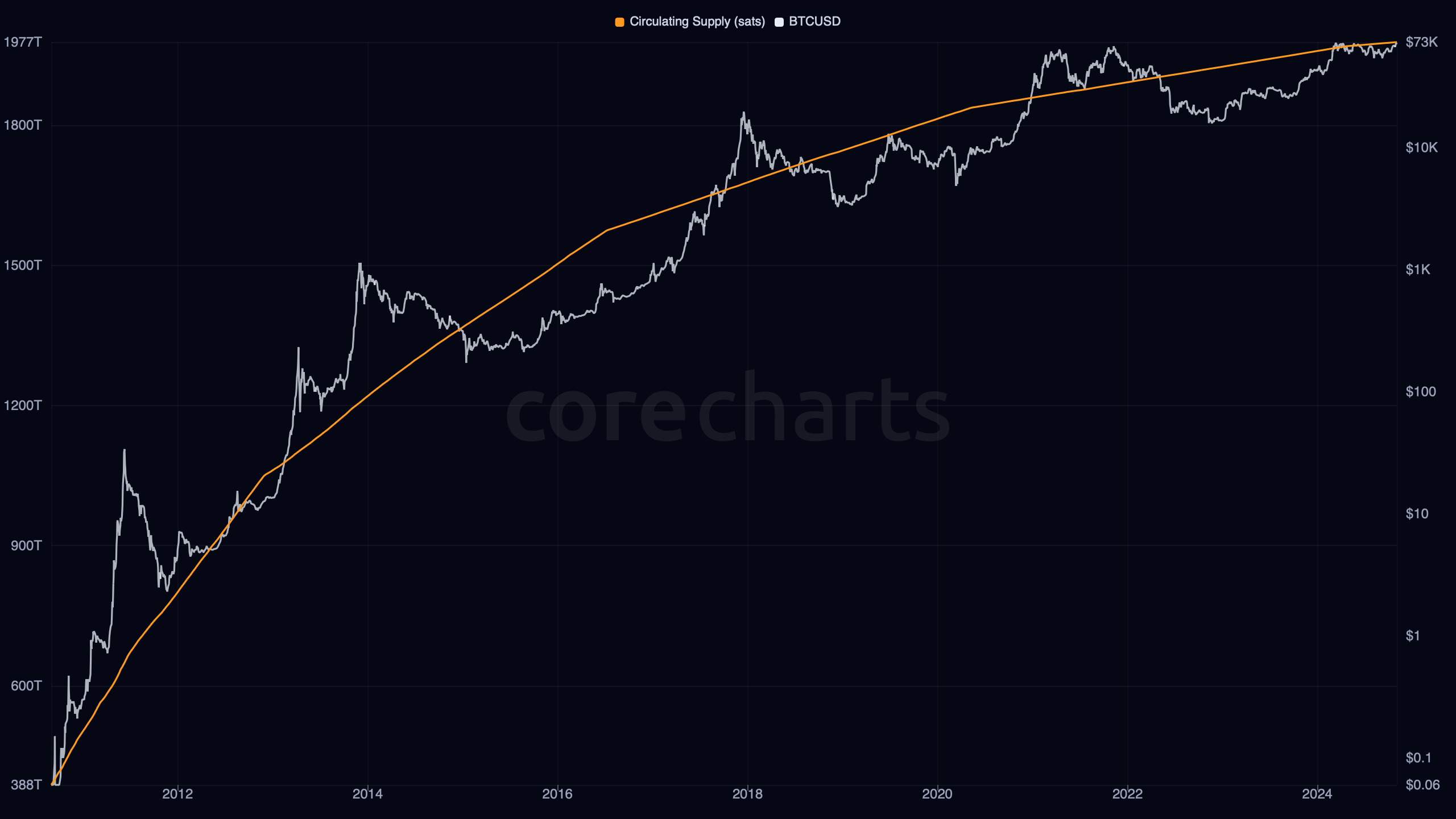
Bitcoin Circulating Supply shows how many satoshis have been issued into circulation by the Bitcoin protocol up to the current date.
It answers the most basic monetary question in Bitcoin:
How much BTC exists in circulating form right now?
In CoreCharts, this is the canonical supply series. It is the base monetary stock from which the BTC-denominated version, market capitalization, issuance ratios, and inflation metrics are derived.
In simplified form, circulating supply is the cumulative result of all historical block subsidies:
Circulating supply rises deterministically through block subsidies toward the protocol maximum of 21 million BTC (2,100,000,000,000,000 satoshis). Final issuance is expected around 2140.
The unit here is satoshis.
This is the protocol-defined supply outstanding. It is not adjusted for lost coins, dormant coins, or coins assumed to be inaccessible. It reflects how much Bitcoin has been created and remains part of the issued supply.
How To Use It
This is the foundational supply series for Bitcoin monetary analysis.
It helps answer questions such as:
- How much BTC has been issued so far?
- Where is the network relative to its fixed issuance schedule?
- How large is the monetary base against which valuation or inflation should be measured?
For most analytical use, this metric matters less as a chart on its own and more as the base for other metrics, especially:
- Circulating Supply (BTC)
- New Supply Issued
- Market Cap
- Annualized Inflation Rate
- Stock-to-Flow
Among this family, Circulating Supply in sats is the canonical source series, because it is the exact native-unit stock. Other versions are presentation or derived forms.
What It Can Say About Price And Market Regime
Circulating Supply is not a cycle signal and not a timing tool. Its role is structural.
Monetary base
Every valuation metric built on supply needs a defined stock. This series provides that stock directly in the smallest native unit.
Halving context
The slope of the supply curve slows after each halving. The level always rises, but the rate of increase declines. That changing slope is what later feeds into inflation, issuance pressure, and scarcity-based frameworks.
Why this version matters
The sats version is the exact protocol-level expression of circulating supply. It avoids any rounding that naturally appears in BTC display units and is therefore the correct base series for precise monetary calculations.
Historical Background
Bitcoin’s circulating supply schedule is part of the original protocol design introduced by Satoshi Nakamoto. Because Bitcoin issuance is deterministic, the supply path can be tracked exactly from block subsidies alone. That fixed supply curve is one of the central features of Bitcoin’s monetary identity.