Bitcoin Inputs per Transaction (P90)
What It Measures
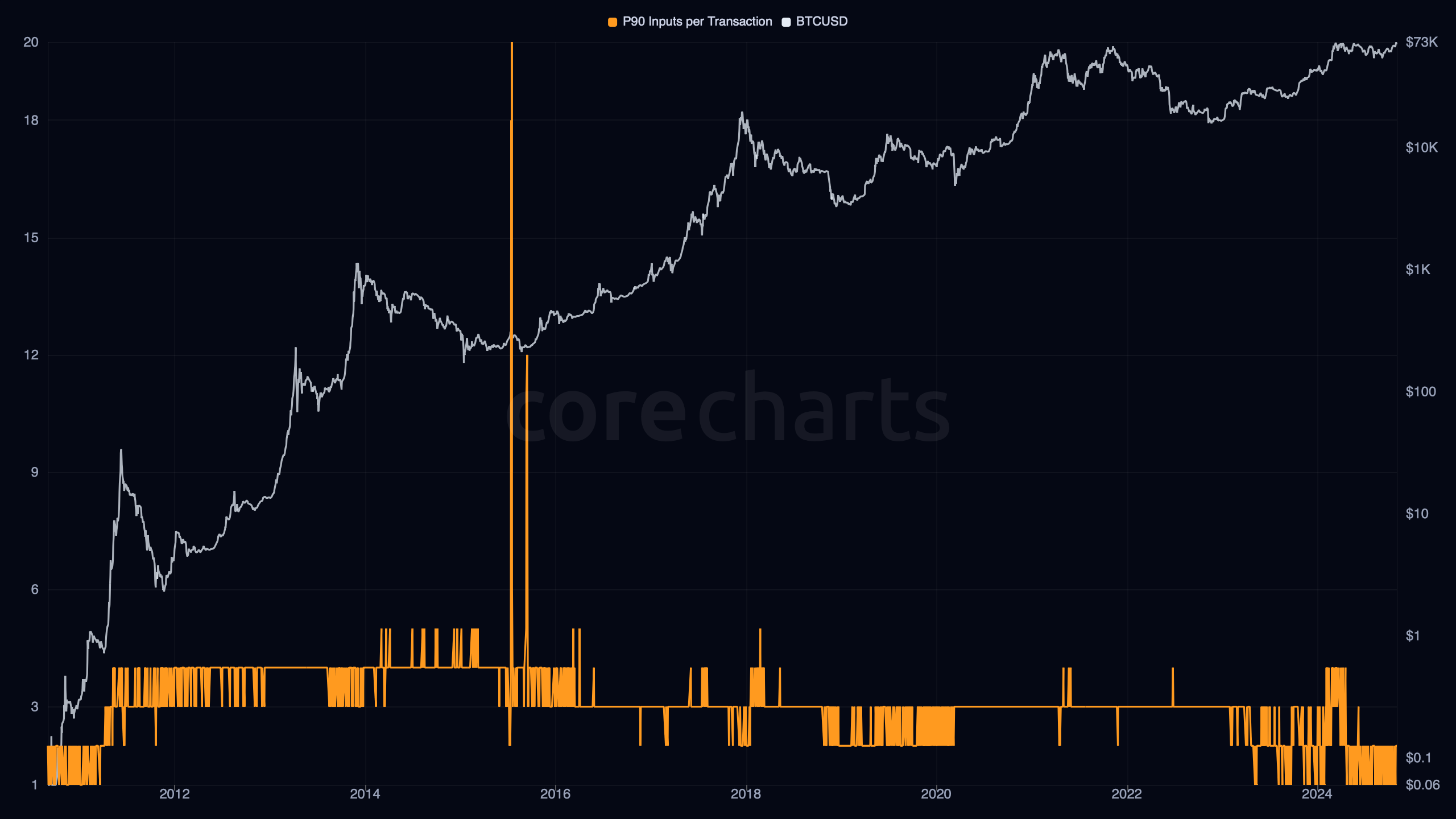
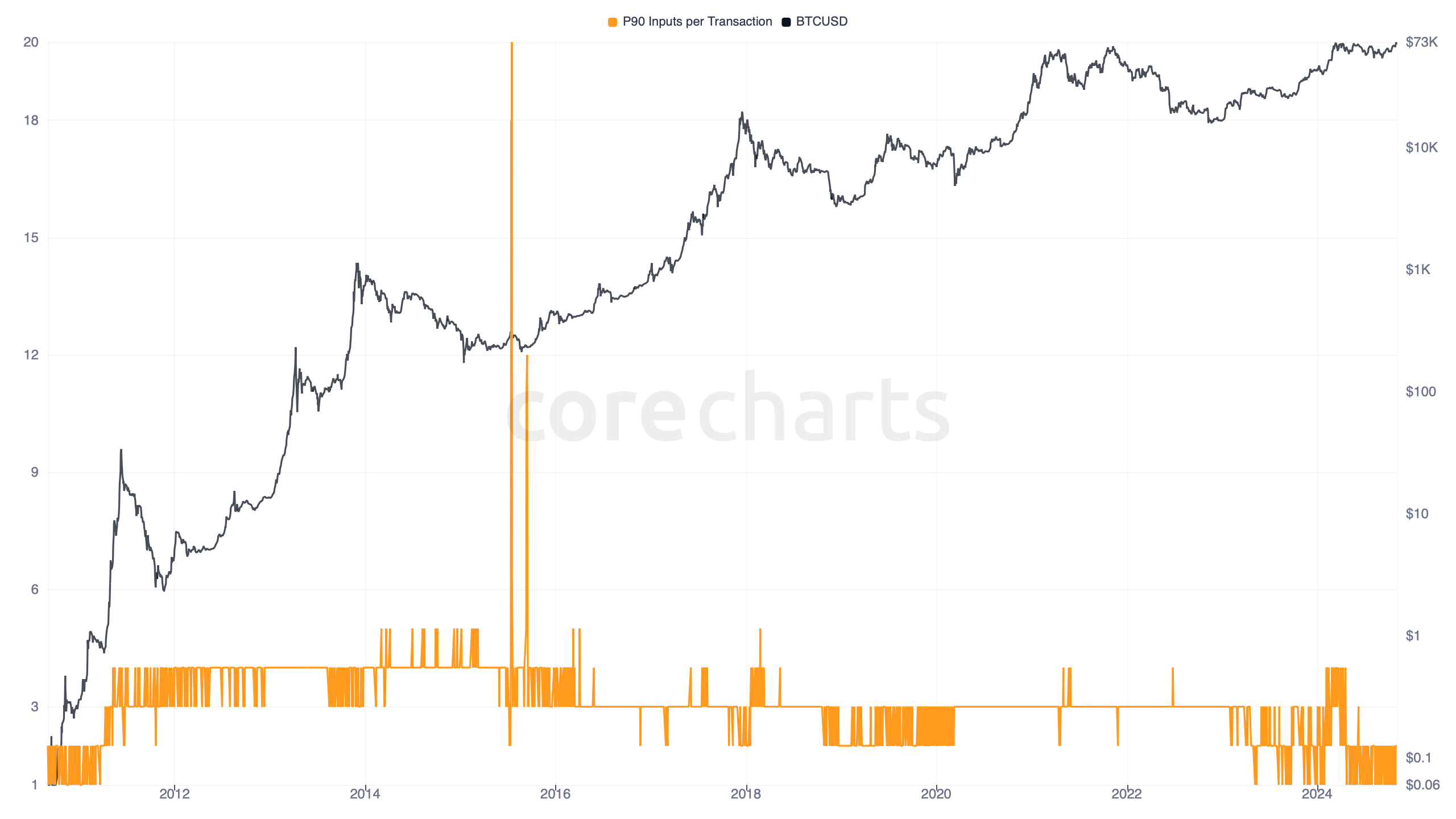
Bitcoin Inputs per Transaction (P90) shows the 90th-percentile input count of Bitcoin transactions on a given day.
It answers the upper-tail version of the same structural question:
How input-heavy were transactions near the top end of the daily distribution?
A 90th-percentile value means that 90% of transactions used this number of inputs or fewer, while the upper 10% used more.
This is the tail-sensitive series in the input-count family.
How To Use It
This metric is useful when the analytical question is about upper-end transaction complexity.
It helps answer questions such as:
- Is the high-input tail expanding?
- Are unusually complex transactions becoming more common?
- Did the average move because the whole distribution shifted, or because the upper end stretched out?
This metric works best next to:
- Average Inputs per Transaction
- Median Inputs per Transaction
Within this family:
- Average is the canonical baseline,
- Median shows the typical transaction,
- P90 shows what is happening near the heavy-input edge of the distribution.
What It Can Say About Market Regime
P90 input count is not a price signal. It is a structural network-behavior metric.
Rising P90 with stable median
This usually means the upper tail is getting heavier while the typical transaction remains fairly unchanged. A subset of transactions is becoming more complex, but the median user behavior is not moving much.
Rising P90 with rising average and median
This is the stronger structural shift. It suggests complexity is increasing not only in the tail, but across a broader share of the transaction set.
Why P90 matters
Without the P90 series, a rise in average inputs can be hard to interpret. P90 tells you whether the upper-end distribution is stretching materially. That makes it the best companion to the average when you want to separate broad change from tail-driven change.
Historical Background
Upper-percentile transaction metrics became useful as Bitcoin usage diversified and the transaction set became more heterogeneous. Once analysts needed to distinguish between the typical transaction and the complex tail, percentile-based structure measures such as P90 became a natural addition.