Bitcoin Receiving Addresses
Definition
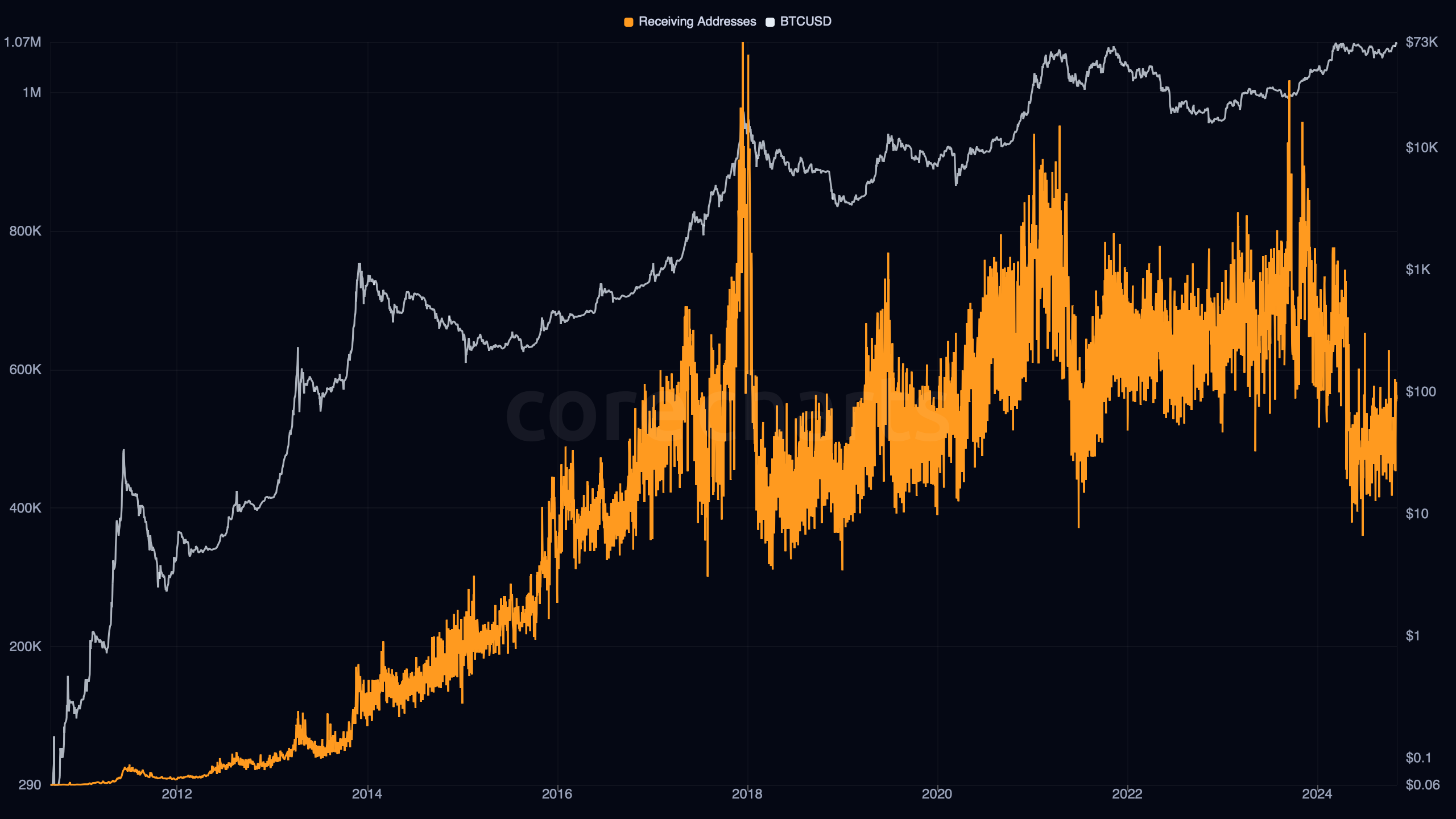
Bitcoin Receiving Addresses counts the unique addresses that appeared on the output side of transactions during the day.
The metric answers a simple question: how many distinct addresses received coins today.
This is a breadth measure for the receiving side of the network. It does not show how much BTC those addresses received. An address counts once whether it received a small payment or a large one.
Reading the series
A rising reading means coins were distributed across a wider set of receiving addresses. More distinct addresses appeared on the destination side of the day’s transaction flow.
A lower reading means receipts were concentrated in fewer addresses. That may reflect quieter participation or a flow pattern in which fewer destinations absorbed the day’s transfers.
The series is most useful when breadth matters more than transfer size. Large value can move to a narrow set of receiving addresses. Small and medium receipts can produce broad receiver participation even when total value transferred is modest.
That is why Receiving Addresses should not be read as a direct proxy for economic demand. It is a structural count of destination breadth.
It should also not be read as a count of distinct users or entities. One service, exchange, or wallet system can generate many receiving addresses, widening the destination set without the same change in underlying participation.
What it can say about market conditions
This metric does not carry a built-in bullish or bearish meaning. Its value is descriptive.
When the series expands, more addresses are appearing as destinations for on-chain transfers. In some periods that aligns with broader participation, wider distribution of coins, or heavier transactional use.
When it contracts, receive-side activity is reaching fewer addresses. The network may still be active, but the destination set is narrower.
The difference between sender and receiver breadth can also matter. A market with many receivers and relatively fewer senders looks different from one where spending breadth dominates.
Relationship to nearby metrics
This series is best compared with Sending Addresses when the question is whether address breadth is expanding on the destination side, the spend side, or both.
It also sits naturally beside Active Addresses. Receiver breadth can widen while the full union count changes much less, which usually means the broader address footprint is not expanding by the same degree.
Historical note
Receiver counts became a standard part of Bitcoin network analysis because transaction totals alone do not show how widely outputs are being distributed. Counting distinct receiving addresses gave analysts a clearer way to track participation on the destination side of on-chain activity.