Bitcoin Total Transaction Fees
What It Measures
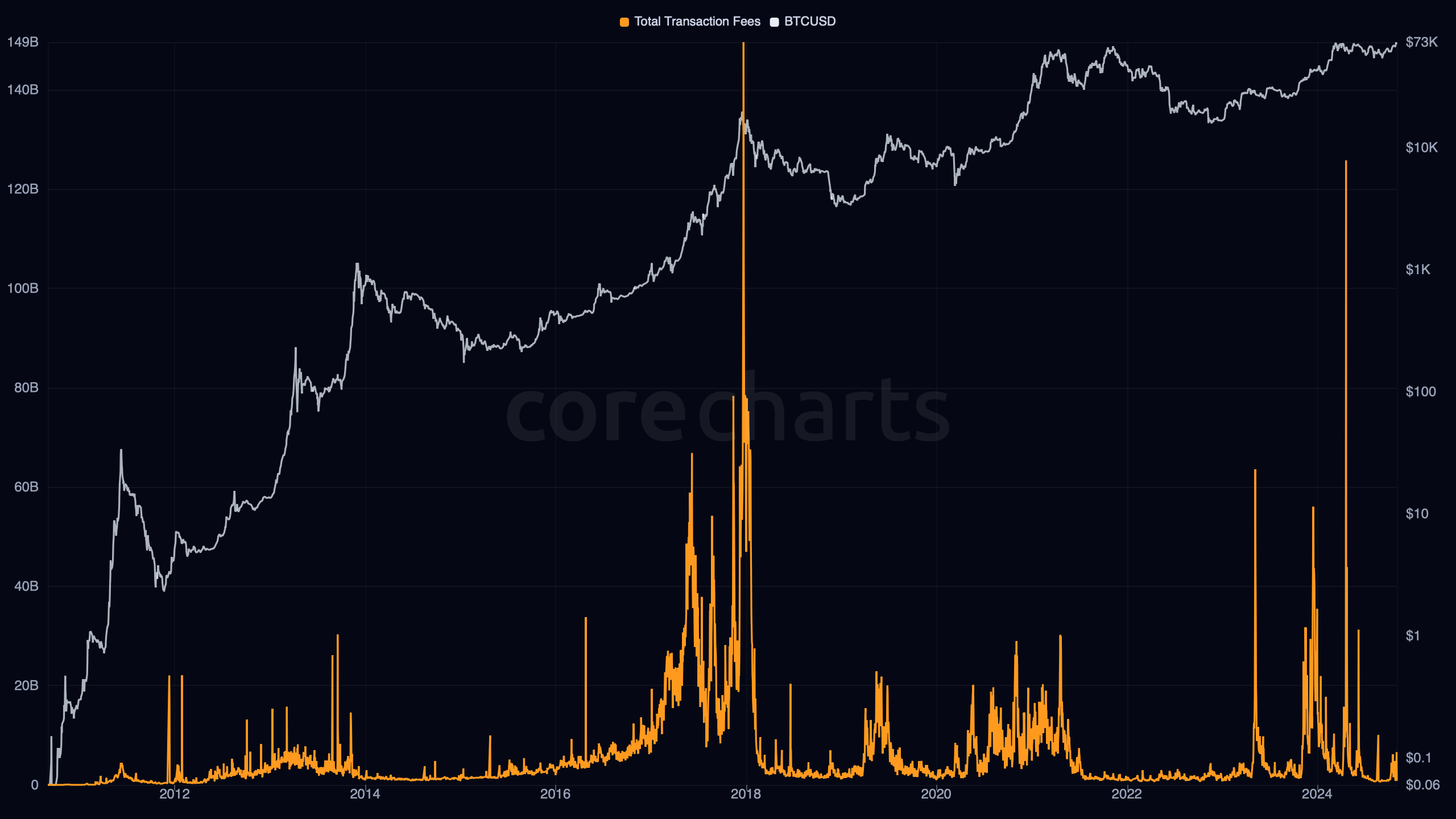
Bitcoin Total Transaction Fees shows the total amount of fees paid by Bitcoin transactions over the observed day.
It answers the base question for this family:
How many satoshis did users pay in transaction fees today?
In simplified form:
The unit is satoshis.
This is the canonical metric in the family. It is the cleanest top-line measure of how much fee revenue users collectively paid. The other fee metrics in this group explain how that total was distributed:
- across the average transaction,
- across the typical transaction,
- and across the higher-fee tail,
- or in fee-rate terms per virtual byte.
How To Use It
Use this metric when the analytical focus is on aggregate fee demand.
It helps answer questions such as:
- How large was the day’s fee market in absolute terms?
- Was fee revenue meaningfully higher or lower than usual?
- Is block-space demand showing up in miner compensation?
This metric is especially useful next to:
- Average / Median Transaction Fee
- Fee Rate percentiles
- Block subsidy
- Miner revenue
Within this family, the relationship is straightforward:
- Total Transaction Fees tells you how large the fee pool was;
- transaction-fee metrics tell you what users paid per transaction;
- fee-rate metrics tell you how competitive block-space pricing was.
What It Can Say About Price And Market Regime
Expanding fee pool
When total fees rise, users are collectively paying more for inclusion. That usually means stronger demand for block space, higher on-chain urgency, or heavier network competition.
Weak aggregate fees
When total fees stay low, the fee market is economically smaller, even if transaction count remains active. That usually means users are not facing significant competition for inclusion.
Why this is the anchor metric
A high median fee with low total fees can happen in a small but expensive environment. A high total fee reading tells you the fee market mattered in aggregate. That is why this metric is the base series for the whole family.
Historical Background
Total fee volume has long been a core Bitcoin network metric because it shows the realized economic demand for block space. As Bitcoin matured, analysts increasingly separated fee-market analysis into three layers: total fee revenue, per-transaction fee burden, and fee-rate competition. Total Transaction Fees remains the top-line starting point.