Bitcoin Spent Volume Age Bands (SVAB)
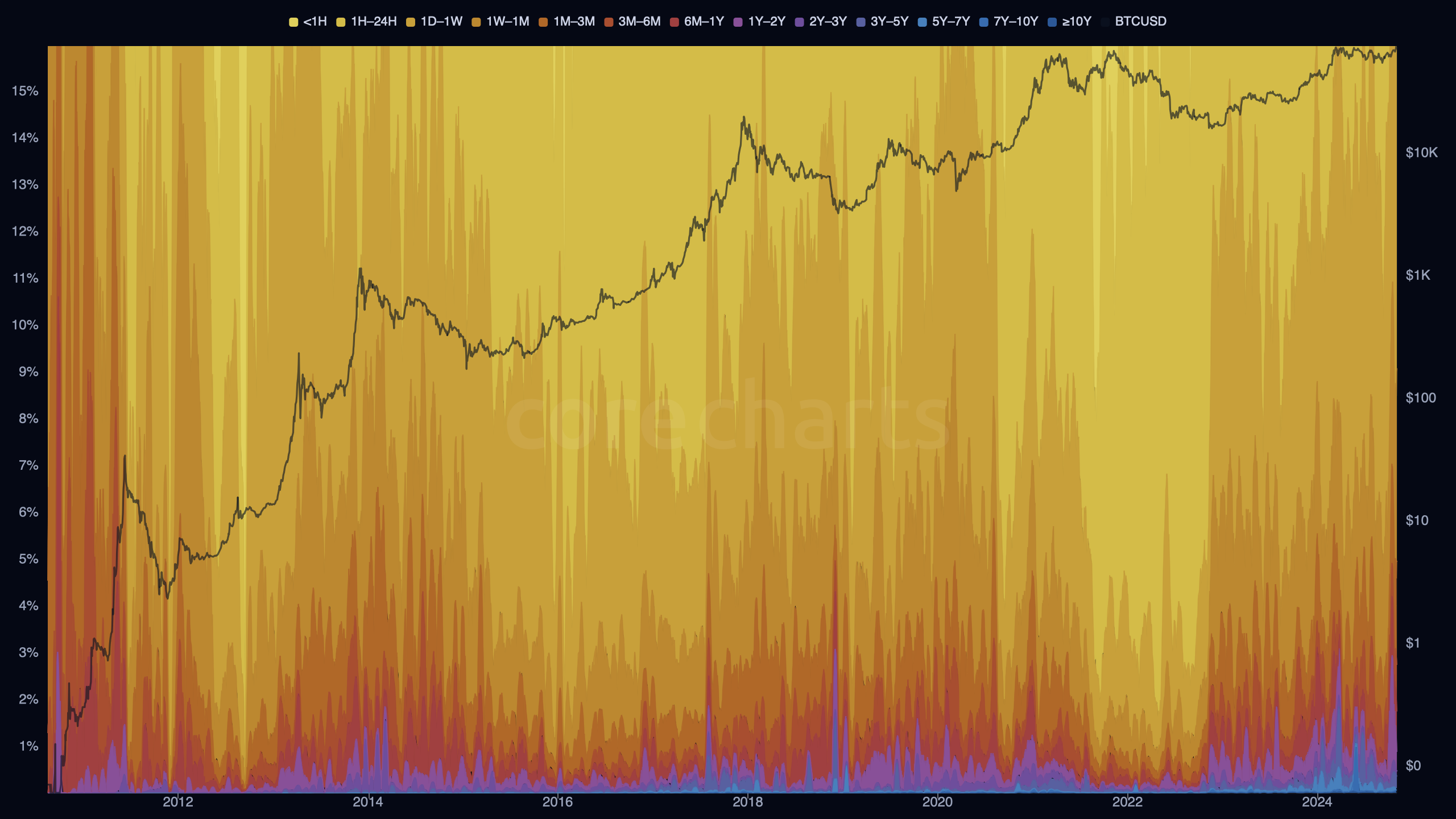
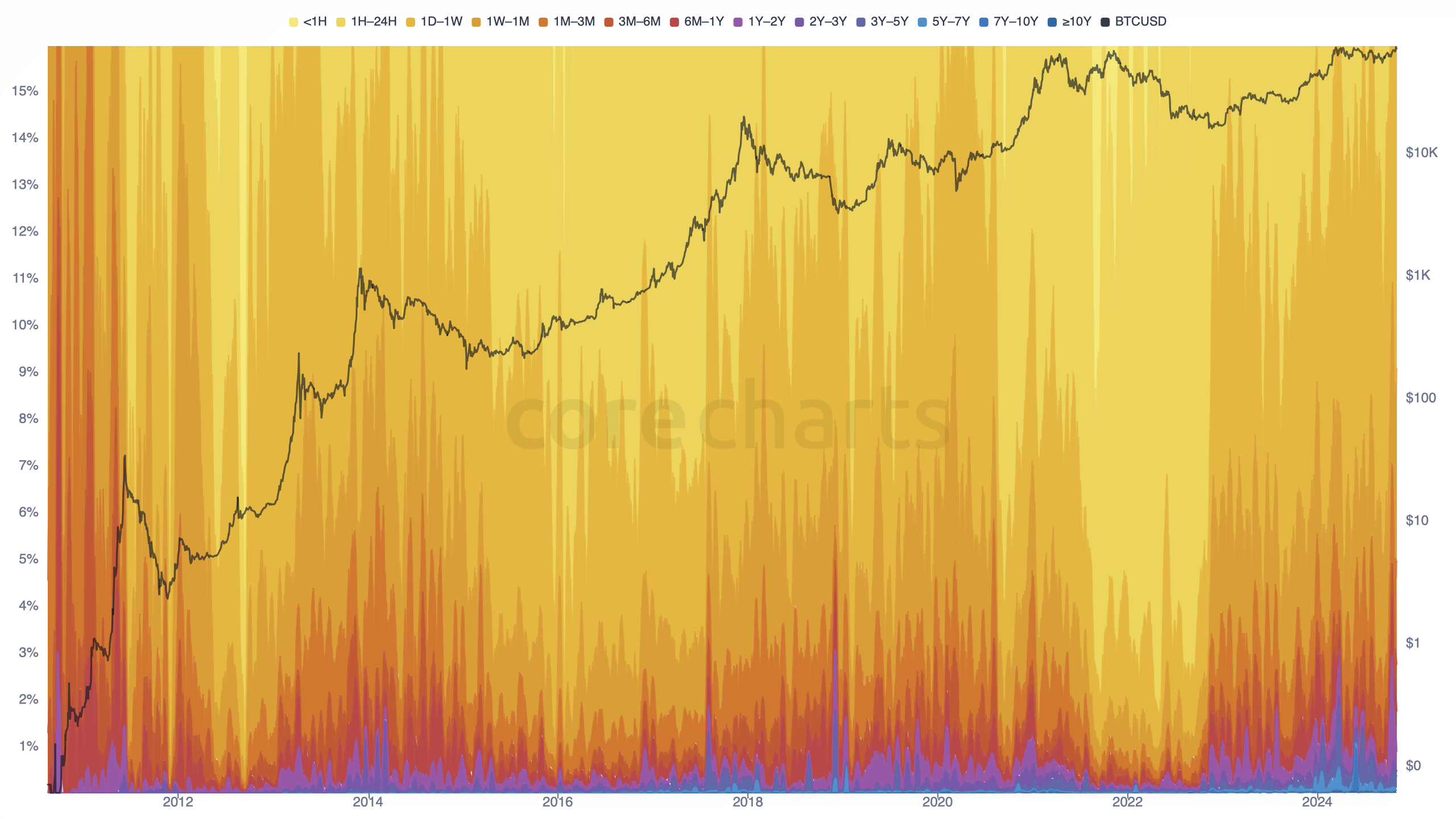
Bitcoin Spent Volume Age Bands (SVAB) split daily spent volume by the age of the coins at the moment they move. In CoreCharts, each band answers one direct question: how much BTC was spent today from outputs that had remained unspent for a given holding period.
This is a spent-side age distribution. It is not a supply-held distribution like HODL Waves. It tracks coins leaving their dormant state, not coins still sitting in UTXOs.
What the metric measures
CoreCharts builds these series from the daily spends dataset. For every spent output, the script takes:
- the output value in satoshis,
- the block timestamp when that output was created,
- the block timestamp when it was spent.
Coin age is then measured as:
For bands above one day, age is converted to whole days:
Daily spent volume is then summed inside each age bucket.
The full CoreCharts band set is:
- lt_1h — spent in less than 1 hour
- 1h_24h — spent between 1 hour and 24 hours
- 1d_1w — spent between 1 day and 1 week
- 1w_1m — spent between 1 week and 1 month
- 1m_3m — spent between 1 month and 3 months
- 3m_6m — spent between 3 months and 6 months
- 6m_1y — spent between 6 months and 1 year
- 1y_2y — spent between 1 year and 2 years
- 2y_3y — spent between 2 years and 3 years
- 3y_5y — spent between 3 years and 5 years
- 5y_7y — spent between 5 years and 7 years
- 7y_10y — spent between 7 years and 10 years
- ge_10y — spent after 10 years or more
Each series is reported in satoshis spent per day.
Practical interpretation of the bands
The short bands — especially lt_1h, 1h_24h, and 1d_1w — mostly reflect recently created coins being turned over again. They are the most sensitive to current transaction flow, exchange activity, and short-term speculation.
The middle bands — roughly 1w_1m through 6m_1y — show coins that were not purely intraday flow, but also were not locked away for a full cycle. These bands often expand when earlier buyers start distributing into strength or when medium-term holders reposition after a trend change.
The older bands — 1y_2y and beyond — matter most in macro analysis. When they stay quiet, older supply remains largely inactive. When they expand sharply, long-dormant coins are returning to market.
How to use it
The main use of Spent Volume Age Bands is to identify which part of the holder base is supplying coins into the market.
A simple way to read the structure is:
- rising short bands with flat old bands — current activity is being driven by recently moved coins;
- rising medium-age bands — swing participants are rotating capital;
- rising old bands — older holders are starting to distribute.
That distinction matters because equal headline spent volume can mean very different things. A day dominated by lt_1h and 1h_24h is not the same event as a day dominated by 3y_5y or ge_10y.
This metric is especially useful next to:
- price,
- SOPR,
- ASOL / MSOL,
- revived supply thresholds,
- HODL Waves.
HODL Waves tell you where supply is still sitting. Spent Waves tell you which part of that supply has started moving.
Reading market behavior with it
Spent age bands are not a standalone timing tool, but they are very useful for market regime confirmation.
Bull market continuation
During strong uptrends, it is normal to see elevated spending from young and medium-age coins. That usually reflects active turnover inside a rising market. As long as the older bands remain relatively contained, the market is being supplied mostly by newer entrants and shorter-duration holders.
That is usually healthier than a rally where very old bands begin expanding aggressively.
Late-cycle distribution
When price is still advancing but the older bands start to rise — especially 1y_2y, 2y_3y, 3y_5y, and older — the market is showing distribution from holders with deeper cost bases and longer holding periods.
That does not mark an exact top by itself, but it often tells you that the market is no longer being supplied only by fast money. More mature supply is joining the sell side.
Stress, capitulation, and forced movement
Sharp expansion in young bands during drawdowns often reflects panic turnover, liquidation-driven flow, or reactive repositioning. If older bands stay muted during those episodes, the decline is being absorbed without broad participation from long-term holders.
If both short and old bands expand together, the event is more structurally important. That suggests selling pressure is spreading across the holder base rather than staying concentrated in recent buyers.
What analytical question it answers
This family of metrics answers a very specific question:
Which age cohort actually spent coins today?
That is more actionable than a generic spent-volume number. Total spent volume tells you how much BTC moved. Spent Waves tell you who, in holding-period terms, was likely responsible for that movement.
Relationship to other age-based metrics
Spent Waves are closely related to several other Bitcoin age metrics, but they are not interchangeable.
- HODL Waves describe the current age structure of unspent supply.
- Revived Supply collapses old-coin spending into threshold-based groups such as 1y+, 2y+, 5y+, or 10y+.
- ASOL and MSOL summarize average and median age of spent outputs.
- CDD weights coin age by value and compresses spending activity into a single aggregate.
Spent Volume Age Bands sit between those views. They preserve the age distribution in bucketed form, which makes them easier to interpret than a single summary statistic and more direct than threshold-only aggregates.
Historical background
The idea behind spent age segmentation comes from early Bitcoin UTXO research and from the broader family of coin-age analysis introduced in on-chain work long before modern dashboard products standardized the presentation. The underlying intuition is straightforward: a transfer from a coin last moved yesterday does not carry the same market meaning as a transfer from a coin last moved five years ago.
Over time, this led to several related metrics — coin days destroyed, dormancy, spent output age, spent output lifespan, revived supply, and bucketed spent-age views. CoreCharts presents the spent-age distribution explicitly in fixed bands so that holder behavior can be read without collapsing everything into a single average.
Notes on interpretation
A rise in an older band does not automatically mean profit-taking by one single holder class. It means that coins with that age profile were spent on that day. The economic interpretation still depends on context:
- trend direction,
- price location in the cycle,
- whether spending is broad or concentrated,
- whether the move is confirmed by SOPR, dormancy, or revived supply.
That said, Spent Waves remain one of the clearest ways to separate routine market churn from genuine movement in older supply.