Bitcoin Addresses with Net Outflow
What It Measures
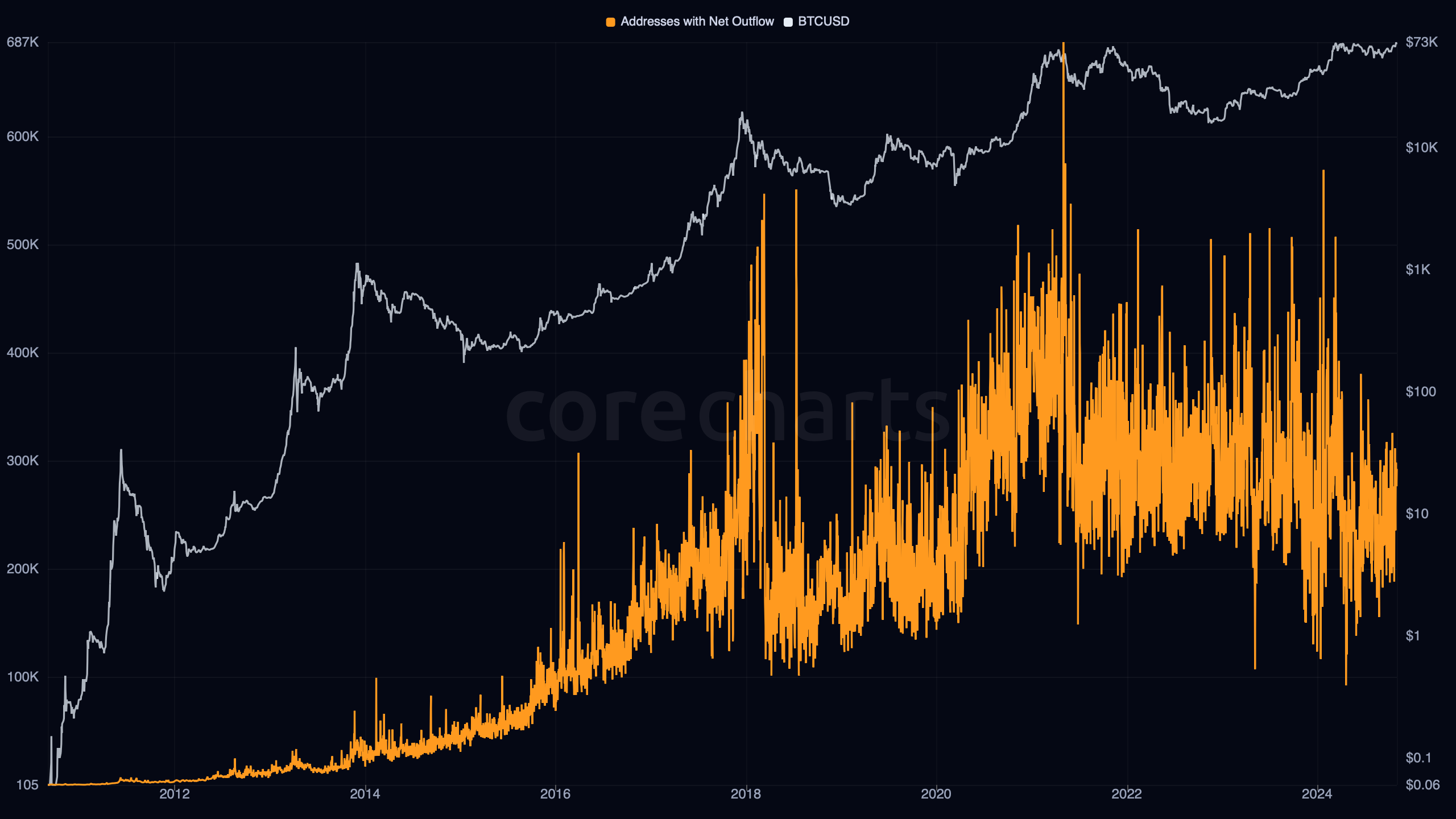
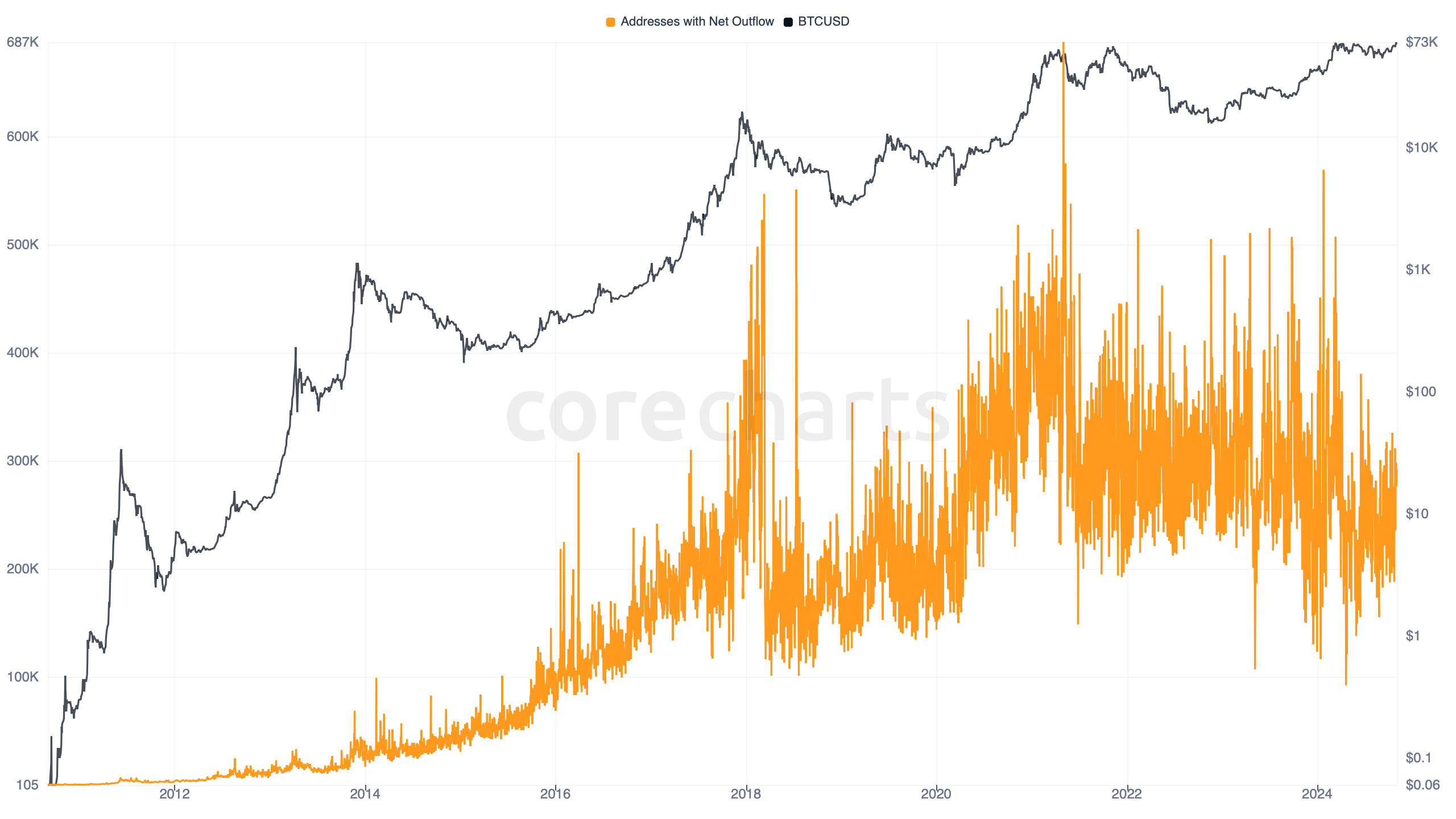
Bitcoin Addresses with Net Outflow counts addresses whose net balance change over the observed day was negative.
The metric comes from daily address-level deltas. An address is included only if it finished the period with less BTC than it started with.
In simplified form:
The unit is addresses.
This is not the same as counting every address that appeared on the spend side of transactions. An address may spend during the day and still end flat or positive after receiving offsetting inflows. This series keeps only addresses that closed the day lower in balance.
For historical rows, the period is the UTC day. The tail row uses a rolling last-24-hour window.
How To Use It
This metric answers a specific question: how broad was negative balance change across addresses.
A higher reading means more addresses ended the day with net outflow. A lower reading means the daily balance reduction was concentrated in fewer addresses.
The series is most informative next to Receiving Addresses and Addresses with Balance Change. Read together, they show whether the day’s redistribution leaned toward net depletion, toward net accumulation, or was simply broad on both sides.
It also works well next to transfer-value metrics. Large spent value can come from a narrow set of addresses, while a broad outflow count can reflect many smaller reductions in balance.
Reading the Series
Broad negative balance change
When the series rises, more addresses are closing the day with less BTC than they began with. That usually means net outflow is spreading across a wider part of the address set.
In active market phases, that can coincide with wider distribution or repositioning. In quieter periods, it may still mark a broad spend-side balance drawdown without saying much about scale.
Narrower spend-side depletion
When the reading falls, fewer addresses are ending the period lower. Coins may still move in size, but the negative balance change is concentrated.
What the series does not say
This is not a direct measure of selling. It records net balance decline at the address level. The coins may have been spent, reorganized internally, or shifted across address structure in ways that do not map neatly to market intent.
Addresses are also not entities. A single holder or service can control many addresses, so breadth of net outflow should not be translated directly into breadth of economic actors.
Relationship to Other Metrics
Receiving Addresses captures positive daily net balance change.
Addresses with Balance Change counts the full non-zero set regardless of sign.
Addresses with Net Outflow should therefore be read as the negative side of the same events-based balance-change family. It does not measure raw transaction participation. It measures addresses that actually finished the day lower.
Historical Background
Net-outflow address metrics became relevant once analysts started working directly with balance deltas rather than transaction appearances alone. That shift made it possible to separate addresses that merely spent during the day from addresses whose end-of-period balance actually declined.
The distinction is useful in Bitcoin because same-day offsetting flows are common enough to blur simpler spend-side counts.