Bitcoin Fees Relative to Block Subsidy
What It Measures
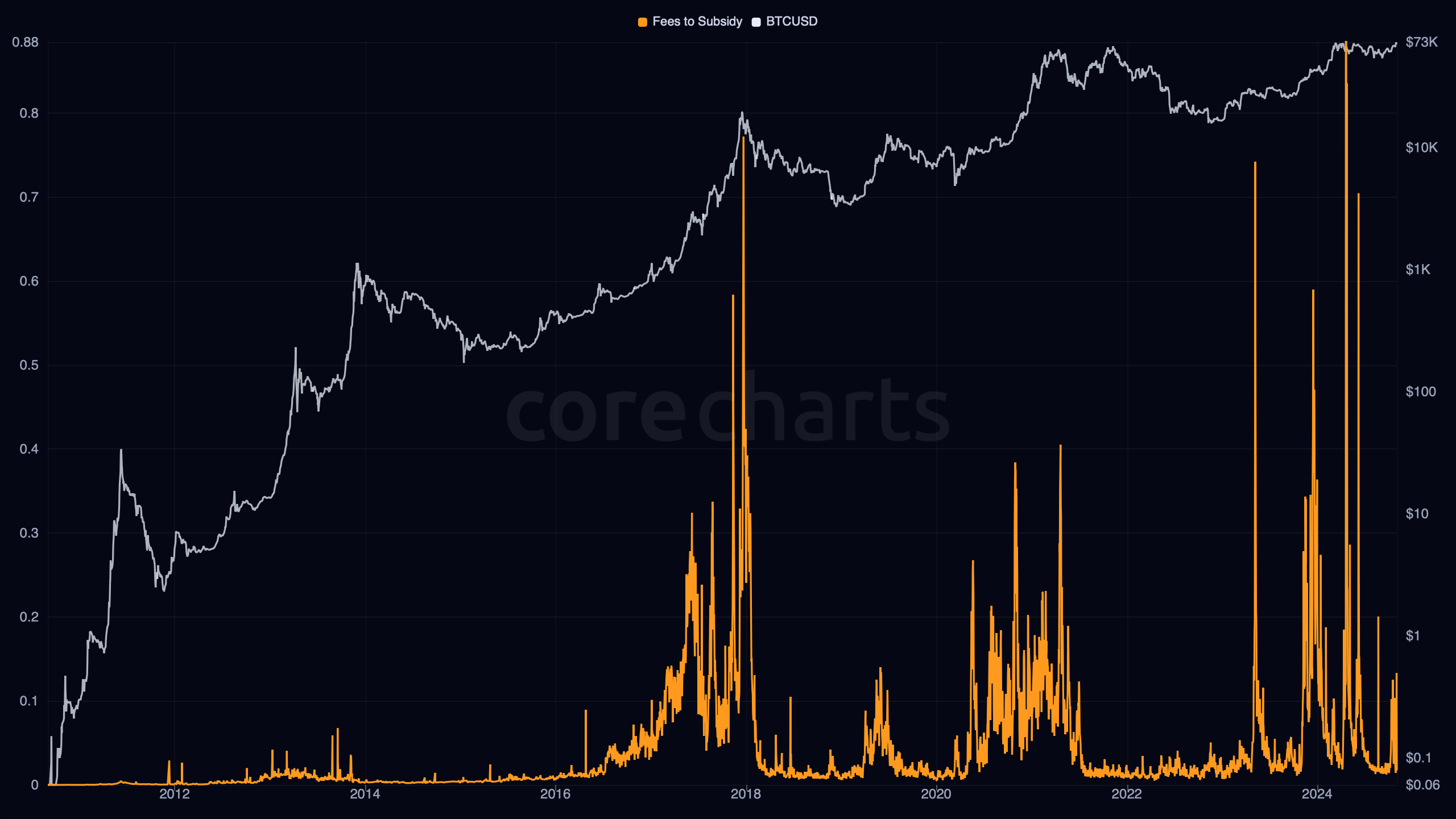
Bitcoin Fees Relative to Block Subsidy shows how large total transaction fees were compared with the subsidy paid to miners over the same day.
It answers a specific question:
How large was the fee market relative to newly issued BTC?
In simplified form:
The result is shown as a ratio or percentage.
This is not a fee-rate metric and not a pure miner-revenue metric. It measures the balance between Bitcoin’s two reward sources:
- protocol issuance through subsidy;
- user-paid demand through fees.
A high reading means fees made up a large share of the subsidy level. A low reading means fees were small relative to newly issued coins.
How To Use It
This metric is useful when the analytical focus is on how meaningful fee income has become inside Bitcoin’s reward structure.
It helps answer questions such as:
- Are fees still minor relative to subsidy, or becoming economically important?
- Is on-chain demand strong enough to rival a meaningful part of issuance?
- How dependent are miners on subsidy versus actual fee-paying usage?
This metric is especially useful next to:
- Block Subsidy
- Transaction Fees
- Fee Share of Miner Revenue
- Security Budget
The distinction matters.
Fees Relative to Subsidy compares fees only to newly issued BTC.
It does not ask how much of total miner revenue came from fees. That is the role of Fee Share of Miner Revenue.
What It Can Say About Price And Market Regime
Strong fee-market periods
When this ratio rises sharply, the fee market is becoming large relative to issuance. That usually happens during periods of elevated block-space demand, congestion, speculative surges, or intense settlement activity.
This is one of the clearest ways to see when user-paid demand begins to matter more than usual in the mining reward mix.
Weak fee-market periods
When the ratio stays low, miner compensation remains dominated by subsidy. That usually means network usage is not generating enough fee pressure to materially challenge the issuance component.
Why the metric matters over the long run
As halvings continue reducing subsidy, this ratio becomes more important. It shows whether fee demand is growing enough to replace a larger share of declining issuance.
That does not mean a high reading is always bullish or a low reading is always bearish. It means the market is revealing how much of Bitcoin’s security spend is being funded by actual block-space demand.
Historical Background
The distinction between subsidy-funded and fee-funded miner rewards has been part of Bitcoin analysis for many years, because Bitcoin’s long-run design implies that subsidy will decline while fees are expected to play a larger role. Metrics like Fees Relative to Subsidy became useful once analysts began asking not just how large fees were in isolation, but how meaningful they were relative to issuance itself.