Bitcoin Economic Supply Spread: Short-Term vs Long-Term Holders
What It Measures
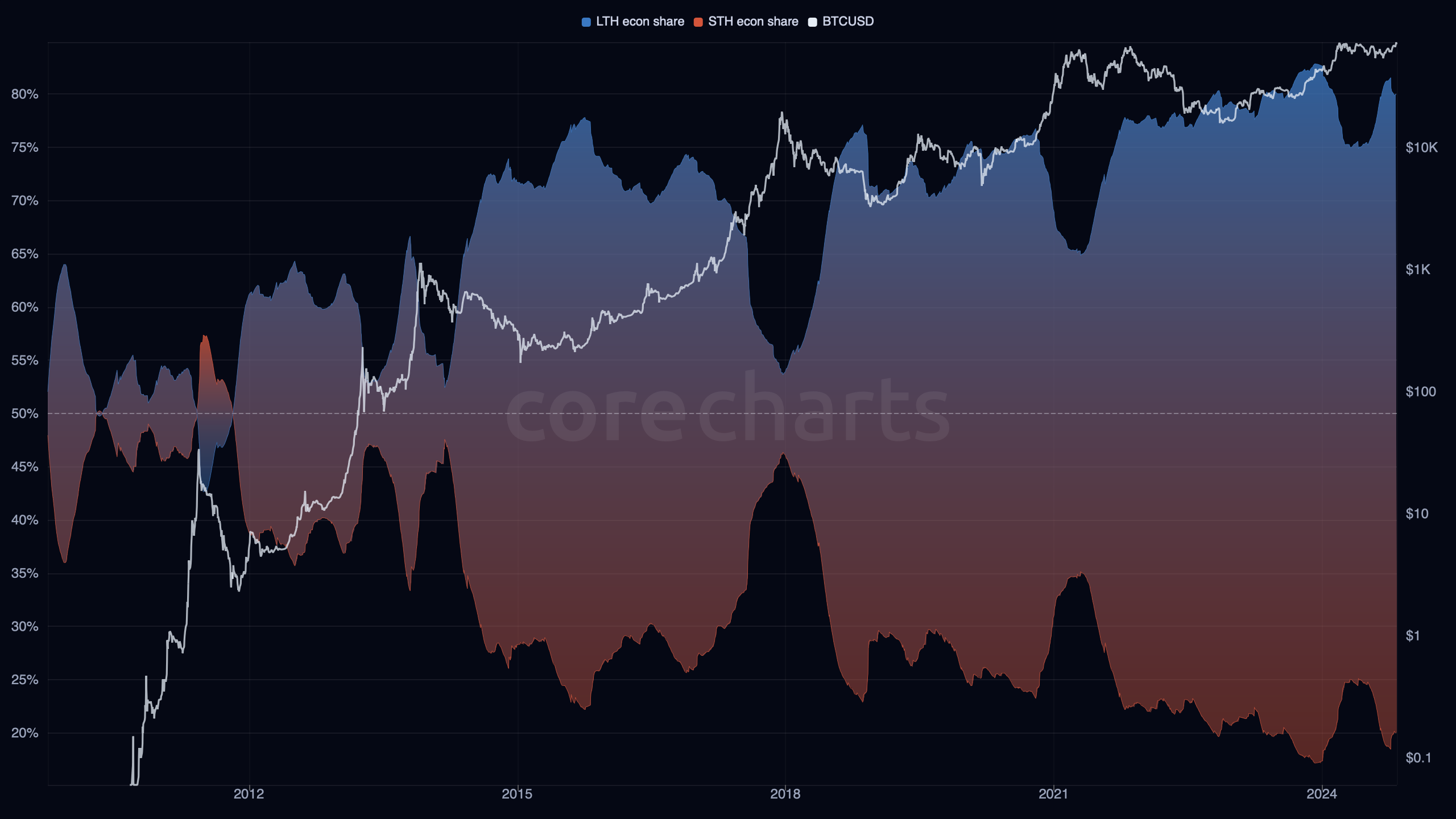
Bitcoin Economic Supply Spread: Short-Term vs Long-Term Holders shows the STH share and LTH share together in one chart so the split of economic supply can be read directly as a two-sided balance.
It answers the clearest group-level question in this family:
How is Bitcoin’s spendable economic supply currently divided between recent holders and older holders?
This is not a separate underlying metric with its own independent calculation. It is the combined comparative view of:
- Short-Term Holder Economic Supply Share
- Long-Term Holder Economic Supply Share
That is why this chart is often the most useful presentation in the family. It puts both sides of the holder split in one frame.
How To Use It
Use this chart when the analytical goal is not to inspect one side in isolation, but to read the balance between the two cohorts.
It helps answer questions such as:
- Is the economic supply base currently dominated by recent holders or older holders?
- Is the market shifting from aging supply toward recently redistributed supply?
- Is the holder structure becoming more mature or more reactive?
This chart is especially useful because it removes the need to mentally compare two separate panels. The spread is visible immediately.
Within the family:
- Economic Supply is the base,
- STH / LTH supply in sats show absolute inventory,
- STH / LTH share show each side individually,
- Economic Supply Spread is the most convenient combined view of the holder split.
What It Can Say About Price And Market Regime
This combined chart is often the most readable regime view in the group.
STH-led structure
When the short-term share is elevated relative to the long-term share, a larger part of the economic supply base is sitting with recent holders. That usually points to a market with more recently redistributed supply and potentially more reactive positioning.
LTH-led structure
When the long-term share is dominant, a larger part of the economic supply base is sitting with older holders. That usually reflects stronger supply persistence and a more mature holder structure.
Why the combined view matters
The individual share metrics are useful, but this chart is often the fastest way to read the holder balance. Instead of asking whether one share rose, it lets you read the full split directly:
how much of the supply base is recent, and how much is old?
That makes it the best presentation chart in the family, even though the canonical base metric remains Economic Supply.
Historical Background
As the STH/LTH framework became established in Bitcoin on-chain analysis, combined split charts became a natural way to present it. Analysts often need to see both sides of the holder structure at once, because the main question is not only how large one cohort is, but how the balance between the two evolves over time.