Bitcoin Puell Multiple, 30-Day
What It Measures
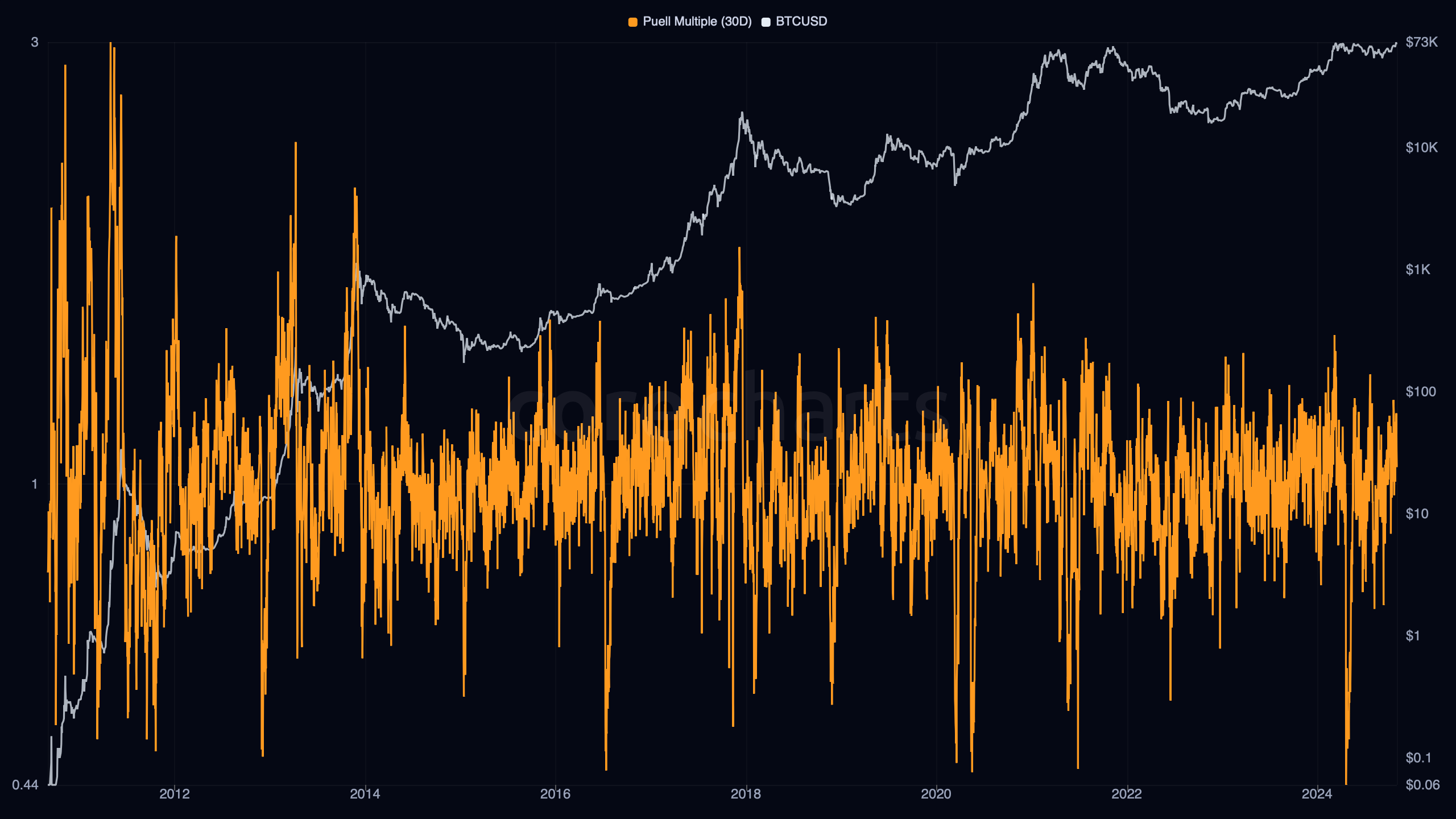
Bitcoin Puell Multiple, 30-Day compares today’s daily issuance value in USD with the average daily issuance value over the last 30 days.
It asks the fastest version of the Puell question:
How unusual is current miner issuance value relative to just the last month?
In simplified form:
This is the short-horizon version of Puell Multiple. It is much more reactive than the canonical 365-day series and more reactive than the 128-day version.
That makes it useful for short-term monitoring, but it also means it carries more noise.
How To Use It
The 30-day version is useful when the goal is to detect recent changes in miner issuance conditions as early as possible.
It helps answer questions such as:
- Has miner issuance value accelerated sharply in the last month?
- Is a short-term compression or expansion developing before it becomes visible in longer windows?
- Did the miner environment change quickly, even if the broader cycle context has not yet shifted?
This version is best used as a short-horizon companion, not as the main reference.
In the Puell family:
- 365-day is the canonical macro version,
- 128-day is the medium-horizon version,
- 30-day is the fast tactical version.
What It Can Say About Price And Market Regime
Fast response to market moves
Because the baseline is only 30 days long, this metric turns quickly when BTC price changes rapidly. That makes it useful for spotting sudden improvement or sudden deterioration in subsidy-driven miner conditions.
Higher sensitivity, higher noise
That same speed is also the limitation. The 30-day version can react strongly to short-lived market moves that do not matter much in the broader cycle.
So if the question is, what is happening to miners right now?, this version is useful.
If the question is, where are miners in the broader cycle?, the 365-day version is still the better anchor.
Best use case
The 30-day Puell Multiple works best as an early-warning layer. It can show the first turn in miner issuance conditions before the longer-window variants confirm it.
That makes it useful for monitoring. It does not make it the canonical version.
Historical Background
The 30-day series is a shorter-window adaptation of the original Puell framework. The underlying idea remains the same: compare current issuance value with a recent average. What changes is the time scale.
This version exists to make the indicator more responsive, not to replace the standard long-window interpretation.