Bitcoin RHODL Ratio
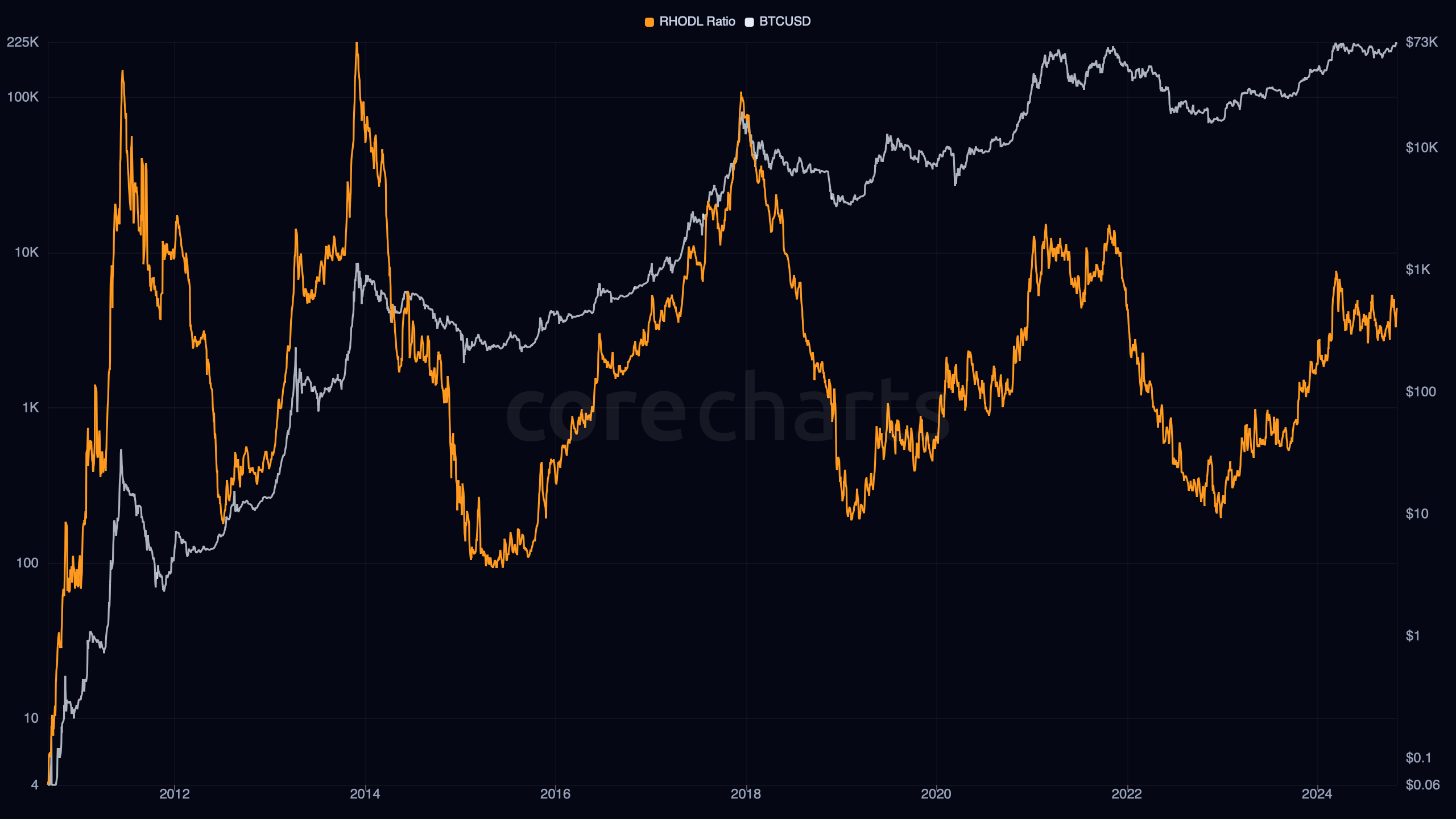
What It Measures
Bitcoin RHODL Ratio compares the realized value of very recently moved coins with the realized value of coins held for one to two years, then scales that comparison by Bitcoin’s age as a market.
In practical terms, it asks:
How large is the realized value of fresh market activity relative to the realized value still sitting in a mature holder cohort?
The logic is:
The time scaling factor adjusts for Bitcoin's growing age as a network, so that earlier cycles — when the entire supply was younger — do not produce artificially low readings compared to later ones.
Two parts matter most:
- the 1-week cohort reflects coins that have moved very recently;
- the 1y–2y cohort reflects supply that has already sat through a much longer holding period.
That makes RHODL a cycle-oriented metric. It is not trying to describe general activity. It is trying to measure whether recent turnover is becoming unusually dominant relative to mature held value.
How To Use It
RHODL is best used as a market temperature tool.
A high reading means recently moved realized value has become large relative to the 1y–2y cohort. A low reading means mature held value still dominates. It is most useful for macro cycle reading, especially beside HODL Waves and Realized Cap, where age structure and realized value need to be read together.
A low reading means mature held value dominates recent turnover.
That makes the ratio useful for questions such as:
- Is the market being driven by fresh speculative activity?
- Has recent turnover become unusually large relative to older held value?
- Is the cycle moving into a hotter or colder phase?
This is not a day-to-day trading oscillator. It is more useful at the macro cycle level.
What It Can Say About Market Regime
Late-cycle heat
RHODL is most informative when recent market activity becomes too dominant. That usually happens when price appreciation pulls a large amount of realized value into recently moved supply, while the relative weight of the 1y–2y cohort becomes smaller.
That kind of expansion often appears during the hotter parts of major bull cycles.
It does not identify an exact top by itself, but a stretched RHODL reading is usually a sign that speculative turnover has become disproportionate to mature held value.
Post-cycle cooling
After speculative phases unwind, the realized value associated with very young coins usually contracts. At the same time, older surviving cohorts regain relative importance. RHODL tends to fall during that reset.
That makes it useful for distinguishing a heated expansion phase from a colder, more mature market structure.
Why the 1y–2y cohort matters
The denominator is important. The ratio does not compare recent coins with all old supply. It compares them with a specific mature cohort that has already survived a substantial holding period.
That makes RHODL more sensitive to cycle pressure than a broader old-vs-young supply comparison.
Historical Background
The RHODL Ratio is associated with Philip Swift and became widely used in Bitcoin cycle analysis as a way to combine age segmentation with realized-cap logic.
Its value comes from that combination. Instead of looking only at coin age, it compares the realized value held in two very different parts of the age distribution:
- coins that moved recently,
- coins that have remained held through a much longer period.
That is why RHODL is primarily used as a macro timing and regime tool rather than a simple activity metric.