Bitcoin Sending Addresses
Definition
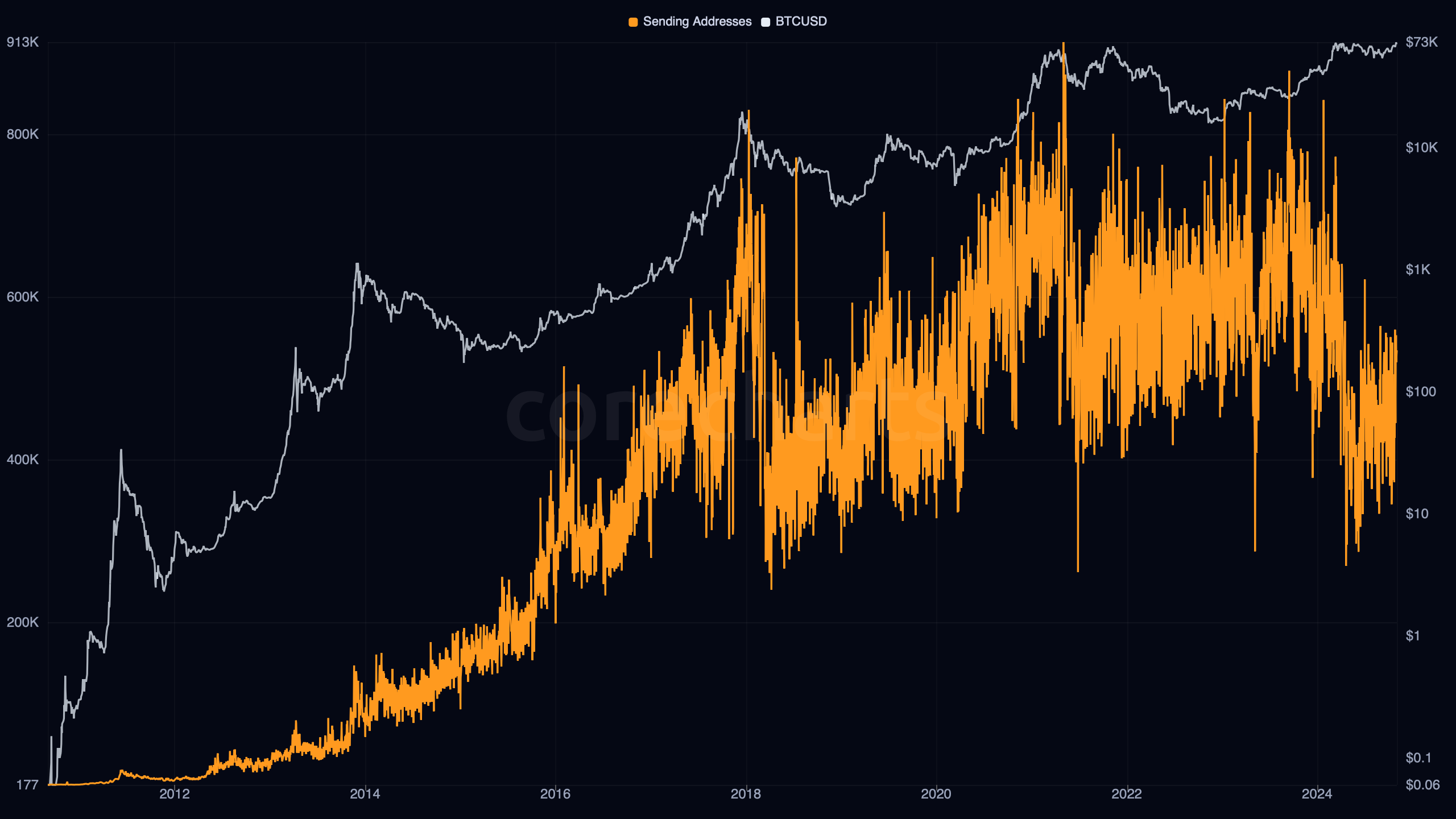
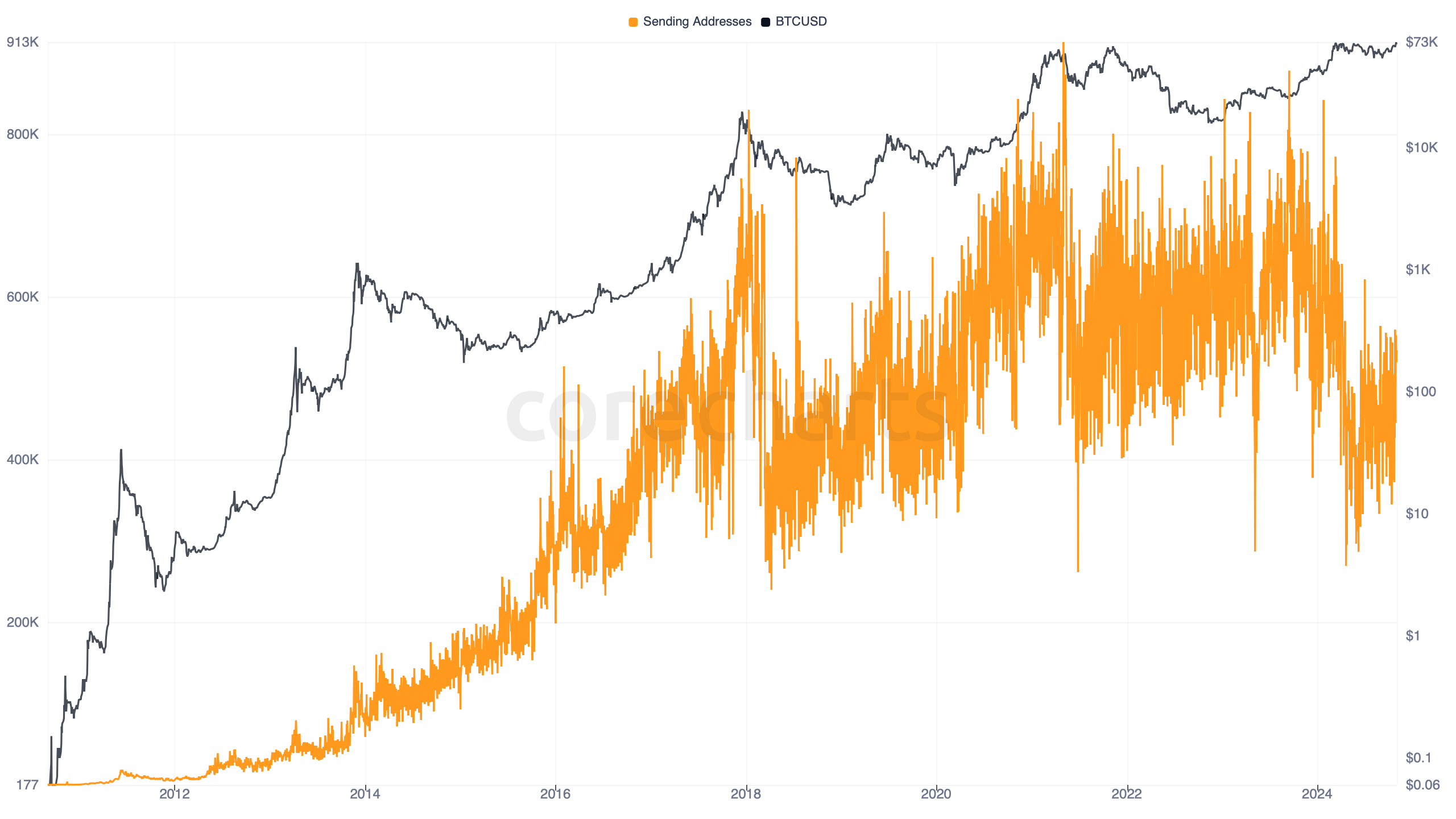
Bitcoin Sending Addresses counts the unique addresses that appeared on the input side of transactions during the day.
The metric answers a narrow participation question: how many distinct addresses were involved in spending coins today.
It is an address-count series, not a volume series. One address can contribute a small spend or a very large one and still count once. The metric says nothing about the amount transferred. It tracks breadth on the spending side.
Reading the series
A higher reading means the set of spending addresses widened. More distinct addresses took part in moving coins out.
A lower reading means spending activity was concentrated in a smaller set of addresses. Coins may still have moved in size, but through fewer senders.
That distinction matters. A day can show heavy transfer volume with only modest sender breadth if a relatively small number of addresses account for much of the spending. The opposite can also happen when many addresses spend small amounts.
For that reason, Sending Addresses is most informative when the question is about participation breadth rather than economic value.
It should also be read as address-level breadth, not entity-level breadth. One holder, exchange, or service can spend through many addresses, so a wider sender count does not map cleanly to a wider set of economic actors.
What it can say about market conditions
This is not a valuation metric and it does not forecast price on its own. It can still be useful around changes in market activity.
When the series expands together with other participation measures, on-chain activity is reaching a broader set of spenders. In stronger market phases, that can reflect wider profit-taking, more active repositioning, or a general increase in transactional activity.
When it stays subdued, spending remains narrower. That often points to quieter on-chain conditions or to a market where activity is being carried by a smaller subset of participants.
The series becomes more meaningful when it diverges from transfer volume. Broad sender participation and large spent volume are not the same thing.
Relationship to nearby metrics
This series is most useful against Receiving Addresses when the question is whether address breadth is being driven by spend-side activity or by a wider destination set.
It also works as a check on Active Addresses. Broad sender participation can leave the union count looking less unusual when receive-side breadth stays narrow, so the family is more informative in comparison than in isolation.
Historical note
Address participation measures became standard once analysts moved beyond transaction count alone. Bitcoin transactions can vary widely in structure, so counting distinct sending addresses offered a cleaner way to estimate how broad spend-side activity actually was on a given day.