Bitcoin Coin Days Destroyed (CDD)
What It Measures
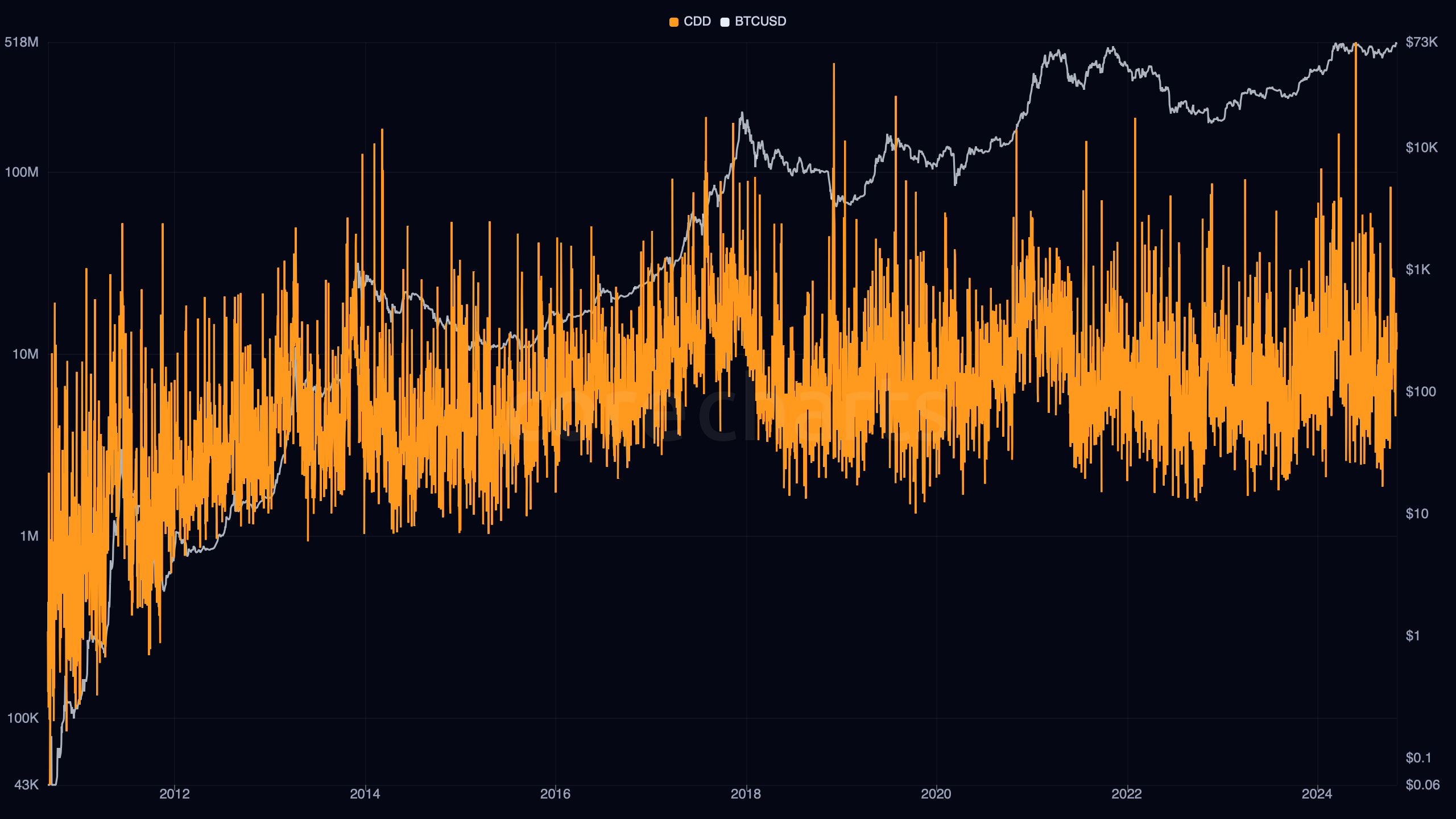
Bitcoin Coin Days Destroyed measures how much dormant coin-age was destroyed by spending on a given day.
It answers one of the oldest and most important questions in Bitcoin on-chain analysis:
How much previously dormant value was brought back into motion today?
The metric combines two things:
- the size of the spent coins,
- and the time those coins remained unspent.
In simplified form:
One bitcoin held for one day contributes one coin-day when spent.
Ten bitcoin held for one hundred days contribute one thousand coin-days when spent.
That is why CDD is not a simple volume metric. It weights spending by dormancy. A transfer of recently moved coins contributes little. A transfer of old dormant coins contributes far more.
How To Use It
CDD is useful when the analytical question is about whether older supply is participating in the market.
A high reading means one or both of the following happened:
- a meaningful amount of BTC was spent;
- the spent BTC had remained dormant for a long time.
This makes CDD particularly valuable for separating routine turnover from older supply activation.
It helps answer questions such as:
- Was today’s activity driven by old coins?
- Is long-dormant supply starting to move?
- Is a market advance or decline being accompanied by deeper holder participation?
CDD is especially informative next to:
- Transfer Volume
- ASOL / MSOL
- Dormancy
- Revived Supply
- Liveliness
What It Can Say About Price And Market Regime
CDD is often most useful during transitions between quiet dormancy and active redistribution.
Low CDD environments
When CDD stays subdued, the market may still be active in transaction count or transfer volume terms, but old supply is not doing much. Activity is being carried mainly by younger or recently moved coins.
High CDD spikes
When CDD jumps, older dormant supply has become active. That can happen in strong bull markets when long-term holders distribute into strength, or during stress events when old coins finally move after long inactivity.
The metric does not tell you whether those coins were sold immediately. It tells you that the market has broken through prior dormancy.
Why CDD matters more than raw volume in some cases
A day with high transfer volume and low CDD is very different from a day with moderate transfer volume and very high CDD. The first says a lot of BTC moved. The second says much older BTC moved.
For cycle analysis, the second case is often more important.
Historical Background
Coin Days Destroyed is one of the earliest and most established metrics in Bitcoin analytics. It is generally associated with early work by ByteCoin and later became a foundational concept across on-chain research. The idea was simple and powerful: not all BTC transfers are equally important, because coins that sat dormant for years carry different informational weight than coins moved yesterday.
That is why CDD has remained a core metric long after simple transaction counts lost much of their interpretive value.